Navigating the Evolving Landscape of WordPress Community Plugins: A Comprehensive 2026 Analysis of BuddyPress, BuddyBoss, and PeepSo

Building a robust online community on WordPress has evolved significantly from its early, straightforward beginnings. What was once a relatively simple choice dominated by BuddyPress and its ecosystem has transformed into a dynamic arena featuring sophisticated commercial solutions. Today, as digital interaction and cohort-based learning gain unprecedented traction, three primary contenders – BuddyPress, BuddyBoss, and PeepSo – stand out in guiding developers and entrepreneurs through the complexities of cultivating engaged online spaces. This comprehensive analysis, factoring in 2026 market dynamics and pricing, delves into each platform’s architecture, feature set, cost of ownership, and strategic positioning to provide clarity for those seeking the optimal community solution for their WordPress site.
The Shifting Paradigm of Online Communities on WordPress
For many years, the path to establishing a community on WordPress was almost monolithic. It typically involved downloading BuddyPress, the pioneering open-source plugin, pairing it with a compatible theme, and integrating bbPress for forum functionality. This approach, while foundational, represented a simpler era of online social interaction. However, the digital landscape has since diversified dramatically, driven by the proliferation of social media platforms, the boom in e-learning, and the emergence of the creator economy. Users now expect richer, more integrated, and mobile-friendly experiences, pushing WordPress community solutions to innovate beyond their traditional roots.
This evolution has led to a bifurcation in the market. On one side stands BuddyPress, the venerable open-source project, still maintained by a dedicated volunteer community. On the other, commercial entities like BuddyBoss and PeepSo have emerged, offering integrated, feature-rich platforms, often with their own themes, mobile applications, and managed hosting options. These commercial solutions address the growing demand for out-of-the-box polish, deeper integrations, and professional support, a stark contrast to the often fragmented, do-it-yourself nature of open-source alternatives.
The underlying truth of this landscape is that BuddyPress, while foundational, has seen its development pace slow considerably. BuddyBoss, recognizing a market need, strategically forked the BuddyPress codebase years ago, charting its own independent course as a premium, integrated platform. Simultaneously, PeepSo entered the fray with an entirely new, from-scratch solution, distinguished by its independent architecture, robust feature set, and offerings like white-label mobile apps and a fully managed "Power Suite." Understanding these divergent paths is crucial for assessing where each solution fits in today’s (and tomorrow’s) market.
A Critical Look at the BuddyPress and BuddyBoss Relationship
A common misconception persists within WordPress circles that BuddyBoss functions as an extension or "add-on" to BuddyPress. This has ceased to be accurate for a considerable period. BuddyBoss originally began its journey as a provider of themes and supplementary add-ons specifically designed for BuddyPress. However, in a pivotal strategic move in 2019, the BuddyBoss team initiated a significant fork, creating standalone versions of both BuddyPress and bbPress, which were then integrated into their proprietary product, the BuddyBoss Platform.
This fork signified a complete separation. Consequently, it is no longer necessary, nor even possible, to install BuddyPress alongside BuddyBoss; the two are incompatible and cannot co-exist on the same WordPress installation. Since this decisive split, BuddyBoss has maintained an entirely independent release schedule, developing its feature set and codebase separately from the open-source BuddyPress project. This historical context is vital for understanding the architectural differences and the distinct development philosophies that now characterize these two platforms.
Deep Dive: The Contenders in 2026
To provide a clear comparative overview, the following sections will delve into each platform, examining their core offerings, unique selling propositions, and potential drawbacks, with particular attention to their projected standing and pricing in 2026.
| Criteria | BuddyPress | BuddyBoss | PeepSo |
|---|---|---|---|
| Free version | Yes | Yes (Platform, limited) | Yes (Core plugin, limited) |
| Premium pricing | N/A (Relies on paid add-ons) | Starting at $299/yr (renews $399/yr) | Starting at $249/yr (renews from $249/yr) |
| Native media (photos, videos) | Requires third-party add-on | Native, included | Photos plugin in Community Bundle |
| Native forums | Requires bbPress (separate plugin) | Native (forked from bbPress) | Third-party wpForo integration available |
| Real-time chat | Basic messaging only | Modern private messaging | Native real-time chat (core) |
| LMS integration depth | Requires bridge plugins | Deep with LearnDash, Tutor LMS, LifterLMS, MemberPress | Integrates with LearnDash, Tutor LMS |
| Native gamification | Requires third-party plugin | GamiPress on Plus plan | Integrates with GamiPress |
| Native moderation | Basic; requires plugin for more | Comprehensive (block, report, suspend) | Native moderation tools |
| Mobile app | No native options | $79/mo Lite or $179/mo Full (separate) | Bespoke white-label app (separate/Power Suite) |
| Theme | Any BuddyPress-compatible theme | Premium BuddyBoss Theme included | Any WordPress theme; modern Block theme included |
| Hosting | Bring your own | Bring your own | Bring your own or bundled into Power Suite |
| Support | Community forums | Premium email support | Premium email support |
Sources: WordPress.org plugin directory (BuddyPress, June 2026); buddyboss.com/pricing (June 2026); peepso.com/pricing (June 2026).
BuddyPress Overview: The Open-Source Foundation
BuddyPress remains the original, free, and open-source community plugin for WordPress, sustained by a global network of volunteer developers. Launched in 2009, it laid the groundwork for social networking functionality within WordPress, encompassing activity streams, member profiles, groups, and private messaging. Its enduring appeal lies in its complete openness and flexibility. For developers who require granular control over their plugin stack and wish to avoid vendor lock-in, BuddyPress offers an unopinionated, highly customizable foundation. With over 100,000 active installations and a long history of major version releases, its presence in the WordPress ecosystem is undeniable.
The strength of BuddyPress is its core philosophy: providing a robust framework upon which any imaginable community feature set can be built. This makes it an ideal choice for technical teams comfortable with coding and custom development, allowing them to precisely tailor the platform to unique project requirements without being constrained by commercial offerings. Its reliance on the vast WordPress plugin directory means that many functionalities can be added, albeit often through third-party extensions.
Where BuddyPress Faces Challenges:
Despite its foundational role, BuddyPress faces inherent challenges associated with its volunteer-led development model. The pace of major releases is typically slow, and core team discussions have openly acknowledged long-term sustainability concerns. This slower development cycle means that modern social networking features—such as native media uploads (photos, videos), rich link previews, and sophisticated "follow" relationships—often require external, sometimes lightly maintained, third-party plugins. The administrative interface and front-end user experience, while functional, can appear dated when compared to the polished offerings of its commercial counterparts.
BuddyPress is most suitable for projects with dedicated development resources and a clear, focused use case where customizability and open-source principles are paramount. It is less ideal for non-technical users seeking a polished, fast-to-deploy solution, or for businesses where project speed and a contemporary user experience are critical. The burden of assembling, integrating, and maintaining a disparate collection of add-ons can quickly become a significant operational overhead.
BuddyBoss Overview: The Integrated Premium Solution
BuddyBoss has carved out a distinct niche by offering a highly polished, integrated, and premium community platform. Emerging from its origins as a BuddyPress theme and add-on provider, BuddyBoss made a strategic pivot in 2019 by forking BuddyPress and bbPress to create its standalone BuddyBoss Platform. This independence allowed BuddyBoss to pursue a rapid development trajectory, focusing on a unified administrative experience, modern front-end design, and, crucially, deep integrations with leading Learning Management Systems (LMS).
BuddyBoss excels as the most opinionated and streamlined option for building course platforms that incorporate a community layer. Its integrations with LearnDash, Tutor LMS, LifterLMS, and MemberPress are particularly robust, often rendering course content directly within the BuddyBoss interface. This creates a cohesive learning and community experience, a significant advantage for educational institutions, online academies, and individual course creators seeking to foster engagement around their curriculum.
Another key differentiator for BuddyBoss is its substantial investment in a companion mobile application. For communities where push notifications and on-the-go access drive engagement—such as fitness communities, cohort-based courses, or high-value membership sites—a branded native app is invaluable. BuddyBoss offers its App as a separate yearly product, available in Lite and Full editions, ranging from $948 to $2,148 per year, reflecting its commitment to mobile-first experiences.
Where BuddyBoss Falls Short:
The primary consideration for BuddyBoss is its total cost of ownership, which can escalate quickly. The Pro plan, which includes the Premium BuddyBoss Theme and Platform Pro, starts at $299 per year (with renewals at $399 per year). The recommended Plus plan, which adds gamification, leaderboards, and advanced engagement tools, begins at $349 per year (renewing at $599 per year from year two). When factoring in the mobile app, a full BuddyBoss build with the Plus plan and the App Full Edition could easily reach approximately $2,497 per year, excluding hosting costs and any additional LMS licenses.
Furthermore, vendor lock-in is a realistic concern. While BuddyBoss asserts compatibility with many legacy BuddyPress add-ons, six years of independent development have inevitably narrowed real-world compatibility. The platform is designed around the BuddyBoss Theme, making significant design changes or migrating away potentially costly and complex.
BuddyBoss remains the ideal choice for agency-built community projects with substantial budgets, course platforms prioritizing deep LMS integration, and operators who view a branded native mobile app as a critical component of their engagement strategy. It is less suitable for projects with tight budget constraints or those simply seeking a lightweight community layer for an existing content site.
PeepSo Overview: The Independently Built Solution
PeepSo distinguishes itself through its independent architectural philosophy. Unlike BuddyBoss, which started as a fork of BuddyPress, PeepSo was built from the ground up as a standalone solution. This includes its own data model, activity stream, user profiles, and messaging system, unburdened by legacy code or database structures dating back to BuddyPress’s 2009 release. This architectural independence allows PeepSo to innovate without the constraints of maintaining compatibility with an aging third-party plugin universe or the slower development pace of an open-source core.

This fresh approach means PeepSo offers a cohesive and modern user experience. Its features, from activity streams to private messaging, are engineered to work together seamlessly. The free core plugin provides foundational community functionality, with paid tiers unlocking a comprehensive suite of add-ons. The Community Bundle, for instance, starts at $124.50 for the first year (renewing at $249 per year), while the Ultimate Bundle, covering full feature parity, is priced at $249.50 in year one (then $499 per year).
PeepSo also offers a bespoke white-label mobile app option. These apps are fully customizable with the customer’s branding (name, icon, splash image, logo, colors), and PeepSo handles the submission and deployment to both the Apple App Store and Google Play Store. This App service can be subscribed to separately or integrated into their premium Power Suite.
For organizations seeking a single vendor to manage their entire community stack—plugin, app, premium hosting, updates, and maintenance—PeepSo offers its "Power Suite." This fully managed package, priced upwards of $7,000 per year, provides an enterprise-grade solution for those who prefer to offload all technical complexities. For most users, however, the standard plugin with an optional app subscription offers a more flexible and cost-effective path, allowing them to retain control over their hosting environment.
Where PeepSo Falls Short:
PeepSo’s primary limitation, relative to BuddyPress and BuddyBoss, is its smaller third-party ecosystem. There are fewer extensions developed by external parties, meaning niche integrations available for BuddyPress might require custom development for PeepSo. While this might be a consideration for highly specialized projects, it is often a non-issue for content-led sites simply adding a community layer, as PeepSo’s core offerings are extensive.
PeepSo is an excellent fit for publishers, content businesses, and creator-led sites looking to integrate a robust community experience with an existing audience. Its independent architecture promotes reliability and performance, and its tiered pricing structure makes it a more affordable option at comparable feature levels than BuddyBoss. The Power Suite further solidifies its appeal for organizations prioritizing a fully managed, hands-off solution.
Head-to-Head: Dissecting Key Feature Differences
While all three platforms provide fundamental community features like activity feeds, member profiles, groups, private messaging, and notifications, their implementations and native inclusions vary significantly. The true differentiators lie in what comes bundled versus what requires additional integration or plugins.
Native Media (Photos, Videos, Documents):
BuddyBoss provides the most comprehensive out-of-the-box media support. Members can natively upload photos, videos, and documents within groups, profiles, and the activity feed without needing additional plugins. This is a significant advantage for communities where rich media is central to engagement.
BuddyPress, in contrast, lacks native media support beyond basic text and profile photos, necessitating third-party add-ons. This often leads to a fragmented user experience and reliance on an ecosystem of add-ons that may not be consistently maintained.
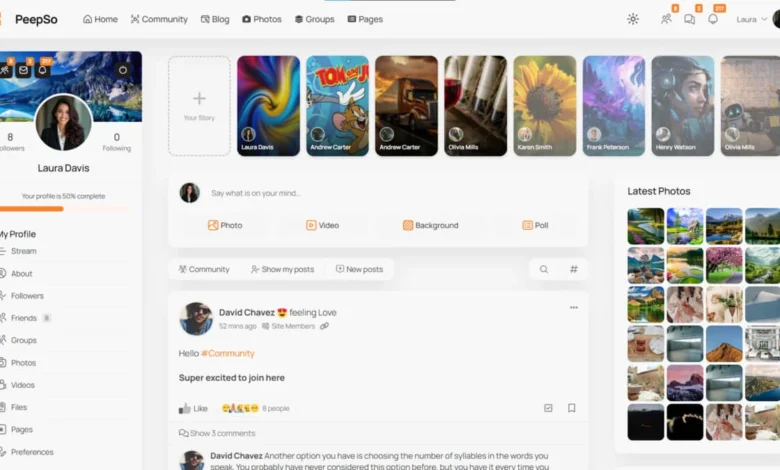
PeepSo includes a dedicated Photos plugin within its Community Bundle, offering robust media functionality. Additionally, PeepSo’s Ultimate Bundle features a unique "Stories" plugin, enabling Instagram-style 24-hour expiring posts—a modern content format not natively offered by BuddyBoss or BuddyPress.
Native Forums:
BuddyBoss integrates a deeply customized version of bbPress, tying forum discussions directly into groups, user profiles, and the activity stream. For communities where forums are a central pillar of interaction, this unified approach is a strong native offering.
BuddyPress requires bbPress as a separate plugin installation. While functional, the integration is less seamless, with visible "seams" between the two plugins rather than a truly unified experience.
PeepSo does not offer native forum support. However, a third-party integration with wpForo, developed by Wbcom Designs, bridges this gap effectively, providing a workable solution though not as deeply integrated as BuddyBoss’s approach.
Real-Time Chat:
PeepSo stands out with its genuinely well-engineered real-time chat, built directly into its core product. This feature is often highlighted even by competitors as a strong point, making PeepSo a frontrunner for communities where instant member-to-member communication is a core value proposition.
BuddyBoss offers modern private messaging that visually and functionally resembles contemporary social networks. While effective for communication, it is not designed as a real-time chat in the same vein as PeepSo’s offering.
BuddyPress provides basic, functional messaging within its core. It facilitates member-to-member communication but lacks the modern aesthetic and real-time responsiveness of its commercial counterparts.
LMS Integration Depth:
BuddyBoss excels in its deep integration with Learning Management Systems. Its robust bridges with LearnDash, Tutor LMS, LifterLMS, and MemberPress ensure that course content is seamlessly presented within the BuddyBoss experience, fostering a truly integrated learning and community environment. This makes BuddyBoss the preferred choice for comprehensive course platforms.
PeepSo integrates effectively with LearnDash and Tutor LMS. Its approach is more conventional, positioning the community alongside the course area rather than fully enveloping it. This works well for creators who desire a strong community layer adjacent to their LMS without the deep intertwining offered by BuddyBoss.
BuddyPress relies on bridge plugins for LMS integration, resulting in a more fragmented experience. While integrations exist, they require technical expertise to assemble and maintain, making it less suitable for those seeking an out-of-the-box cohesive solution.
Gamification, Moderation, and Mobile App Strategy:
BuddyPress, true to its open-source nature, depends entirely on third-party plugins for gamification and advanced moderation tools, and offers no first-party mobile app solution. This flexibility comes with the overhead of assembly and maintenance.
BuddyBoss bundles GamiPress into its Plus plan for gamification features like points, leaderboards, and achievements. It includes comprehensive native moderation tools (blocking, reporting, suspending) and provides its separate BuddyBoss App for native iOS and Android experiences.
PeepSo offers native moderation tools within its core. For gamification, it integrates with GamiPress. Its mobile app strategy involves bespoke white-label apps, available as a separate subscription or as part of the fully managed Power Suite, offering complete branding control.
The consistent pattern across this comparison reveals BuddyBoss as the most natively bundled solution, justifying its premium pricing. PeepSo offers a more integrated bundle than BuddyPress but less than BuddyBoss, with a notable edge in real-time chat. BuddyPress, by design, remains the lightest, requiring users to assemble much of its functionality themselves. The choice between these models ultimately depends on a project’s specific needs, budget, and internal technical capabilities.
Head-to-Head: The Plugin Ecosystem Question
Both BuddyPress and BuddyBoss often highlight their extensive third-party plugin ecosystems as a significant advantage. While a large number of available add-ons can seem appealing on paper, the practical reality often deviates from this perception.
A substantial portion of BuddyPress and BuddyBoss-compatible add-ons suffer from inconsistent maintenance, with many being lightly updated or, in some cases, effectively abandoned. Some haven’t seen an update in years, while others are only tested against deprecated WordPress versions. For hobby projects, this might be an acceptable risk. However, for businesses that rely on their community for engagement, retention, and revenue, this lack of reliability poses a serious threat. Compatibility issues after WordPress core updates, unaddressed security vulnerabilities, and features that cease to function can quickly undermine a business’s operational stability.

PeepSo, by contrast, operates with a smaller, more tightly controlled ecosystem. While this means fewer third-party extensions to choose from, it translates into greater reliability. The add-ons that exist are more actively maintained, and the core plugin is developed as a unified product by a single vendor, simplifying updates and ensuring consistent compatibility.
The choice here depends on the specific needs of the project. If a site requires a highly niche integration that only a single, specialized developer has created, BuddyPress’s broader (though less reliable) universe might be beneficial. However, for businesses prioritizing long-term stability, predictable behavior, and streamlined maintenance, PeepSo’s more controlled ecosystem emerges as a significant asset.
Head-to-Head: The Real Cost of Ownership (2026 Projections)
Beyond the initial sticker price, understanding the true cost of ownership over a three-year period, including promotional rates and renewal pricing, is essential for informed decision-making. The following table provides a breakdown of three-year totals for various configurations, utilizing 2026 pricing.
| Configuration | Year 1 | Year 2 | Year 3 | 3-Year Total |
|---|---|---|---|---|
| BuddyPress + premium add-ons + theme | $200–$500 | $200–$500 | $200–$500 | $600–$1,500 |
| BuddyBoss Pro (Theme + Platform Pro) | $299 | $399 | $399 | $1,097 |
| BuddyBoss Plus (Pro + engagement tools) | $349 | $599 | $599 | $1,547 |
| BuddyBoss Plus + App Full Edition | $2,497 | $2,747 | $2,747 | $7,991 |
| PeepSo Community Bundle | $124.50 | $249 | $249 | $622.50 |
| PeepSo Ultimate Bundle | $249.50 | $499 | $499 | $1,247.50 |
Note: Hosting costs are generally not included in these figures, except for the PeepSo Power Suite. BuddyBoss offers a "Done For You Bundle" at $4,999 in Year 1, which packages Theme, Platform Pro, App Full Edition, and implementation services. BuddyPress add-on and theme costs are highly variable. PeepSo’s standalone bespoke app subscription is priced privately and not shown above.
BuddyPress: While the core plugin is free, a realistic BuddyPress build typically necessitates purchasing two to three premium add-ons to compensate for core feature gaps, alongside a community-optimized theme. This usually results in an annual spend of $200-$500, leading to a 3-year total of $600-$1,500, plus hosting.
BuddyBoss: In 2026, the Pro plan begins at $299 (promotional, renewing at $399/year), bundling the Premium BuddyBoss Theme with Platform Pro. The more feature-rich Plus plan, including gamification, starts at $349 (promotional, renewing at $599/year). Adding the App Full Edition significantly increases the cost, pushing a comprehensive BuddyBoss Plus stack to approximately $2,497 in the first year and over $7,991 over three years, before hosting and any LMS licenses.
PeepSo: The PeepSo Community Bundle is priced at $124.50 for the first year (renewing at $249/year), totaling $622.50 over three years. The Ultimate Bundle, offering full feature parity, is $249.50 in year one (renewing at $499/year), leading to a 3-year total of $1,247.50. For projects requiring a branded mobile app, PeepSo offers a bespoke white-label app as a separate subscription. The comprehensive PeepSo Power Suite, which bundles the plugin, mobile app, and premium managed hosting, starts at $7,000+ per year. This price point, while substantial, often sits below an equivalent BuddyBoss-plus-App-plus-managed-hosting stack for comparable features.
Across comparable feature tiers, PeepSo consistently emerges as the more affordable option. This makes it a compelling choice for projects operating under strict budget constraints.
Head-to-Head: Core Differentiators Beyond Features
Once a feature checklist is satisfied, the decision often boils down to more fundamental differences that impact long-term project viability and operational overhead.
Vendor Relationships and Management Overhead:
- BuddyPress: Leads to the most fragmented vendor relationships. The core plugin is free, but themes, forums, media support, gamification, and other crucial components typically come from disparate third-party vendors. This necessitates managing numerous renewal cycles and support inquiries across multiple entities.
- BuddyBoss: Streamlines vendor relationships to two or three. The Theme and Platform Pro are bundled, and LMS integrations are built-in. However, the mobile app is a separate yearly subscription, and hosting remains the user’s responsibility. This is cleaner than BuddyPress but still involves managing multiple renewals.
- PeepSo: Offers the option to consolidate into a single vendor relationship with its Power Suite, which covers the plugin, app, hosting, updates, and maintenance. For standard PeepSo users, the core plugin and its add-ons come from a single source, with the choice to add the app and hosting separately, bringing its vendor count closer to BuddyBoss but with greater internal cohesion.
Reliability and Richness of the Plugin Ecosystem:
- BuddyPress: Boasts the largest number of third-party add-ons, a legacy of over 15 years. However, this vastness comes with the caveat that many add-ons are poorly maintained or abandoned, requiring significant due diligence to identify reliable solutions.
- BuddyBoss: Occupies a middle ground. Its third-party add-on universe is smaller than BuddyPress’s, especially since the 2019 fork. However, BuddyBoss’s extensive first-party feature set reduces the need for external plugins, leading to greater stability for core functionalities.
- PeepSo: Has the smallest, but arguably most reliable, add-on ecosystem. With fewer abandoned add-ons, a unified codebase from a single vendor, and centrally maintained integrations, users can expect predictable behavior and fewer compatibility headaches. This trade-off between quantity and quality often favors long-term operational stability.
Pace of Innovation and Development:
- BuddyPress: Characterized by the slowest development pace. As a volunteer-led project, major releases are infrequent, prioritizing stability and openness over rapid feature deployment. Modern community features tend to arrive late or not at all without external contributions.
- BuddyBoss: Exhibits the fastest development pace. Driven by a dedicated commercial product team, it pushes aggressive feature releases and updates throughout the year. This rapid innovation, however, reinforces lock-in to the BuddyBoss Theme and ecosystem and contributes to its scaling renewal costs.
- PeepSo: Maintains a steady and predictable development rhythm. Releases occur every few weeks, as evidenced by its changelog, driven by a focused product team. The unified product architecture facilitates easier updates and support compared to the fragmented BuddyPress model.
Verdict: Matching the Plugin to Your Project’s Needs
The optimal community plugin choice ultimately hinges on the specific nature of your project and the trade-offs you are willing to embrace.
BuddyPress is best suited for organizations or individuals with in-house development expertise and a desire for maximum control and customization. Its appeal lies in its free, open-source foundation, absence of vendor lock-in, and the flexibility to assemble a bespoke feature set. It is less appropriate for projects demanding immediate polish, rapid deployment by non-technical users, or those requiring modern social features out-of-the-box.
BuddyBoss is the definitive choice for course platforms seeking deep LMS integration with LearnDash, Tutor LMS, or LifterLMS, and for any community where a branded native mobile app is a strategic imperative for engagement and retention. Projects must have a healthy budget to accommodate its premium pricing structure, which includes the Theme, Platform Pro, and the separate App subscription. In return, users gain a highly polished, opinionated, and fast-shipping solution.
PeepSo is ideal for publishers, content businesses, and creator-led sites aiming to add a robust community layer to an existing audience. Its standalone architecture, focused product offering, and smaller yet centrally maintained ecosystem contribute to greater reliability and performance. For projects with budget constraints, PeepSo offers a more affordable option across comparable tiers.
The PeepSo Power Suite targets operators who require a single-vendor, fully managed solution encompassing the plugin, branded mobile app, and premium hosting. If the goal is enterprise-grade reliability without the burden of managing the WordPress stack or multiple vendor relationships, Power Suite stands as the most comprehensive managed offering among the contenders.
The Decision Behind the Decision
While feature comparisons provide a crucial starting point, the ultimate decision transcends a simple checklist. The surface-level feature parity across these three products is high; the meaningful distinctions reside in their underlying philosophies and the long-term implications of their respective ecosystems. The choice is less about right or wrong, and more about aligning with the inherent trade-offs and vendor relationships that best suit your project’s strategic objectives.
A user opting for BuddyPress prioritizes openness and ownership, embracing the freedom and responsibility of an open-source foundation. A user choosing BuddyBoss values polish and deep integration, particularly within the e-learning sphere, and is prepared to invest in a premium, integrated experience. A user selecting PeepSo seeks focus and product cohesion, benefiting from a robust, independently built platform with a streamlined ecosystem and competitive pricing.
Each path answers a different question about what constitutes an ideal community platform. Understanding your project’s core questions—be it budget sensitivity, technical autonomy, mobile-first strategy, or seamless LMS integration—will invariably lead you to the most appropriate WordPress community plugin. The evolving landscape of 2026 presents a rich array of options, each capable of empowering diverse online communities, but a careful, informed choice remains paramount.