The Evolution of Google Ads: Why Digital Marketers Must Embrace AI-Driven Automation Over Legacy Strategies

The digital advertising landscape has undergone a profound transformation over the past decade, shifting away from manual campaign adjustments and granular keyword management toward advanced artificial intelligence and machine learning architectures. Platforms such as Google Ads and Meta have aggressively integrated automated systems into their core infrastructures, fundamentally altering how performance marketing campaigns are structured, optimized, and measured. Despite these technological leaps, a significant portion of the marketing industry continues to rely on legacy methodologies—a disconnect that industry analysts argue is eroding corporate profitability and limiting campaign efficiency.
Historical Context and the Shift Toward Automation
To understand the current state of search marketing, one must examine the evolution of digital advertising platforms from their inception in the early 2000s to the present day. For nearly two decades, success in platforms like Google AdWords (now Google Ads) was defined by human intervention. Marketers built elaborate account hierarchies, meticulously managed match types, adjusted device and geographic bids, and executed multiple manual changes daily to eke out marginal performance gains. This era rewarded hyper-segmentation, Single Keyword Ad Groups (SKAGs), and constant human monitoring.
However, as search queries grew exponentially more complex—driven largely by mobile adoption and voice search—human capacity to predict and manually match search intent reached its limit. Google and other ad tech giants responded by developing sophisticated narrow-AI systems capable of processing billions of real-time signals, including user location, browsing history, device context, and immediate behavioral intent.
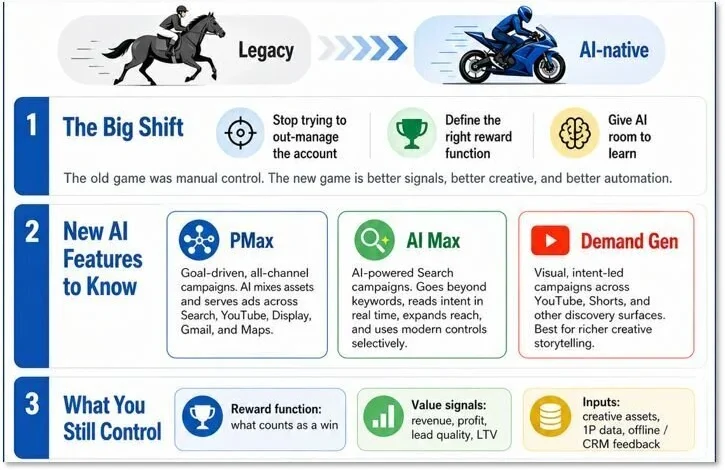
Over the years, this evolution has culminated in comprehensive automated solutions. Performance Max (PMax), introduced to consolidate campaigns across Search, YouTube, Display, Gmail, and Maps, allows advertisers to input goals, budgets, and creative assets, leaving the AI to dynamically mix and match elements for optimal delivery. Similarly, AI Max for search-only campaigns evaluates real-time intent beyond traditional keywords, while Demand Gen harnesses machine learning to drive visual storytelling across video platforms like Shorts.
The Cost of Stagnation: Legacy Practices vs. Modern Intelligence
Despite the proven efficacy of automated bidding and broad-match algorithms, many search marketers and agencies remain anchored to outdated operational frameworks. Industry experts point to persistent debates over brand versus non-brand segmentation, endless tinkering with match types, and the compulsion to make constant manual adjustments as relics of the past that actively harm campaign performance.
This resistance to change is often driven by a psychological attachment to control. Marketers accustomed to the AdWords era frequently view AI-driven platforms with skepticism, fearing a loss of oversight. Yet, empirical evidence from digital marketing audits suggests that human operators attempting to out-manage auction-by-auction intent parameters manually are fighting a losing battle against systems that evaluate signals at machine speed.
Pragmatic digital strategists emphasize that the choice to revert to legacy methods is no longer commercially viable. Organizations that cling to manual bid modifiers and rigid keyword structures often find themselves outpaced by competitors who leverage AI to capture broader, highly relevant audiences at scale.
The Google Ads Maturity Model: Evaluating Organizational Readiness
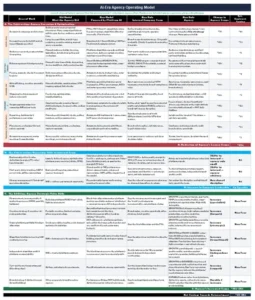
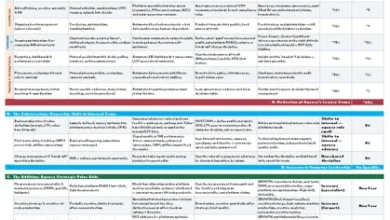
To help organizations objectively assess their transition from legacy operations to AI-native execution, industry veterans have developed structured evaluation frameworks, such as the Google Ads Maturity Model. This assessment tool helps marketing departments audit their digital sophistication across critical operational dimensions, moving away from subjective self-deception and toward rigorous data-backed evaluation.
The maturity model evaluates companies across two primary vectors: Capability Scoring, which measures technological sophistication on a scale from zero (legacy) to four (AI-native), and Depth Scoring, which measures how widespread those capabilities are deployed across an organization’s advertising spend. By multiplying these dimensions across core operational areas, companies can calculate a comprehensive maturity score.
The model is divided into several foundational pillars, beginning with Measurement and Value Architecture.
1. Measurement and Value Architecture
At the core of any automated advertising system lies the reward function—the specific definition of what constitutes a successful business outcome. If an advertiser feeds an AI platform low-value proxies such as raw pageviews, standard sessions, or unweighted form submissions, the machine will optimize for volume rather than actual profitability.
Modern measurement architecture requires the implementation of enhanced conversions, data-driven attribution, and value-based bidding that prioritizes revenue, profit margins, or predicted lifetime value (LTV). Furthermore, integrating offline conversion imports (OCI) and customer relationship management (CRM) feedback loops allows the AI to understand which leads ultimately convert into paying customers. Organizations scoring poorly in this dimension often report high traffic volumes coupled with low bottom-line returns, underscoring the reality that advanced creative and targeting cannot compensate for flawed foundational metrics.
2. Search Operating Model
The second critical dimension involves the transformation of the search operating model. Traditional accounts relied heavily on manual cost-per-click (CPC) structures, rigid exact-match keywords, and constant human intervention. In contrast, modern search operations embrace Smart Bidding, broad matching logic, and responsive search ads (RSAs), utilizing automated controls primarily for brand governance rather than daily micromanagement.
When evaluating depth of execution within this dimension, analysts examine the percentage of non-brand search budgets operating under smart bidding and the utilization of comprehensive AI-driven placement tools. Transitioning to this model requires organizations to surrender the illusion that human operators can manually parse auction intent better than algorithms processing billions of daily data points.
Implications and the Future of Performance Marketing
The broader implications of this technological shift extend far beyond tactical campaign management; they signal a fundamental restructuring of marketing talent and agency business models. For years, digital marketing agencies have justified their retainers by pointing to the sheer volume of manual changes made within client accounts. As routine tasks are absorbed by machine learning, the role of the marketer is elevating from tactical execution to strategic architecture.
In the modern paradigm, the primary responsibilities of a digital marketer are no longer adjusting bids or mining search query reports. Instead, they focus on feeding the machine superior first-party data, designing compelling creative assets, defining precise business value signals, and setting governance parameters.
Organizations that successfully navigate this transition report significant performance gains, with efficiency multipliers frequently reducing wasted ad spend while driving substantial increases in revenue and profit. Conversely, companies that maintain legacy workflows risk obsolescence as competitors leverage automated systems to scale faster and more efficiently.
Ultimately, the ongoing evolution of platforms like Google Ads marks the end of an era defined by manual optimization. By embracing AI-driven methodologies and aligning organizational capabilities with modern measurement architectures, businesses can unlock unprecedented growth while transforming digital marketing from a soul-sucking administrative burden into a strategic, high-impact growth engine.