The Evolution of Digital Advertising: Why Modern Marketers Must Embrace AI-Driven Google Ads

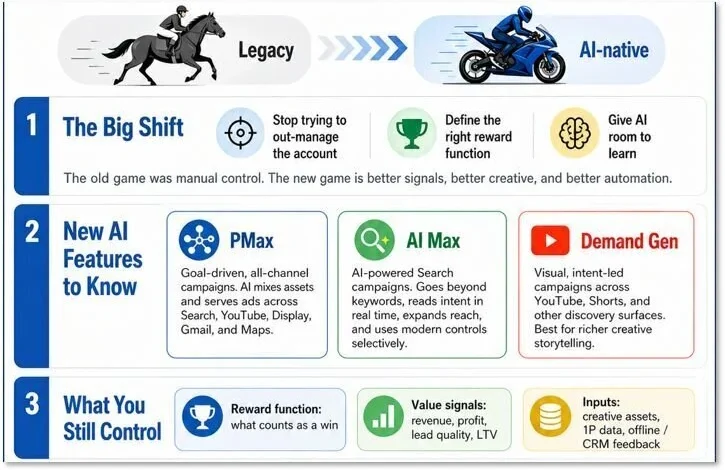
In an era defined by fuel-efficient, long-range transportation, the continued reliance on manual, legacy advertising methodologies presents a stark paradox. Just as driving a horse and carriage on a modern highway defies economic and logistical logic, clinging to outdated search marketing tactics in the age of artificial intelligence actively erodes corporate profitability. The advertising ecosystem, anchored heavily by platforms such as Google Ads and Meta, has undergone a fundamental transformation. Google’s ongoing integration of machine learning and artificial intelligence has rendered traditional, hands-on campaign management obsolete. Rather than fighting this paradigm shift, industry experts argue that the optimal strategy is to leverage automation, allowing algorithms to handle real-time optimization while humans focus on high-level strategic alignment and creative direction.
The persistence of legacy frameworks in boardrooms and strategy sessions remains a central point of friction for industry veterans. Many search marketing teams continue to frame campaigns around strict brand and non-brand dichotomies, spending countless hours tinkering with match types, hourly scheduling, geographic modifiers, negative keyword lists, and manual bid adjustments. Similarly, agencies often attempt to justify their retainers by claiming value through multiple daily micro-adjustments. According to digital marketing analysts, this intensive micromanagement is counterproductive, pulverizing profit margins by attempting to outsmart systems that process billions of real-time intent signals faster than any human team ever could.
Background Context and the Shift Toward Automation
The transition of Google Ads from a keyword-driven directory to an intent-driven machine-learning engine has unfolded over the past decade. In the early days of AdWords, granular human control—such as Single Keyword Ad Groups (SKAGs) and aggressive manual bid modifications—was essential to achieve optimal return on ad spend. However, as consumer behavior fragmented across mobile devices, YouTube, local maps, and conversational search queries, the sheer volume of data surpassed human cognitive capacity.
Google responded by gradually introducing algorithmic features designed to predict consumer intent rather than merely matching typed text. Milestones in this evolution include the rollout of Smart Bidding, the introduction of Responsive Search Ads (RSAs), and the development of campaign types that synthesize multiple inventory channels. Meta initiated parallel shifts within its own social advertising ecosystem, moving away from hyper-targeted audience stacking toward broad-targeting algorithms powered by machine learning. This historical trajectory demonstrates that platform automation is not a temporary trend, but a permanent structural evolution of the digital advertising marketplace.
Current AI Architecture in Google Ads
Today’s digital advertising ecosystem relies on three foundational, AI-powered campaign structures that replace legacy manual architectures: Performance Max (PMax), AI Max, and Demand Gen.
Performance Max consolidates inventory across Search, YouTube, Display, Gmail, and Maps into a single automated campaign. Advertisers supply campaign goals, budgets, and creative assets—including text, images, videos, and logos—while Google’s machine learning models dynamically mix and match these components to capture conversions wherever they are most likely to occur.
AI Max represents the next evolution for search-only campaigns. By abandoning rigid concepts like exact match types and separate brand versus non-brand buckets, AI Max evaluates real-time contextual intent to serve ads for highly relevant queries, expanding audience reach well beyond explicit keyword definitions. Meanwhile, Demand Gen serves as a visual, AI-driven successor to Discovery ads, optimizing the delivery of video assets and Shorts based on deep predictive intent signals.
Across all three formats, the human role has fundamentally changed. Advertisers no longer control every tactical lever of delivery; instead, they control the reward function—defining what constitutes a successful business outcome—while the artificial intelligence evaluates a vastly superior array of contextual signals than any human operator could perceive.
The Google Ads Maturity Model and Assessment Framework
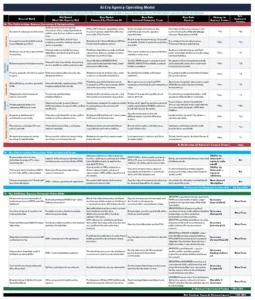
To evaluate whether an organization operates in the modern AI-driven landscape or remains trapped in legacy workflows, digital strategists have introduced quantitative maturity models. These frameworks measure an organization’s sophistication across two primary dimensions: capability scoring (assessing the technological advancement of processes from legacy to AI-native on a 0 to 4 scale) and depth scoring (evaluating how widespread those practices are across total advertising spend, ranging from pilots under 10% to execution defaults of 75% to 100%).
The comprehensive Google Ads maturity framework spans six critical dimensions, with specific weights assigned based on their impact on long-term business outcomes:
-
Measurement and Value Architecture (30 Points)
The foundation of modern advertising relies on the quality of data fed into automated systems. Because machine learning optimizes entirely toward the reward function it receives, weak measurement invalidates all subsequent optimization. Modern architectures utilize enhanced conversions, data-driven attribution, value-based bidding (prioritizing profit or predicted lifetime value rather than raw lead volume), and centralized data activation layers such as Google’s Data Manager. Organizations still optimizing for basic pageviews or treating every lead as equal lag significantly behind. -
Search Operating Model (20 Points)
The modern operating model requires moving away from manual cost-per-click bidding, time-of-day bid modifiers, and obsessive keyword slicing. Instead, it relies on Smart Bidding, broad matching strategies, responsive search ads, and high deployment rates of AI Max. Controls are applied selectively for brand governance rather than daily micromanagement. -
First-Party Data and Audience Intelligence
Modern campaign performance increasingly relies on secure, privacy-compliant first-party data integration. Organizations must leverage customer match lists and consented data streams to guide machine learning algorithms toward high-value demographic and behavioral segments. -
Surface Breadth and Campaign Mix
Maturity involves diversifying across the full spectrum of available Google inventory rather than siloing budgets entirely within traditional text search. This includes integrating video, display, and local surfaces through automated multi-channel campaigns. -
Creative and Landing Page Adaptability
Because AI platforms dynamically assemble assets, advertisers must provide a robust volume of diverse creative variations. Success requires rapid iteration of visual and textual assets paired with landing pages optimized for seamless user experiences. -
Operating Cadence and Governance
The cadence of team operations shifts from reactive, hourly tactical adjustments to proactive strategic oversight, asset refreshing, and monitoring of overarching business metrics and algorithm health.
Implications and Strategic Analysis
The broad transition toward automated advertising infrastructure carries profound implications for corporate structures, agency business models, and individual marketing careers. For enterprises, transitioning from legacy management to AI-native execution consistently yields efficiency gains, frequently unlocking multiples in revenue and profit by eliminating the friction of manual optimization.
For digital marketing agencies, this evolution requires a fundamental restructuring of service offerings. Agencies that built their value propositions on labor-intensive tasks—such as manual bid adjustments, keyword pruning, and fractional campaign segmentation—must pivot toward higher-value advisory services. These include data architecture design, first-party data collection strategies, creative asset production pipelines, and defining precise business reward functions for machine learning algorithms.
For individual professionals, the shift eliminates soul-sucking, repetitive administrative tasks in favor of analytical and strategic oversight. While adapting to this new landscape requires a cultural and operational learning curve, the alternative—sustaining antiquated management practices—results in continuous financial leakage and diminished competitive agility. As the digital advertising market standardizes around machine learning, the competitive advantage no longer belongs to the firm that can out-manage an ad account by hand, but to the organization that feeds the machine the highest-quality data, the most compelling creative assets, and the most accurate definitions of customer value.
Related posts: