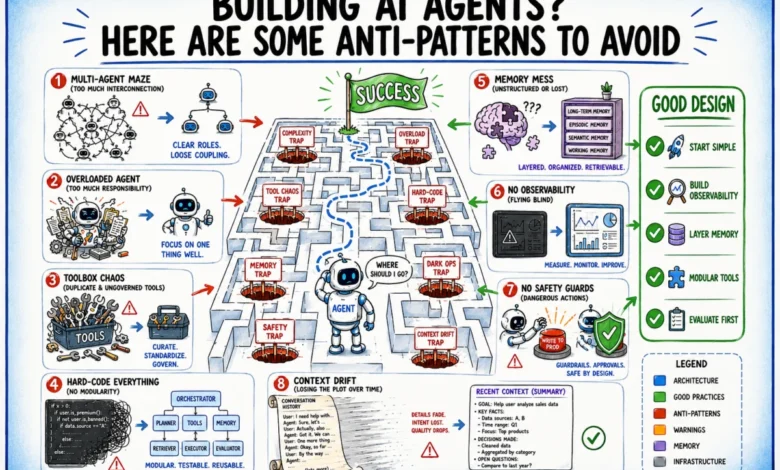
AI agent projects are prone to predictable failures, not typically due to the sophistication of the underlying language models, but rather stemming from critical missteps in architectural design, memory management, tool integration, and the incremental introduction of complexity. These structural flaws, often unaddressed until later stages of development when remediation becomes prohibitively expensive, are the primary culprits behind project stagnation and outright failure. A thorough understanding of these common pitfalls is essential for developing effective AI agents. The antithesis of these anti-patterns lies in a strategic approach: beginning with simplicity, prioritizing robust observability, and introducing complexity only when demonstrable value is evident. Conversely, teams that adopt an inverse strategy—embracing complexity from the outset—are more likely to encounter these detrimental patterns. This comprehensive analysis delves into the prevalent architectural and operational anti-patterns that derail AI agent initiatives, offering actionable strategies for their avoidance.
The Amplified Impact of Agent Failures
While a traditional language model might offer an incorrect answer, leading to a conversational dead-end, an agentic system operates on a fundamentally different paradigm. These systems are designed to solve tasks by assessing situations, selecting appropriate tools, executing actions based on those tools, and dynamically adjusting their approach when encountering obstacles. This inherent reasoning loop, while the source of their power, also dramatically amplifies the consequences of errors. Unlike a chatbot whose failure is typically contained within a single turn, an agent that errs mid-task can continue to operate, potentially making further detrimental decisions. It might invoke tools with incorrect parameters, generate outputs that downstream processes critically depend on, or become trapped in an infinite loop due to an inability to recognize its predicament. The "blast radius" of a single flawed decision can expand exponentially with each subsequent step.
Furthermore, autonomous agents accumulate state across their operational steps. This means that errors do not occur in isolation; they compound. An incorrect tool call in the second step of a multi-stage process can corrupt the contextual information available for the fifth step. A stale entry in the agent’s memory can influence decisions made several steps down the line. By the time a user perceives an issue, the agent may have already executed multiple incorrect actions based on an erroneous initial assumption. This compounding effect distinguishes agent failures as being different in nature, not merely in degree, from those encountered in simpler AI applications.
The Pitfall of Premature Multi-Agent Architectures
A pervasive architectural misstep involves treating sophistication as an inherent design goal. Many teams, upon learning about advanced concepts such as multi-agent systems, hierarchical orchestrators, and peer-to-peer collaboration, rush to implement these complex patterns before definitively validating whether a single, simpler agent can adequately address the core problem.
Multi-agent systems introduce significant coordination overhead, which invariably increases both costs and debugging complexities in ways that are difficult to predict during the initial design phases. Before committing to a multi-agent architecture, teams should critically assess several key questions:
- Is there a clear, demonstrable need for parallel processing or distributed expertise? If a single agent can execute the task sequentially and efficiently, the overhead of managing multiple agents is likely unwarranted.
- What is the communication and synchronization strategy between agents? Complex inter-agent communication protocols can become a significant bottleneck and a source of errors.
- How will emergent behaviors be managed and debugged? The interactions between multiple agents can lead to unpredictable outcomes that are far more challenging to diagnose than issues within a single agent.
- Can the problem be effectively decomposed into discrete, manageable tasks suitable for individual agents? If the task requires deep, continuous collaboration, a multi-agent approach might be necessary, but this is rarely the case for initial deployments.
In most scenarios, a single agent is sufficient for the initial deployment. The recommended strategy is to start with the most straightforward solution that can achieve the desired outcome, rigorously measure its performance, and only then introduce additional layers of complexity if the collected data unequivocally demonstrates the necessity.
The Fallacy of the All-Encompassing Single Agent
Conversely, another common anti-pattern is the attempt to build a single agent tasked with performing an excessively broad range of functions. An agent configured with fifteen distinct tools, encompassing sprawling, multi-part instructions, and burdened with the responsibility for vastly different task categories, is destined to underperform across all of them. The principle of optimization dictates that excelling in one domain often comes at the expense of proficiency in others. This is precisely why routing specific inputs to specialized agents, rather than relying on one monolithic, general-purpose agent, typically yields superior results.
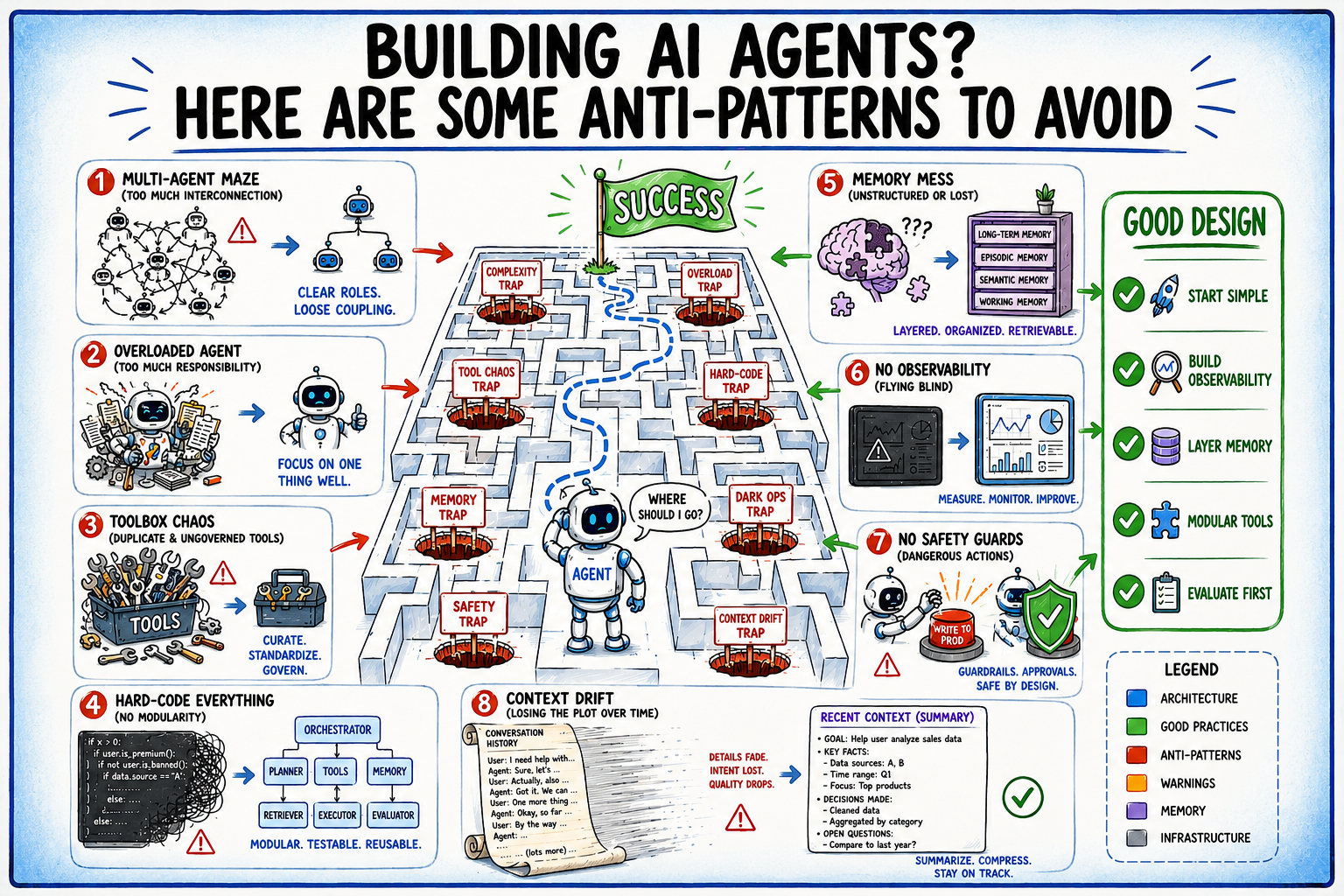
The solution is not always to proliferate more agents. Often, a single, well-defined agent with a narrow, specialized skillset can outperform a bloated, general-purpose counterpart. The initial step should always be to meticulously narrow the agent’s scope of responsibility. If, after this focused optimization, the agent’s performance remains insufficient, then and only then does a compelling case emerge for splitting the functionality into multiple, more specialized agents. This iterative refinement process ensures that each agent is optimized for its intended purpose.
The Peril of Tool List Sprawl
The introduction of each new tool into an agent’s operational context represents an additional element that the underlying model must consider when making decisions. A sprawling toolset significantly increases the probability of the model selecting an inappropriate tool, inflates the size of the prompts required for effective communication, and complicates debugging efforts due to the exponentially larger number of potential execution paths within any given task. Tools that possess overlapping functionalities or an excessive number of available options actively distract agents from pursuing efficient and direct strategies.
To mitigate this, it is crucial to maintain a minimal and purpose-specific toolset:
- Tool Minimization: Only include tools that are absolutely essential for the agent’s defined tasks.
- Purpose Specificity: Ensure each tool has a clear, distinct function. Avoid redundancy or tools that can perform nearly identical operations.
- Granular Permissions: Design tools with fine-grained permissions, limiting their access to only the data and operations they require.
A lean, focused toolset allows the model to more effectively identify and utilize the correct functionality, thereby improving performance and reducing the likelihood of errors.
The Danger of Hardcoding Logic Over Building for Adaptability
Agent systems are inherently dynamic and subject to constant evolution in production environments. A prompt that functions flawlessly today may require revision next week as tools are refactored, underlying models are updated, or new capabilities emerge. When an agent’s core logic is embedded within a monolithic, hardcoded implementation rather than being composed of separable, interchangeable components, even minor changes can inadvertently break other parts of the system.
A modular design approach is paramount for ensuring adaptability and maintainability. This involves:
- Centralized Prompt Configuration: Prompts should be managed as external configurations, allowing for easy updates without altering the core code.
- Discrete Tool Units: Each tool should be developed and managed as an independent, self-contained unit.
- Composable Agents: Agents should be assembled from only the specific components and tools they require for a given task, promoting reusability and reducing dependencies.
This architectural principle ensures that the agent system can evolve gracefully alongside the underlying technologies and business requirements.
The Neglect of Dedicated Memory Design
A common oversight is designing AI agents with the same approach used for chatbots: simply passing conversational history in and expecting a relevant response out. However, agents engaged in multi-step tasks require more sophisticated memory capabilities. They need to recall previous actions, ascertain the success or failure of tool calls, and maintain the context of intermediate results that must be carried forward. Without a deliberate and robust memory design, the limitations of context windows quickly become a production incident rather than a manageable design consideration.
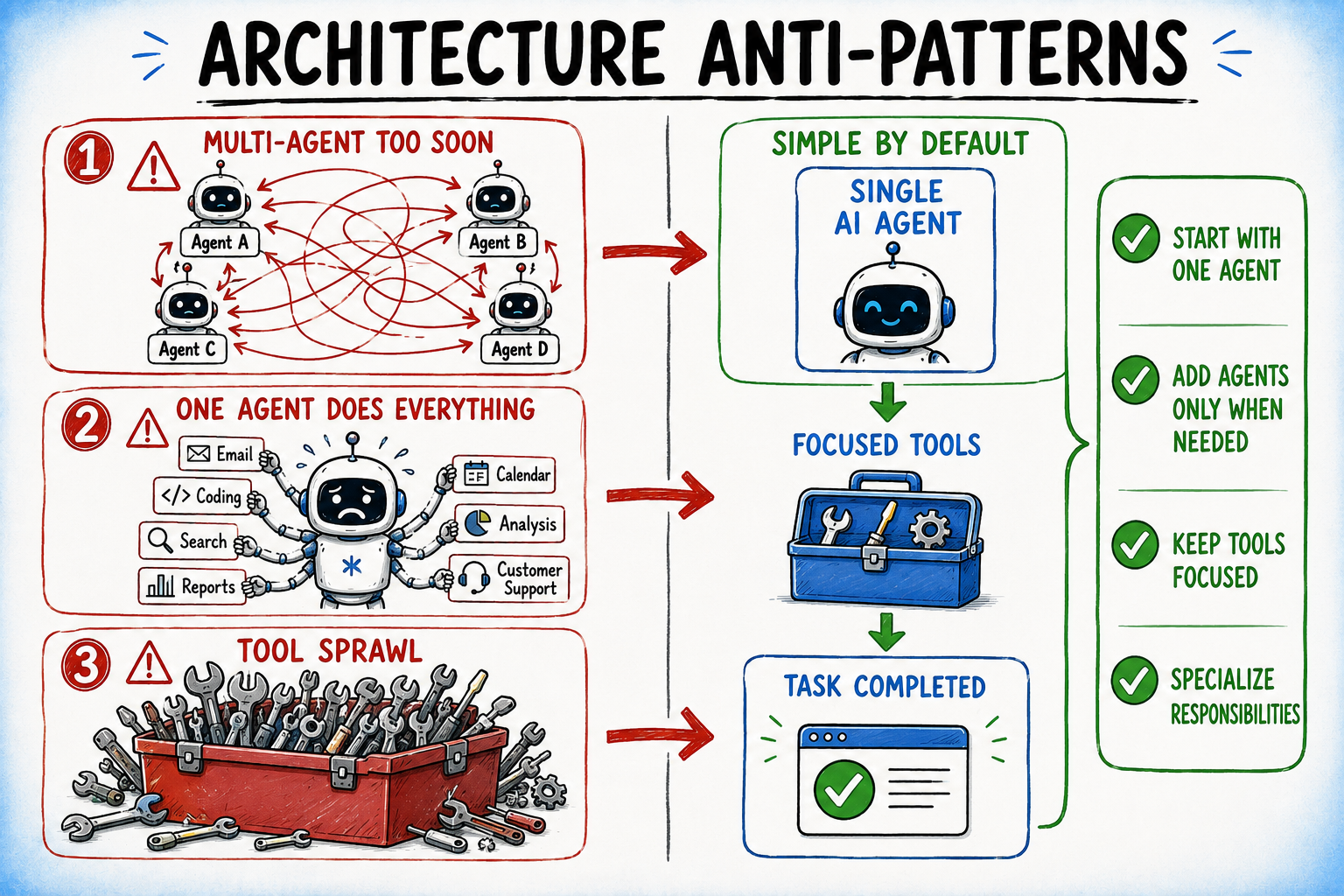
A layered memory architecture effectively addresses this challenge:
- Session Memory: This holds the immediate context of the current task, including recent interactions and intermediate results.
- Long-Term Memory: This stores more persistent information, such as user preferences, historical task outcomes, or learned patterns, which can inform future decisions.
- Action Logs: Detailed records of all actions taken, tool invocations, and their results provide a crucial audit trail for debugging and analysis.
Implementing a memory architecture from the initial stages of development is critical. Retrofitting such a system onto an already deployed agent is a profoundly challenging endeavor, often necessitating a near-complete rebuild.
The Critical Absence of Observability
AI agents are inherently non-deterministic systems with opaque reasoning processes. When failures occur, a simple stack trace is insufficient for diagnosing the root cause of a particular decision. Comprehensive visibility is required into the entire prompt chain, the parameters used for tool calls, the model’s step-by-step reasoning path, and the flow of context throughout multi-step executions.
Teams that deploy agents without built-in observability will invariably spend considerable time debugging issues that could have been resolved in minutes with proper instrumentation. This challenge is particularly acute in multi-agent systems, where a failure in one agent’s output can cascade through several downstream agents before manifesting as a visible symptom. Therefore, building observability into the agent system from the very first line of code is not an option, but a necessity.
The Danger of Ungoverned Write Access
Large Language Models (LLMs) are known to "hallucinate," generate incorrect reasoning, and present flawed information with a high degree of confidence. Consequently, an agent that possesses direct write access to production systems or the ability to send communications to real users must be equipped with stringent guardrails. Read operations and write operations represent fundamentally different risk categories and must be treated as such from the outset of the design process.
In practice, this translates to several critical considerations:
- Permission Boundaries: Carefully define and enforce strict permission boundaries for each tool, granting access only to the specific data and operations necessary for its intended function.
- Human-in-the-Loop for Writes: For actions with significant potential consequences, implement a human-in-the-loop mechanism where critical write operations require explicit human approval.
- Action Sandboxing: Isolate potentially destructive actions in sandboxed environments that can be reviewed and validated before being executed in the live system.
- Confirmation Mechanisms: For any action that modifies data or sends communications, implement clear confirmation steps to ensure the agent’s intent aligns with the desired outcome.
Designing an agent’s permission structure to accurately reflect the actual risk associated with each tool, rather than granting broad, default access, is a foundational principle for secure and reliable agent deployment.
The Oversight of Context Drift in Long-Running Tasks
The context provided to an agent at the commencement of a task can degrade over time as the task progresses. Data may change, and the outputs from early steps can become stale. This phenomenon, commonly referred to as "context rot," describes the diminishing capacity of a model to accurately recall information as the volume of tokens within its context window increases. Consequently, the context window must be viewed as a finite resource with diminishing returns, rather than an inexhaustible repository. For agents engaged in prolonged tasks, this degradation is not an anomaly but a normal operating condition.
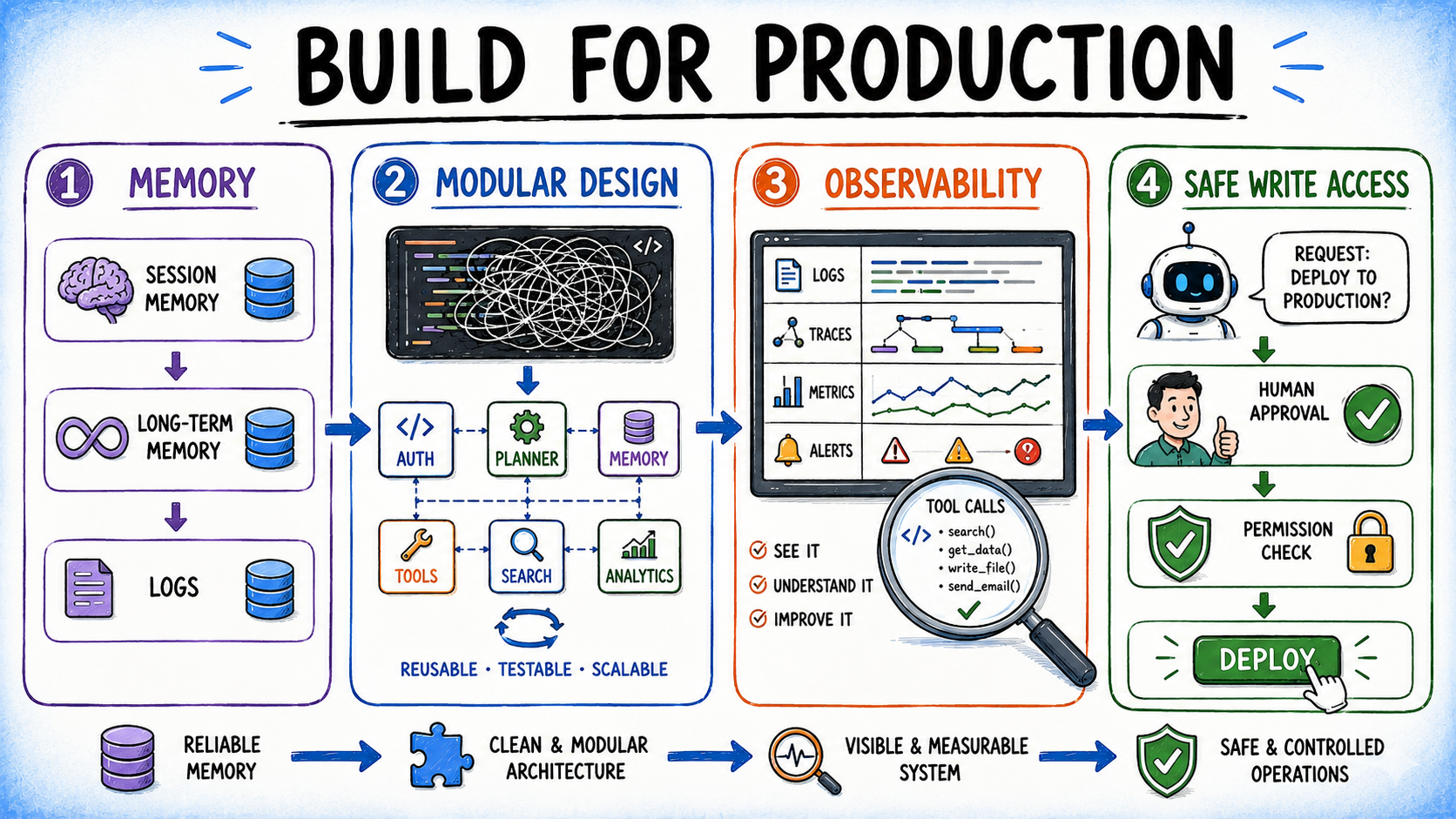
Practical mitigations for context drift include:
- Context Editing: Implement mechanisms to actively prune or summarize less relevant information from the context window as the task evolves.
- Response Pagination: For tasks that generate extensive outputs, break them down into manageable, paginated segments to prevent overwhelming the context.
- Output Size Caps: Set explicit limits on the size of generated outputs to ensure they remain within the effective limits of the context window.
Addressing context drift proactively, before the agent begins to exhibit signs of hallucination or degraded performance, is crucial for maintaining task integrity.
The Folly of Deploying Without Rigorous Evaluation
Agents that perform admirably within controlled test environments often expose novel failure modes when deployed into production. Relying solely on testing against a fixed set of "happy-path" examples merely confirms the agent’s ability to handle scenarios that were already anticipated.
Effective agent evaluation necessitates a more comprehensive approach:
- Adversarial Testing: Subject the agent to a diverse range of adversarial and edge-case inputs to uncover vulnerabilities and unexpected behaviors.
- Business Outcome Metrics: Define success metrics that directly correlate with tangible business outcomes, rather than focusing solely on internal model performance indicators.
- Feedback Loops: Establish a robust feedback loop where production failures directly inform and guide subsequent development iterations.
Conclusion: Navigating the Labyrinth of AI Agent Development
The journey of developing AI agents is fraught with potential missteps, with failures more frequently rooted in architectural shortcomings than in the limitations of the underlying models. Common pitfalls include over-engineering systems, creating agents with excessively broad responsibilities, neglecting the critical role of memory, lacking adequate observability, and granting unmanaged access to tools. By understanding and actively avoiding these anti-patterns, development teams can significantly enhance their probability of success.
| Antipattern | The Fix |
|---|---|
| Multi-agent architecture too soon | Start with a single agent; introduce additional agents only when measured data unequivocally justifies their need. |
| One agent doing everything | Narrow the scope initially; specialize before attempting to scale functionality. |
| Tool list sprawl | Maintain a minimal, non-overlapping, and purpose-specific set of tools. |
| Hardcoded monolithic logic | Keep prompts in configuration, treat tools as discrete units, and compose agents from reusable components. |
| No memory architecture | Integrate layered memory (session, long-term, and logs) from the project’s inception. |
| No observability | Implement structured logging and distributed tracing prior to deployment. |
| Ungoverned write access | Differentiate read/write permissions, implement guardrails, and require human confirmation for high-stakes actions. |
| Context drift in long tasks | Employ context editing, response pagination, and output size caps to manage context degradation. |
| Deploying without evaluating | Test with adversarial and edge-case inputs, and align success metrics with business outcomes. |
By adhering to these principles and proactively addressing these common anti-patterns, development teams can build more robust, reliable, and effective AI agents, paving the way for successful implementation and tangible value realization.
Related posts: