Google Ads Unveils Bidding System Overhaul, Promising Predictability Amidst Potential Swings

Google Ads is set to implement significant changes to its bidding system on August 17th, a move the tech giant claims will enhance performance predictability for advertisers. However, industry analysts and seasoned advertisers are cautioning that these alterations could, in fact, lead to unforeseen volatility in campaign results, particularly for those utilizing target-based bidding strategies. The adjustments primarily focus on how campaigns employing Target Cost Per Acquisition (tCPA) and Target Return on Ad Spend (tROAS) will operate, shifting the priority towards achieving stated goals even if current performance significantly exceeds them.
Understanding the Core Changes: A Shift in Bid Strategy Prioritization
At the heart of the upcoming Google Ads update is a redefined approach to target-based bidding. Previously, strategies like tCPA and tROAS were designed to optimize campaigns towards a specific cost per acquisition or return on ad spend. However, the new system will place a heightened emphasis on adhering strictly to the defined target. For instance, if an advertiser has set a tROAS of 300% and their campaign is currently delivering a 500% return, the system will now actively work to bring that performance down to the 300% target, rather than allowing it to continue exceeding it. While a target bid strategy was inherently meant to function in this manner, Google’s explicit declaration that hitting the stated goal is now the absolute priority signals a more aggressive enforcement of these targets.
Google has indicated that these changes will predominantly affect campaigns that are currently budget-limited. However, given the interconnected nature of advertising accounts and the potential for ripple effects, many advertisers and industry observers are recommending a comprehensive review of all campaigns, regardless of their current budget constraints. This proactive approach is crucial for anticipating and mitigating any unintended consequences.
Preparing for the Shift: Advertiser Responsibilities and Google’s Support Tools
The onus is now on advertisers to thoroughly assess their performance objectives and preferences in light of these impending changes. A critical first step involves establishing clear performance benchmarks and understanding the implications of the new system. Advertisers need to make deliberate decisions regarding:
- Acceptance of Current Performance: Will advertisers be comfortable with their campaign performance being adjusted downwards to meet a lower target, even if they are currently exceeding it?
- Maintenance of Exceeded Performance: If current performance is significantly better than the set target, should the target be adjusted upwards to reflect this reality and prevent a dip?
- Custom Target Adjustments: Is there a need to redefine targets entirely based on realistic and achievable performance levels?
- Strategic Shifts: For advertisers prioritizing volume or revenue above all else, would a shift to different bidding strategies, such as "Maximize Conversions" or "Maximize Conversion Value," be more beneficial?
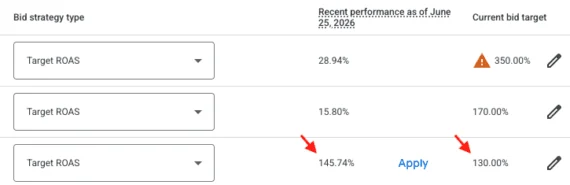
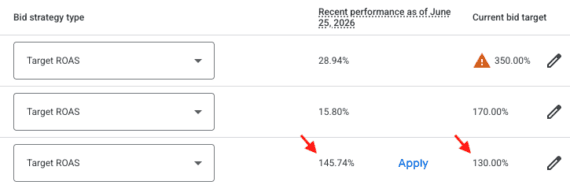
To facilitate this transition, Google has introduced a new bid target adjustment tool. This tool is designed to provide advertisers with a clear overview of their current targets and recent campaign performance, enabling them to make informed decisions. The tool visually represents the gap between actual performance and set targets, often highlighting campaigns where performance has significantly outpaced the goal. For example, a campaign might show a recent ROAS of 145.74% against a target of 130.00%. Under the new system, without any intervention, this campaign would be optimized downwards to achieve the 130.00% target.
Navigating the Options: Strategies for Advertisers

Google Ads has outlined four primary options for advertisers to consider as they adapt to the new bidding system:
Option 1: Keep the Target as Is
For advertisers who are content with their current target ROAS or CPA and do not wish to pursue performance exceeding that target, no immediate action is required. If the campaign is performing above the set goal and the advertiser is comfortable with this performance being adjusted downwards to meet the target, they can simply allow the system to proceed. This approach is the most passive but requires a clear understanding and acceptance of potential performance limitations.
Option 2: Maintain Recent Performance
This option is for advertisers whose campaigns are consistently outperforming their set targets and who wish to maintain that higher level of performance. Google advises a gradual approach to increasing targets. If a campaign’s recent ROAS is, for instance, 200% against a 130% target, advertisers should consider increasing the target incrementally. A recommended strategy is to adjust the target to no more than 156% (a 20% increase on the current performance). After a period of two weeks, further adjustments can be made if performance remains strong. This gradual experimentation is key to learning and adapting to the nuances of the new system.
However, a critical consideration when pursuing this strategy is the impact on overall account performance. If individual campaign targets are increased significantly, while others remain low, the aggregated account-level ROAS could suffer. For example, a single high-performing campaign that is now set to a 500% tROAS against a 300% goal might still reduce the overall account return if other campaigns are not performing as strongly or are also subject to downward optimization. Advertisers must maintain a holistic view of their account’s financial health.
Option 3: Adjust the Custom Target
This strategy involves a more direct and potentially significant adjustment to the campaign’s target. If an advertiser knows that a 300% tROAS target is unrealistically low given their historical data and market conditions, and that 400% is a more achievable and desirable performance level, they can directly set this new custom target. This approach bypasses the gradual adjustments recommended in Option 2 and is suitable for situations where a substantial re-calibration is needed. It requires a firm understanding of what constitutes realistic and optimal performance for the specific campaign and business objectives.
Option 4: Switch to Maximize Strategy
For advertisers whose primary objective is to maximize the volume of conversions or the total revenue generated within a set budget, switching to "Maximize Conversions" or "Maximize Conversion Value" bidding strategies may be the most appropriate course of action. These strategies are designed to achieve the highest possible volume of desired outcomes without being strictly bound by specific CPA or ROAS targets. While this can lead to an increase in overall conversions or revenue, it is important to note that efficiency, in terms of cost per conversion or return on ad spend, may decline. Advertisers adopting this strategy should be prepared for potentially higher ad spend and a less predictable efficiency metric, with the focus shifting to sheer output.
Historical Context and Industry Reactions
Google’s advertising platform has undergone numerous evolutions since its inception. The introduction of automated bidding strategies, powered by machine learning, has been a hallmark of its development, aiming to simplify campaign management and improve performance. However, these shifts have often been met with a mixture of anticipation and apprehension from the advertising community. Past changes to algorithms and bidding functionalities have, at times, led to periods of instability as advertisers and the system itself adapt.
The current announcement is no exception. While Google emphasizes enhanced predictability, the underlying mechanism of forcing performance down to a target, even when significantly exceeding it, introduces a new layer of complexity. Industry forums and professional networks are buzzing with discussions about the potential for unintended consequences. Some experts fear that this aggressive target adherence could penalize highly efficient campaigns, forcing them to spend more to achieve a lower return, thereby reducing overall profitability for some businesses. Others are cautiously optimistic, believing that the increased focus on achieving stated goals could lead to more disciplined campaign management and better alignment with specific business objectives.
Supporting Data and Broader Implications
The effectiveness of Google Ads’ bidding strategies is intrinsically linked to vast datasets and sophisticated algorithms. Billions of auctions occur daily, and the system continuously learns from user behavior, market trends, and advertiser inputs. The recent changes are a product of this ongoing optimization process, with Google aiming to refine how its machine learning models interpret and act upon advertiser-defined goals.
The implications of this update extend beyond individual campaign performance. For businesses that rely heavily on precise CPA or ROAS targets for profitability, this shift could necessitate a significant re-evaluation of their advertising strategies. Companies operating on thin margins or with aggressive growth targets will need to be particularly vigilant. The potential for "unpredictable swings" could impact budget allocation, forecasting, and overall financial planning if not managed carefully.
Furthermore, the emphasis on hitting targets could inadvertently create a feedback loop where campaigns that are already performing exceptionally well are artificially constrained. This might lead to missed opportunities for exponential growth or market share capture. Conversely, for businesses struggling to meet their targets, the new system might provide a more structured approach to achieving them, albeit with the potential for reduced efficiency if targets are set too conservatively.
Official Statements and Future Outlook
While the provided content does not include direct quotes from Google representatives regarding this specific update, Google’s official documentation and support pages consistently highlight their commitment to empowering advertisers with tools and insights to achieve their business objectives. The rationale behind such updates is typically framed around improving the efficacy of the platform, enhancing user experience, and driving better results for advertisers.
The introduction of the bid target adjustment tool is a clear indication that Google acknowledges the need for transparency and support during this transition. By providing advertisers with the means to visualize current performance against targets, they are enabling a more data-driven approach to decision-making.
Looking ahead, the success of this Google Ads bidding system overhaul will depend on several factors. Firstly, the actual on-the-ground performance for a diverse range of advertisers will be the ultimate test. Secondly, the clarity and effectiveness of Google’s ongoing communication and support will be crucial in helping advertisers navigate any challenges. The platform’s ability to adapt and provide further refinements based on real-world feedback will also play a significant role. As always in the dynamic world of digital advertising, continuous monitoring, strategic adaptation, and a willingness to experiment will be key for advertisers to thrive in this evolving landscape.