Fine-Tuning vs. Frozen Embeddings: When to Adapt the LLM vs. the Sklearn Head

The rapid proliferation of Large Language Models (LLMs) has fundamentally altered the landscape of natural language processing (NLP). As businesses and developers move beyond general-purpose chatbots toward specialized, domain-specific applications, they face a critical architectural decision: how to effectively adapt these powerful, resource-intensive models to specific tasks. This choice generally crystallizes into two competing methodologies—full or partial fine-tuning via techniques like Low-Rank Adaptation (LoRA), or the extraction of frozen embeddings for use with lightweight, classical machine learning classifiers. As compute costs remain a primary barrier to entry for many organizations, understanding the performance trade-offs between these two strategies has become a priority for machine learning engineers and data scientists.
The Evolution of Model Adaptation
Historically, the machine learning community relied on fine-tuning entire pre-trained networks. However, as model sizes expanded into the tens and hundreds of billions of parameters, the computational cost associated with adjusting every weight became prohibitive. The introduction of Parameter-Efficient Fine-Tuning (PEFT) methods, specifically Low-Rank Adaptation (LoRA), provided a breakthrough. By freezing the original model weights and injecting small, trainable adapter matrices into the transformer layers, developers could achieve performance gains comparable to full fine-tuning at a fraction of the compute cost.
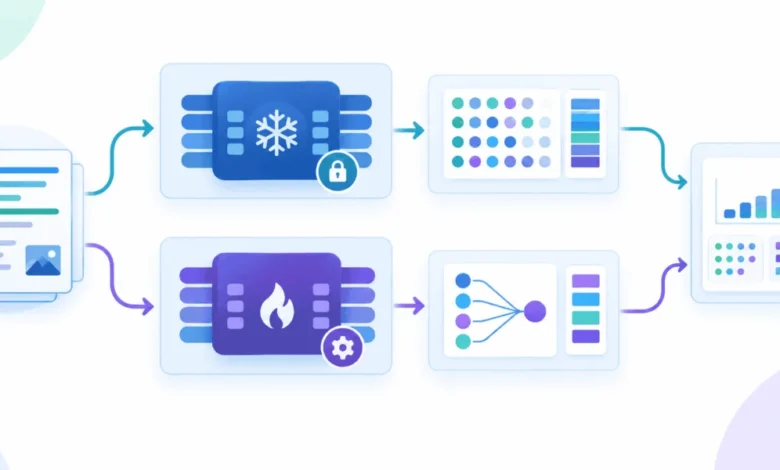
Conversely, the use of frozen embeddings represents a more traditional, "feature-engineering-first" philosophy. In this workflow, the LLM is treated as a static encoder. Input text is passed through the model to extract the internal hidden states—the mathematical representation of the text—which are then treated as input features for a traditional algorithm such as a Random Forest or Support Vector Machine (SVM) via libraries like scikit-learn. This approach minimizes the need for backpropagation through the LLM itself, significantly reducing the requirement for high-end GPU resources during the training phase.
Comparative Methodology and Resource Utilization
To analyze the effectiveness of these approaches, practitioners often look at three primary metrics: classification accuracy, training time, and memory overhead. In a controlled test utilizing the AG News dataset—a standard benchmark for news classification—the differences in operational efficiency become clear.
When employing a frozen embedding strategy using a model like Qwen/Qwen2.5-1.5B, the process is bifurcated. The LLM acts solely as a feature generator. During the extraction phase, the model must process the entirety of the dataset to output the high-dimensional vectors. While this stage is computationally intensive, requiring approximately 96.5 seconds for a small subset on a T4 GPU, the secondary stage—training a Scikit-Learn classifier—is near-instantaneous. The total time for the classifier training is often measured in milliseconds or low-single-digit seconds. This modularity allows for rapid iteration; if a data scientist decides to switch from a Random Forest to an XGBoost classifier, they do not need to re-run the computationally expensive feature extraction process.
In contrast, LoRA fine-tuning integrates the learning process directly into the model’s architecture. Utilizing 4-bit quantization (QLoRA) to manage VRAM constraints, this method requires the model to perform active optimization of the adapter layers across multiple epochs. On the same hardware and dataset, this approach takes significantly longer—approximately 300 seconds—representing a roughly 300% increase in training duration compared to the frozen embedding approach.
Performance Benchmarks and Trade-offs
The primary argument for opting into the higher cost of LoRA is performance. Empirical data suggests that fine-tuning generally yields higher predictive accuracy. In the aforementioned test, the LoRA-trained model achieved an 87% accuracy rate, whereas the frozen embedding approach peaked at 82%.
This 5% delta is significant in high-stakes environments such as medical diagnosis, legal document review, or financial risk assessment, where every percentage point of accuracy correlates to tangible business outcomes. However, for applications where the threshold for success is lower—such as basic sentiment analysis or internal document categorization—the 82% accuracy of a frozen embedding model may be deemed "sufficient."
Strategic Implications for Industry
The choice between these two strategies is rarely a matter of technical capability alone; it is a question of deployment scale and latency requirements.
-
The Case for Frozen Embeddings: This methodology is superior for teams operating on constrained budgets or those utilizing "Serverless" GPU environments where every second of compute time is billed. Because the model remains frozen, it is also highly resistant to "catastrophic forgetting," a phenomenon where fine-tuning a model on new data causes it to lose its previously learned general knowledge. Furthermore, because the classifier is external, it can be deployed on standard CPUs, allowing the LLM to be utilized as a shared, frozen service across multiple downstream applications.
-
The Case for LoRA Fine-Tuning: Fine-tuning is indispensable when the domain language is highly specialized. For instance, medical literature or proprietary legal contracts often contain linguistic patterns that a base model, trained on general internet data, cannot interpret effectively. By adjusting the model weights through LoRA, the model learns the nuances of the domain, leading to superior performance in zero-shot or few-shot inference scenarios later on.
The Future of Hybrid Architectures
Looking ahead, the industry is trending toward hybrid approaches. Some developers are experimenting with "Adapter-as-a-Service" models, where a single base model is hosted, and users can swap out lightweight LoRA adapters in real-time depending on the specific query. This combines the performance benefits of fine-tuning with the infrastructure efficiency of a centralized model.
Moreover, the rise of specialized embedding models—designed specifically for vector databases—is further challenging the need to use general-purpose LLMs as feature extractors. As these models become more capable, the gap between frozen embeddings and fine-tuned models may continue to narrow for classification tasks, potentially pushing fine-tuning to be reserved exclusively for complex generative tasks like creative writing, code generation, or nuanced conversational agents.
Conclusion
The decision to fine-tune an LLM or use it as a frozen embedding extractor is a fundamental crossroads in the development of AI-driven software. If the primary goal is rapid development, cost-efficiency, and leveraging classical machine learning techniques, the frozen embedding approach remains an industry standard for a reason. It is robust, fast, and separates the "intelligence" of the model from the "decision-making" of the classifier.
However, if the objective is to achieve the highest possible precision in a niche domain where the model must "understand" specialized concepts, LoRA fine-tuning is the superior, albeit more expensive, path. As the cost of compute continues to fluctuate and model architectures become more efficient, the ability to pivot between these two strategies will remain a critical skill for any organization looking to operationalize large language models effectively. Ultimately, the "best" strategy is not the one that yields the highest absolute accuracy, but the one that best aligns with the specific performance requirements and resource constraints of the intended application.