Beyond Keywords and Queries: The Rise of Organic Answers Optimization in Modern Digital Marketing

The digital marketing landscape is undergoing a structural transformation as consumer behaviors shift away from traditional keyword-based search engines toward generative artificial intelligence platforms and autonomous software agents. For over two decades, Search Engine Optimization (SEO) has served as the foundational pillar of digital visibility and customer acquisition. However, the rapid proliferation of Large Language Models (LLMs) and conversational answer engines has fractured traditional web traffic pathways. In response to this evolution, industry analysts and marketing leaders are introducing a unified framework: Organic Answers Optimization (OAO).
This emerging paradigm merges traditional SEO with Answer Engine Optimization (AEO), recognizing that modern consumers increasingly rely on conversational interfaces to discover, evaluate, and purchase products and services without ever visiting a brand’s traditional landing page. As corporate balance sheets and digital marketing budgets adjust to these changing consumption habits, organizations are being forced to rethink how they measure online visibility, consumer influence, and revenue generation.
The Evolution of Consumer Discovery: From Search to Complete
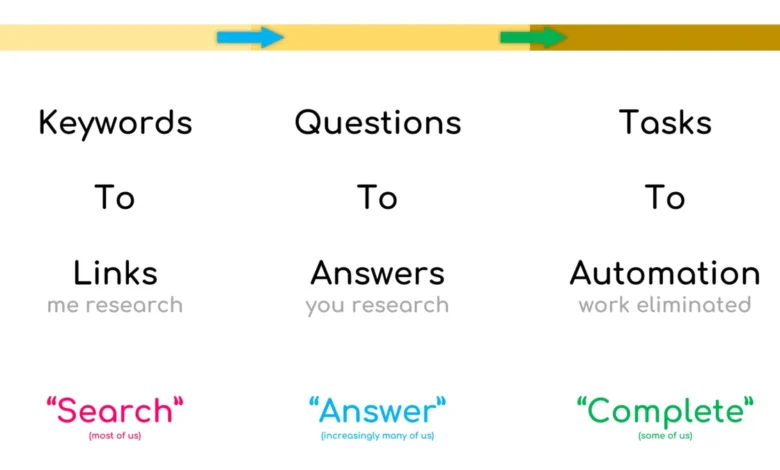
To understand the necessity of OAO, industry observers point to a clear historical progression in consumer behavior over the past several years. This evolution can be categorized into three distinct phases: Search, Answer, and Complete.
In the traditional Search phase, which still commands the majority of overall web traffic and revenue, users initiate intent by entering concise keywords into search engine aggregators. This pattern, utilized by over a billion people globally, delivers a results page populated by paid advertisements and organic links, prompting users to embark on a manual research mission across multiple websites.
The second phase, Answer, has gained substantial traction—particularly among younger demographics such as Generation Z, roughly half of whom reportedly utilize LLMs on a daily basis. Rather than stringing together fragmented keywords, users pose complex, context-rich questions to conversational agents. For instance, instead of searching for "lightweight carry-on luggage," a consumer might ask an AI assistant to recommend a compact bag suitable for a multi-leg European trip under a specific budget, complete with matching accessory requirements. The AI model synthesizes options, surfaces previously unknown brands, and delivers definitive recommendations within seconds, entirely bypassing traditional search engine results pages.
The third and most advanced phase, Complete, represents the bleeding edge of consumer behavior, currently adopted by a smaller percentage of digital users. In this phase, the consumer delegates the entire transactional process to an autonomous agent. The user provides a multi-layered prompt that includes product specifications, delivery deadlines, and return policy preferences, instructing the AI agent to execute the purchase directly. While some institutional firewalls block autonomous agents from completing transactions entirely, these systems increasingly add items to virtual carts or facilitate seamless checkouts, fundamentally altering the traditional ecommerce funnel.
The Economic Imperative: Why Siloed Metrics Fail CFOs
As consumer behavior shifts rightward along this behavioral spectrum, traditional marketing analytics face severe limitations. Chief Financial Officers and executive leadership teams are increasingly indifferent to whether inbound traffic originates from a legacy search engine query, a conversational AI recommendation, or an autonomous purchasing agent. Their primary metrics remain clear: brand selection, conversion efficiency, and bottom-line revenue.
Data from major digital commerce ecosystems underscore the high stakes of this transition. Analytics from retail traffic studies indicate that visits driven by LLM recommendations frequently exhibit significantly higher revenue-per-visit and conversion rates compared to traditional organic search traffic. Yet, many corporate marketing departments continue to operate in rigid silos, maintaining separate teams for SEO and content-driven AEO initiatives.
This compartmentalization creates a distorted view of performance. While organic search traffic across many legacy categories has experienced year-over-year declines—often dropping by 20% to 30%—answer engine referrals are steadily climbing from negligible baselines. Because early commercial returns from AEO efforts frequently manifest through traditional organic search pathways, treating these channels as distinct entities prevents organizations from accurately measuring their total influence. Consequently, industry experts argue that enterprises must adopt a unified OAO scorecard to capture the true continuum of digital visibility.
Redefining Measurement Methodologies: Methodologies Trump Metrics
Implementing a unified OAO framework requires a critical examination of data collection methodologies. In the realm of digital analytics, the principle of "garbage in, landfill out" applies heavily to the tools currently used to evaluate answer engine performance.
Unlike traditional search engines, which provide structured data through webmaster tools, conversational AI platforms do not publicly share comprehensive user prompt logs. Consequently, third-party software vendors attempting to model long-tail queries or estimate answer engine visibility often rely on probabilistic panels or proprietary estimations. While these tools offer directional insights for competitive benchmarking, they cannot provide exact raw numbers.
To navigate this complex data environment without falling victim to vanity metrics, marketing analysts recommend establishing three core Key Performance Indicators (KPIs) focused on financial impact and brand presence:
-
Non-Brand Organic Search Profit: This metric measures the profit generated from orders or leads originating from unpaid search visits where the user did not include the brand, product, or service name in their query. Because brand-name searches exhibit low incrementality, the true value of organic optimization lies in capturing unaware audiences.
-
Answer Engine Profit: This KPI tracks direct conversions and revenue attributable to conversational AI referral channels. Although referral string modifications by AI providers can complicate attribution, tracking these profit figures helps justify content investments in multi-format assets, such as video and audio, which heavily influence AI synthesis models.
-
AI Brand Score: Derived from probabilistic testing methodologies, this score evaluates how often and how prominently an AI assistant recommends a specific brand when presented with category-level prompts that exclude brand names. Functioning similarly to an unaided brand awareness baseline or a share of an LLM’s virtual shelf, this metric helps quantify long-term influence.
Implications and Strategic Outlook for Enterprises
The transition toward Organic Answers Optimization carries profound implications for digital agencies, brand strategists, and enterprise technology infrastructure. As search engines increasingly integrate conversational AI modes directly into their primary interfaces—often without labeling or isolating traffic sources—the boundary between traditional search and generative answers will continue to blur.
Organizations that cling exclusively to legacy SEO tactics risk experiencing sudden, unpredicted shocks to their digital revenue streams as older demographics gradually adopt conversational discovery tools. Conversely, companies that embrace an OAO strategy—focusing on comprehensive, multi-channel content distribution that satisfies both human searchers and algorithmic evaluators—can safeguard their market share.
Ultimately, the rise of OAO signals the maturation of digital marketing analytics. By combining rigorous financial metrics with probabilistic visibility scores, modern enterprises can bridge the gap between faith in emerging technologies and empirical business results, ensuring preparedness for the next era of digital commerce.