Snapchat Report Reveals Shifting Consumer Perceptions Around AI Chatbots and Privacy Trade-Offs

Artificial intelligence has rapidly transitioned from an experimental novelty into an integrated component of daily digital life. A comprehensive new report published by Snapchat, titled Navigating the Age of AI, sheds light on this monumental shift. Based on an expansive survey of over 4,200 active artificial intelligence users conducted by research giants Ipsos and WPP, the report explores how consumer trust, daily reliance, and general perception of AI chatbots are evolving in real-time. The findings paint a complex picture of a society increasingly willing to lean on algorithmic assistants for personal guidance and emotional processing, yet fiercely protective of their boundaries when it comes to hyper-targeted advertising and purely synthetic media.
Massive Adoption Rates and Daily Integration
The statistical overview provided in Snapchat’s report highlights a profound baseline adoption rate that would have seemed implausible just a few years ago. According to the data, 48 percent of everyday consumers now utilize artificial intelligence tools on a daily basis. Furthermore, within professional and creative ecosystems, 50 percent of content creators and digital marketers now identify AI as a core, indispensable component of their routine workflows.
This widespread integration is no longer confined to backend data processing or automated text generation; it is deeply personal. Users are increasingly turning to chatbots and digital assistants to help guide critical decision-making processes, navigate social interactions, and even provide product recommendations. Rather than viewing AI as a distant, intimidating technology, a significant majority of surveyed individuals described these systems as cooperative digital partners capable of enhancing human productivity and expression.
The Psychology of AI Companionship
One of the most striking revelations of the Ipsos and WPP data is the psychological refuge that users find within conversational artificial intelligence. More than 80 percent of respondents described AI assistants as friendly and collaborative. More notably, 74 percent of users view AI interfaces as a completely judgment-free space.
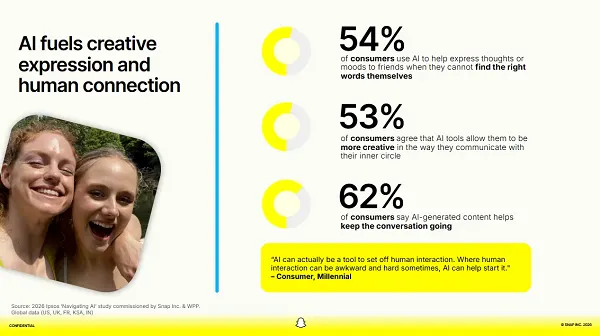
In practice, consumers are leveraging this perceived safety to privately coach themselves through complex emotions, difficult conversations, and delicate social scenarios before ever sharing their thoughts with human peers. The report notes that Snapchat users specifically are 2.2 times more likely to agree that AI positively impacts their social lives, and 1.6 times more likely to rely on AI tools to plan real-world activities. Approximately 62 percent of users stated that AI helps them maintain and fluidly navigate conversations, indicating a growing reliance on algorithms to articulate internal ideas and thoughts.
The Evolution of the Privacy and Value Exchange
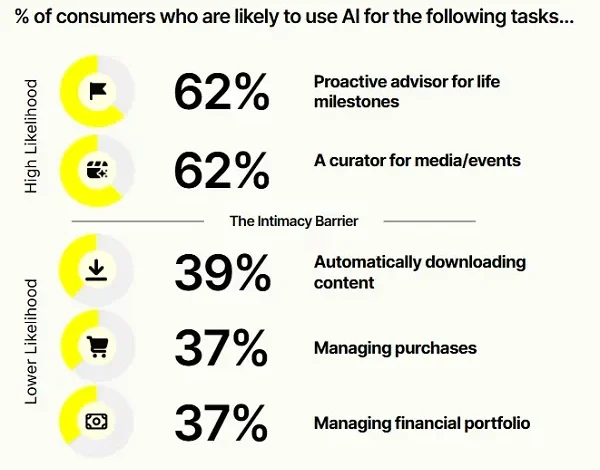
Despite the deep integration of AI into personal communication, longstanding consumer reservations persist, particularly regarding financial management and commercial transactions. Many users remain hesitant to allow AI systems to directly manage bank accounts, execute purchases, or handle sensitive financial data. However, Snapchat’s report argues that modern consumer definitions of privacy are far more fluid than traditional wisdom suggests.
The report asserts that privacy in the digital age is no longer treated as an absolute right, but rather as a sliding scale governed by utility. According to Snapchat’s analysis, modern consumers are rarely asking whether a specific digital practice is completely private; instead, they are calculating whether the convenience is worth the data cost. The underlying thesis is that users will willingly trade personal information in exchange for highly personalized artificial intelligence experiences, provided the immediate, tangible value is obvious and frictionless.
This dynamic exposes a long-standing core philosophy of the broader social media industry: utility often supersedes absolute security in the minds of everyday users. By openly acknowledging and promoting this transactional mindset, platforms are attempting to normalize data collection as a fair and equitable trade-off for access to sophisticated productivity tools.
The Contradiction of Personalization and Synthetic Content
Yet, this optimistic view of the privacy trade-off runs headfirst into a stark consumer contradiction highlighted later in the same report. While users appear comfortable trading data for conversational assistance, they draw a hard line when that same data is weaponized for commercial advertising or when the output lacks a human soul.
According to Snapchat’s data, 70 percent of consumers find the use of personal data in hyper-personalized artificial intelligence advertisements to be highly intrusive. Furthermore, 56 percent of respondents consider 100 percent AI-generated content to be soulless and empty.
This creates a fascinating dichotomy in consumer behavior. On one hand, individuals are rapidly growing comfortable engaging with conversational chatbots and sharing intimate personal thoughts with algorithms that feel directly beneficial to their mental well-being. On the other hand, those same individuals reject the commercialization of that data through targeted advertising and express deep skepticism toward entirely synthetic, automated content creation. Users want the utility of AI when it serves them privately, but they resist corporate exploitation of those very same interactions.
Broader Industry Implications and Future Outlook
The release of the Snapchat report arrives at a critical juncture for the technology sector. As artificial intelligence integration accelerates across virtually every major social media platform, tech companies are racing to monetize these expensive features while maintaining user trust.
The findings suggest a delicate balancing act for businesses and developers moving forward. While consumers have proven remarkably receptive to adopting AI as a personal sounding board and lifestyle assistant, platforms cannot assume a blanket waiver on privacy. The willingness of a user to confide in a chatbot does not automatically translate into a willingness to be tracked across the broader web for targeted marketing campaigns.
Ultimately, Snapchat’s findings indicate that the future of artificial intelligence adoption will not be determined solely by technological capability, but by psychological boundaries. Developers must navigate the fine line between providing hyper-personalized utility and respecting the instinctive human aversion to corporate intrusion and synthetic emptiness. As users continue to redefine how they interact with machines, the industry must learn to honor the nuance of a public that loves its AI companions, but deeply resents being treated as a targeted commodity.