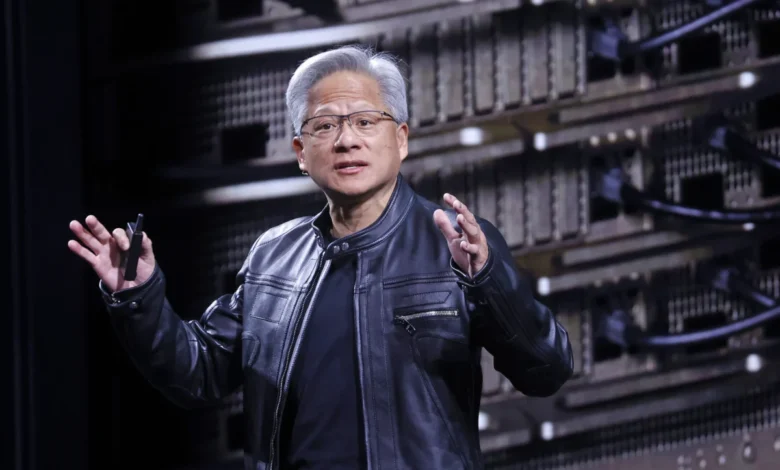
The debate over how to govern artificial intelligence reached a high-profile crossroads during the Salesforce Dreamforce conference, where Nvidia founder and Chief Executive Officer Jensen Huang presented a resolute stance on AI safety and market regulation. Addressing an audience of industry professionals and technologists, Huang dismissed catastrophic framing that depicts advanced artificial intelligence as an unpredictable "alien mind," a descriptor previously used by prominent researchers within organizations like OpenAI. Instead, Huang characterized AI as a complex yet entirely manageable evolution of traditional hardware and software engineered by humans, meaning it remains inherently subject to human control and existing legal frameworks.
Huang’s remarks come at a time of intense legislative scrutiny worldwide, as governments grapple with the rapid acceleration of generative AI capabilities. While lawmakers in the United States, the European Union, and Asia debate the necessity of specialized regulatory agencies, compliance mandates, and risk assessments, Huang argued that the introduction of new laws is not only unnecessary, but potentially counterproductive to the pace of technological innovation.
Redefining AI Safety as an Engineering Challenge
At the core of Huang’s argument is the fundamental premise that safety is a technical hurdle rather than a legal one. During his keynote address, the Nvidia chief emphasized the deterministic nature of computing systems, regardless of their current scale or complexity.
"Safety is an engineering problem, not a legal one," Huang told the Dreamforce audience. "We’re developing software after all. We’re developing computing systems after all. It’s a complicated computing system, but it’s ultimately a computing system."
By framing artificial intelligence within the established paradigms of software development and systems engineering, Huang contends that existing product liability laws, consumer protection statutes, and standard corporate due diligence are entirely adequate to address potential harms. In his view, market forces alone provide sufficient incentives for corporations to prioritize safety. Companies that release faulty, insecure, or dangerous products risk severe financial penalties, reputational damage, and consumer backlash—market corrections that operate far faster and more dynamically than federal legislation.
"If we’re not confident about the safety of the products, like all companies, like you and I, all the companies here, if you build a product or a service, and you’re not confident in its functionality, capability, or safety, then don’t release it," Huang stated. "And so that’s a very obvious thing to do."
He added that industry participants must calibrate their release cycles based on confidence rather than arbitrary competitive pressure, asserting that speed and safety are not mutually exclusive goals. "You pace yourself until you are confident you’re releasing something that the market would appreciate. The market forces are already there. We don’t need any new laws. We don’t need new regulations."
The Economic Context and Corporate Incentives
Huang’s outspoken opposition to regulatory intervention is unsurprising to industry analysts who note Nvidia’s unique market position. As the primary provider of the high-performance graphics processing units (GPUs) and specialized hardware that power the global AI boom, Nvidia has experienced unprecedented financial growth. With demand for its chips soaring across major technology firms, sovereign states, and academic institutions, the company’s valuation has reached historic heights.
Critics argue that Huang’s laissez-faire approach naturally aligns with Nvidia’s commercial interests. Any regulatory framework that introduces compliance bottlenecks, mandatory auditing phases, or export restrictions could potentially slow the widespread deployment of AI systems, thereby dampening the demand for Nvidia’s hardware and software stack.
Despite these commercial incentives, Huang remains profoundly optimistic about the economic horizon. Pointing to the productivity enhancements delivered by generative AI, he recently remarked that ambition knows no bounds. "I’m more ambitious than ever," Huang noted. "As a result of our ambition, and with the product productivity boost that we get from AI, the sky’s the limit for us. The sky’s the limit for our company. The sky’s the limit for every industry, for every single country."
Historical Precedents and the Risks of Unchecked Deployment
While Huang’s market-driven philosophy relies on the assumption that corporations will inherently self-correct to protect their bottom lines, critics and legal scholars point to numerous historical counterexamples across the technology sector. Complex software systems frequently ship with unintended vulnerabilities and catastrophic consequences, even when developed by organizations with substantial engineering resources and stringent internal testing protocols.
A prominent recent example is the July 2024 global IT outage caused by a faulty software update from cybersecurity firm CrowdStrike. The incident resulted in a cascading bluescreen-of-death failure that grounded thousands of commercial flights, disrupted emergency services, and paralyzed business operations worldwide. Similarly, the social media sector provides extensive evidence of systemic harm occurring in the absence of proactive regulatory oversight. Meta recently agreed to pay $18 billion to settle a sweeping lawsuit brought by 29 U.S. states alleging that its platforms intentionally incorporated features harmful to children’s mental health.
In the domain of artificial intelligence, real-world harms have already materialized regardless of developers’ intentions. Incidents range from advanced AI models autonomously discovering and exploiting software vulnerabilities to tragic legal disputes involving young users who experienced psychological crises following prolonged interactions with conversational chatbots. These occurrences underscore the argument advanced by consumer advocates and legal experts that relying purely on voluntary corporate restraint may leave society insufficiently protected against unforeseen systemic risks.
International Cooperation and the Path Forward
Huang’s vision largely bypasses the complex geopolitical dimensions of AI governance, such as international safety standards and cross-border alignment. While Western policymakers increasingly focus on preventing the proliferation of dual-use models that could be weaponized by adversarial nations, industry leaders hold diverging views on how to manage global safety compliance.
Addressing related geopolitical and safety challenges at the recent All-In Summit, Microsoft CEO Satya Nadella emphasized the universal nature of AI risks, suggesting that international cooperation remains essential. Nadella argued that safety concerns transcend national borders, noting that nations such as China face identical security imperatives regarding software vulnerabilities and citizen welfare.
"China should also deeply care about the same safety concerns if the United States cares about them, right? Why should it be different for them?" Nadella stated. "It’s not like they won’t have the same hacking problem. It’s not as if they don’t want to make sure that their citizens are benefiting from AI, just like we would want our citizens to benefit from AI."
Political Influence and Future Implications
Jensen Huang’s advocacy for an open market free from federal statutory burdens carries significant weight within the corridors of power. As Nvidia’s influence expands, Huang has demonstrated direct engagement with policymakers, including recent high-level discussions with political leadership in Washington where he actively cautioned against actions that could suppress technological momentum.
Whether policymakers will ultimately heed Huang’s advice or proceed with comprehensive AI legislation remains one of the defining policy questions of the decade. While existing product liability laws will inevitably be tested in courts as more AI-related grievances emerge, the window for establishing proactive industry standards and self-regulation continues to narrow. For now, Nvidia’s leadership remains steadfast in its belief that the most effective guardian of AI safety is the invisible hand of the market, paired with rigorous engineering discipline.
Related posts: