The Ultimate Guide to Naming UI Components, Design Tokens, and Digital Products: Best Practices and Resources for Cross-Functional Teams

In the modern digital landscape, the success of a software product, design system, or user interface often hinges on a deceptively simple task: giving things the right name. Across the technology sector, cross-functional teams comprising product managers, UI/UX designers, and software engineers frequently struggle with a linguistic divide. Designers speak the dialect of visual composition and spatial hierarchies; developers operate in the precise, modular syntax of codebases and component libraries; product managers rely on user stories and business metrics; and end-users bring their own intuitive, problem-oriented vocabulary. When these distinct groups fail to establish a shared lexicon, the result is chronic friction, architectural confusion, and diminished product adoption.

The repercussions of poor naming conventions extend far beyond aesthetic disagreements or messy repositories. Industry data indicates that teams waste countless hours every week attempting to decipher ambiguous variable names, redundant HTML classes, or poorly labeled design tokens. Furthermore, user research consistently demonstrates that low feature adoption rates are frequently rooted not in a lack of utility, but in poor discoverability caused by confusing terminology. Recognizing these challenges, the design and development community has increasingly prioritized the formalization of naming taxonomies, producing a wealth of open-source frameworks, digital glossaries, and structural guides designed to bridge the gap between human language and digital infrastructure.
The Cognitive and Collaborative Challenge of Nomenclature
Naming is inherently difficult because language actively shapes how humans conceptualize problems and communicate solutions. In software engineering and interface design, a name must strike a delicate balance: it must be specific enough to prevent ambiguity while remaining flexible enough to accommodate future iterations and component reuse. Names that are overly generic—such as "box," "container," or "element"—fail to convey intent, forcing developers to inspect code or designers to trace layer trees manually to understand a component’s function. Conversely, names that are hyper-specific—such as "blue-header-banner-v2"—limit scalability, breaking down the moment a brand undergoes a redesign or a dark mode toggle is introduced.

Historically, this tension has led to fragmented workflows. In a typical product lifecycle, a designer creates a component in a prototyping tool like Figma, assigning it a local name. A front-end developer then translates that asset into a React component or CSS module, often inventing a brand-new class name based on BEM (Block, Element, Modifier) methodology. Simultaneously, a copywriter or product manager refers to the same feature by its business logic name in documentation. This linguistic fragmentation creates a translation tax on every sprint, increasing onboarding times for new team members and escalating the risk of technical debt.
To combat this, leading design systems organizations have adopted a standardized approach to taxonomy. A robust naming framework typically relies on a logical, hierarchical structure that decouples visual presentation from semantic intent. By establishing a shared vocabulary early in the product development lifecycle, organizations can streamline communication, accelerate delivery timelines, and ensure that codebases remain maintainable over years of scaling.

Curated Resources for General Class and Code Naming
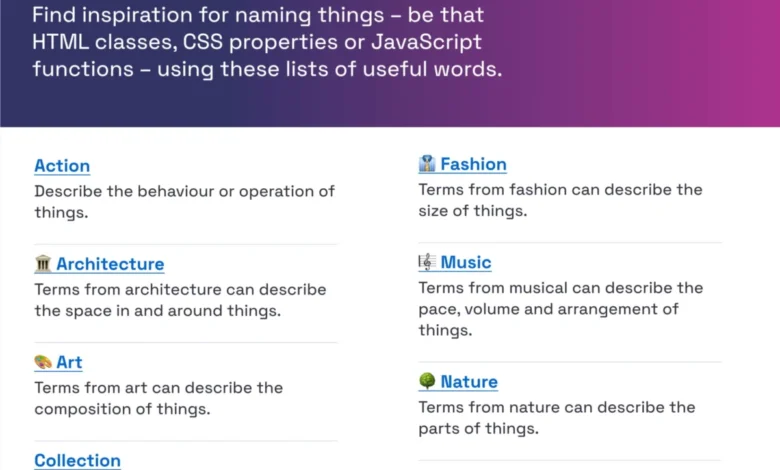
For developers and designers seeking inspiration beyond standard nomenclature, several specialized repositories and tools have emerged to expand creative horizons. Among these is Classnames, developed by Paul Robert Lloyd, which serves as an extensive digital thesaurus for HTML classes, CSS properties, and JavaScript functions. Rather than relying on repetitive programming terminology, the platform provides thematically grouped lists of descriptive words categorized by behavior, spatial relationships, order, grouping, and association.
Furthermore, Classnames incorporates unconventional thematic collections drawn from domains such as architecture, publishing, fashion, theater, music, art, and the natural sciences. By encouraging practitioners to draw upon metaphors from the physical world, these resources help teams craft semantic identifiers that are both evocative and precise. For instance, utilizing architectural terms to describe layout structures or theatrical metaphors for state management can provide immediate intuitive clarity to complex code architecture.

Navigating Color Taxonomy and Palette Scalability
Color management presents one of the most persistent hurdles in digital product design. Traditional hexadecimal codes (#FFFFFF or #000000) are machine-readable but entirely opaque to human cognition, while generic descriptive terms like "light blue" or "dark gray" quickly collapse when a design system expands to include dozens of chromatic variations.
To address this, David Aerne maintains an expansive open-source repository of color names that catalogs more than 30,000 unique color designations. Sourced from historical references, linguistic databases, and thousands of community contributions, the repository includes interactive tools such as Color Parrot and dedicated color-picker utilities. By assigning distinct, recognizable names to specific chromatic values, design systems can move away from rigid scale-based numbering (e.g., blue-100 through blue-900) toward semantic naming structures that communicate tone and context, facilitating better collaboration between design token architects and front-end developers.

Establishing Best Practices for Layers, Groups, and Components
Within design environments like Figma or Sketch, the internal organization of artboards, layers, and component variants often dictates the efficiency of handoff procedures. Javier Cuello, a prominent voice in design systems governance, has formulated a comprehensive set of best practices dedicated to layer and component naming.
According to Cuello’s guidelines, an effective layer name must possess four core attributes: it must be logically structured, concise, universally understood within the team, and entirely divorced from temporary visual properties. For example, naming a layer "Rectangle 45" offers zero contextual value, whereas "Button/Primary/Hover" immediately communicates the component type, its hierarchy, and its interactive state. Cuello’s framework provides explicit do’s and don’ts, helping design teams eliminate structural clutter and ensure that design files mirror the component architectures found in production codebases.
Scaling Design Tokens Across Multi-Brand Ecosystems
As enterprises scale to support multiple brands, regional variations, and diverse product suites, the challenge of naming design tokens—the foundational variables that store design attributes such as spacing, typography, and color—becomes exponentially more complex. A prime example of this enterprise-grade challenge is documented by the design systems team at Intuit, the parent organization behind products like Mailchimp, QuickBooks, TurboTax, and Mint.
Faced with disparate product identities and legacy codebases, Intuit developed a flexible design token taxonomy capable of transcending individual brand themes to serve as a unified foundational system. Nate Baldwin, detailing the architecture of Intuit’s taxonomy, emphasized the importance of transitioning away from superficial property-based naming toward a tiered semantic model. This approach separates primitive tokens (raw values) from semantic tokens (contextual applications), ensuring that updates to a core brand palette cascade predictably across all dependent applications.

Similarly, the Vodafone UK Design System team introduced a comprehensive Variables Taxonomy Map within the Figma community. This framework outlines a four-tier architecture connecting brand primitives, semantic variables, component-level tokens, and page-specific implementations. Building upon foundational token research by industry experts like Nathan Curtis, Vodafone’s mapping system ensures that any team member can instantly trace the origin, purpose, and application of a token simply by reading its identifier. Romina Kavcic has further democratized this practice through tools such as the Design Token Naming Guide and the Design Token Names Inventory spreadsheet, which offer practitioners structured methodologies for configuring states, roles, and categories without losing track of complex token dependencies.
Standardizing UI Component Nomenclature
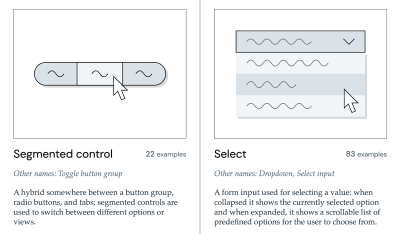
When teams struggle to define what a specific interface element should be called, looking outward to established industry standards is often the most effective remedy. Iain Bean addressed this specific pain point by compiling the Component Gallery, an exhaustive digital archive that aggregates interface components from dozens of real-world design systems.

The Component Gallery catalogs more than 50 distinct UI components—ranging from structural elements like accordions and modals to accessibility utilities like visually hidden text—and cross-references them with the alternative names used across different organizational ecosystems. Complementary tools like Name That UI provide a visual dictionary that bridges the gap between colloquial descriptions and formal design system nomenclature, enabling junior designers and developers to quickly master industry-standard terminology.
Optimizing Feature Naming for User Discoverability
While internal naming conventions dictate developer velocity and maintainability, external product and feature naming directly influences user acquisition, retention, and engagement. Low feature adoption rates are frequently diagnosed as usability failures when, in reality, they stem from poor discoverability caused by obscure internal marketing jargon.

UX researcher Erin Gannon has outlined a practical methodology for naming new features to ensure they are rapidly discovered, understood, and integrated into user workflows. Gannon’s research underscores that effective feature names must be anchored in user needs rather than internal corporate terminology. By identifying the primary "job-to-be-done" and conducting lexical research—asking users to describe a problem or solution in their own native vocabulary—product teams can craft feature names that resonate immediately with their target audience, thereby accelerating time-to-value. For broader product and service nomenclature, open-source repositories like Onym provide systematic frameworks, brainstorming methodologies, and vetting tools to guide teams through the complex lifecycle of brand naming.
Implications and Industry Outlook
The systematic evolution of nomenclature in design and engineering reflects a maturing digital industry. As software ecosystems grow increasingly sophisticated, the invisible friction caused by poor communication exacts a measurable toll on productivity and user satisfaction.

By investing in rigorous naming conventions, structured design token taxonomies, and user-centered feature vocabulary, organizations can eliminate the costly translation errors that occur between design studios and engineering sprints. Ultimately, establishing a unified language across disciplines is not merely an administrative exercise; it is a foundational prerequisite for building scalable, accessible, and intuitive digital products that resonate with both the teams who build them and the users who rely upon them.