Synthesia Launches Roleplay Sessions to Transform Corporate Training Through Interactive AI Avatars and Performance Analytics

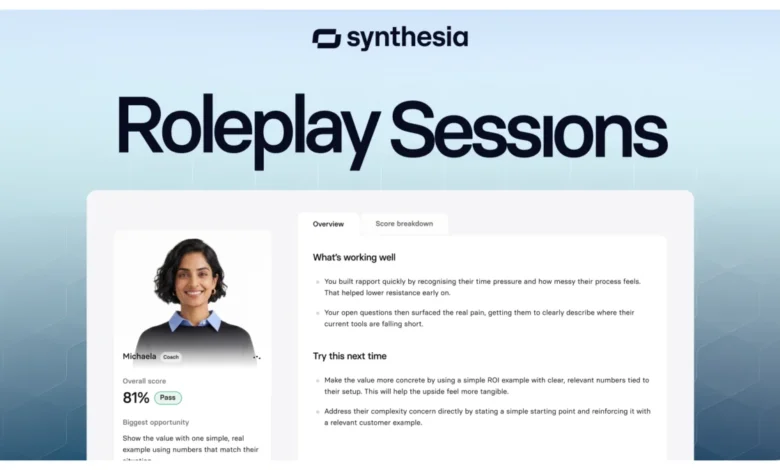
The London-based AI unicorn Synthesia, recently valued at $4 billion, has unveiled a significant pivot in its product strategy with the launch of Roleplay Sessions, an interactive training platform designed to move beyond passive video generation and into the realm of real-time human-to-AI interaction. For years, the startup built its reputation on enabling enterprises to create high-quality training videos using synthetic avatars, significantly reducing the time and capital required for traditional video production. However, as the initial novelty of generative AI matures into a demand for measurable return on investment, Synthesia is betting that the future of enterprise AI lies in its ability to facilitate behavioral change and provide granular performance data to management.
Roleplay Sessions represents the first installment of a broader initiative known as the Sessions platform. According to information shared exclusively with TechCrunch, this platform is slated to expand into various high-stakes corporate functions, including job interviews and candidate screening. The current iteration allows employees to engage in verbal practice for difficult scenarios—such as sales pitches, performance reviews, and sensitive customer service complaints—with an AI avatar that responds dynamically, challenges the user’s assertions, and provides a comprehensive score based on a predetermined rubric. This move signals a shift from Synthesia being a mere content creation tool to becoming a robust performance-management platform with a sophisticated video interface.
The Evolution of Corporate Learning and Development
The launch of Roleplay Sessions arrives at a critical juncture for the corporate learning and development (L&D) sector. Traditionally, corporate training has relied on a mix of text-based modules, pre-recorded videos, and occasional in-person workshops. While video has long been considered superior to static text for engagement, research suggests that passive consumption rarely leads to long-term behavioral changes. Synthesia’s internal research and external academic meta-analyses, such as those from the Doerr Institute for New Leaders at Rice University, indicate that the most effective way to internalize new skills is through active practice and immediate feedback.
In many corporate environments, "role-playing" has historically been a logistical nightmare, requiring expensive consultants or pulling senior managers away from their primary duties to act as sparring partners for junior staff. By automating this process, Synthesia aims to provide "practice at scale." Employees no longer have to wait for a quarterly workshop to practice a difficult conversation; they can engage with a realistic AI avatar at any time, receiving objective feedback that is untainted by the personal biases of a human supervisor.
Victor Riparbelli, CEO and co-founder of Synthesia, emphasized that while video is a powerful medium for information delivery, it is insufficient for skill mastery. "Video performs way better than text or sending out a document," Riparbelli stated. "But for most things, we learn the best by actually practicing something rather than just reading it." This philosophy underpins the shift toward the Sessions platform, which seeks to bridge the gap between "knowing" and "doing."
Technical Infrastructure and the Strategic Moat
From a technical standpoint, Roleplay Sessions utilizes a hybrid approach that combines Synthesia’s proprietary avatar and voice-cloning technology with the advanced reasoning capabilities of OpenAI’s large language models (LLMs). While many startups in the generative AI space rely entirely on third-party models, Synthesia’s "moat"—or competitive advantage—lies in its front-end delivery and the data layer it builds on top of the AI’s responses.
By integrating custom rubrics and performance analytics, Synthesia provides executives with a level of visibility into their workforce that was previously unattainable. For instance, a global sales director can now analyze data from thousands of AI-led practice sessions to identify specific areas where the sales force is struggling, such as handling objections regarding pricing or technical specifications. This data-driven approach transforms AI from a creative tool into a strategic asset for human resources and talent management.
This transition is also a defensive maneuver in a crowded market. As generic video generation becomes increasingly commoditized, specialized applications that offer deep integration into enterprise workflows are more likely to retain high-value customers. Synthesia is positioning itself not just as an AI company, but as an essential part of the enterprise software stack, comparable to platforms like Workday or Salesforce, by focusing on performance outcomes rather than just output.
Early Adoption and Market Reach
Despite being in its early stages, Roleplay Sessions has already secured a roster of high-profile clients. A company spokesperson confirmed that early adopters include one of the top three companies by market capitalization in Europe, a top-five Fortune 100 company, and one of the world’s largest recruitment firms. These organizations are primarily utilizing the tool for sales enablement and leadership development, focusing on the "soft skills" that are often the hardest to teach and measure.
The platform offers two primary modes of implementation. Larger enterprises can use Synthesia’s consultants to build bespoke training environments tailored to their specific products, internal culture, and historical training data. Alternatively, companies can use the platform’s self-service tools to create their own role-play scenarios. This flexibility allows the product to serve both massive conglomerates with complex needs and smaller organizations looking for out-of-the-box solutions.
While the current offering is focused on the enterprise tier, Synthesia has plans to democratize access. As the cost of AI inference continues to decline, the company intends to roll out Roleplay to small businesses, individual prosumers, and educational institutions within the next few months. This expansion could have significant implications for the education sector, providing students with a tool to practice everything from language learning to medical bedside manners.
A Timeline of Synthesia’s Growth
Synthesia’s journey from a research-heavy startup to a $4 billion industry leader reflects the broader trajectory of the AI industry:
- 2017: Synthesia is founded by Victor Riparbelli, Steffen Tjerrild, and world-renowned computer vision researchers Matthias Niessner and Lourdes Agapito. The initial goal is to democratize video production using AI.
- 2020-2021: The company gains viral attention with high-profile campaigns, including an AI-powered David Beckham speaking nine languages for a malaria awareness campaign. It secures Series A funding as enterprise interest in synthetic media grows.
- 2023: Synthesia raises $90 million in a Series C round led by Accel, with participation from NVentures (Nvidia’s venture arm), valuing the company at $1 billion and officially granting it "unicorn" status.
- 2024-2025: The company focuses on "expressive" avatars, introducing technology that allows AI characters to display human-like emotions and micro-expressions.
- January 2026: Synthesia hits a $4 billion valuation following a secondary share sale, allowing employees to cash in on their equity and signaling strong investor confidence in its long-term enterprise strategy.
- Late January 2026: The launch of Roleplay Sessions marks the company’s evolution from content generation to interactive performance management.
Industry Implications and the Shift Toward Measurable AI
The launch of Roleplay Sessions comes at a time when the "honeymoon phase" of generative AI is ending. In 2023 and 2024, many corporations rushed to adopt AI tools based on their novelty and the fear of being left behind. However, the 2025-2026 fiscal years have seen a shift toward accountability. Chief Information Officers (CIOs) and Chief Financial Officers (CFOs) are now demanding proof that AI investments are generating tangible business results, such as increased sales, reduced churn, or faster onboarding.
Synthesia’s new direction addresses this demand directly. By providing a feedback loop and scoring system, the platform allows L&D departments to report concrete metrics to leadership. If a sales team’s average "objection handling score" improves by 20% after using Roleplay Sessions, that is a quantifiable win that justifies the software’s cost.
Furthermore, the expansion into recruitment and candidate screening through the broader Sessions platform could disrupt the HR technology market. If AI avatars can conduct initial screenings or assess a candidate’s soft skills through interactive role-play, it could significantly reduce the administrative burden on hiring managers. However, this move is also likely to invite scrutiny regarding AI bias and the ethics of using automated systems to make employment-related decisions—a challenge that Synthesia will need to navigate through transparent rubrics and rigorous testing.
Conclusion
Synthesia’s introduction of Roleplay Sessions represents more than just a new product feature; it is a strategic realignment that acknowledges the limitations of passive content. By focusing on interaction, practice, and data-driven feedback, the company is attempting to solve one of the oldest problems in corporate management: how to effectively change human behavior at scale. As the Sessions platform expands into hiring and other high-stakes areas, Synthesia is positioning itself to be the interface through which modern professionals learn, practice, and prove their capabilities in an increasingly AI-integrated world. The success of this venture will likely depend on how well these AI "role players" can mimic the nuance of human interaction and whether enterprises can successfully integrate these automated insights into their broader talent development strategies.
Related posts: