Seth Meyers Critiques Elon Musk AI Odyssey Project Amid Growing Debate Over Generative Media Authenticity

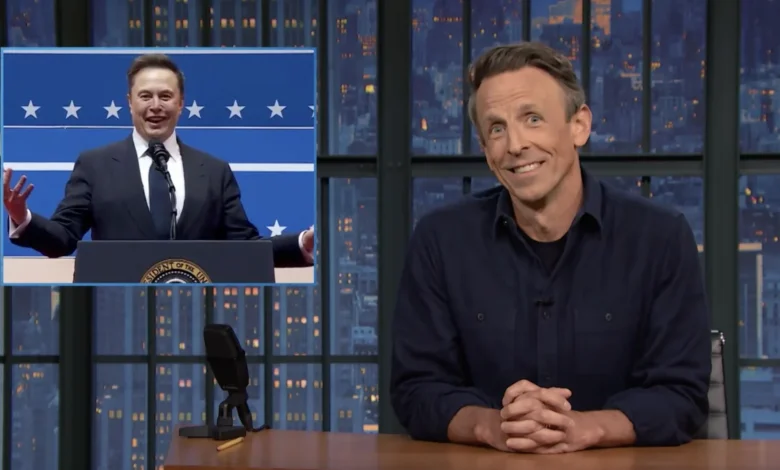
Late-night television host Seth Meyers has joined a growing chorus of skeptics regarding Elon Musk’s latest foray into the entertainment industry: an artificial intelligence-generated adaptation of Homer’s The Odyssey. The project, which Musk claims will be a "historically accurate" rendition of the ancient Greek epic, has sparked significant discussion across both the technology and entertainment sectors. During a recent segment on Late Night with Seth Meyers, the comedian offered a biting critique of the venture, questioning the feasibility of Musk’s vision and the inherent contradictions in applying "historical accuracy" to a foundational work of mythology.
The announcement of the project, which is reportedly being developed using xAI’s Grok platform, comes at a time when the use of generative AI in Hollywood remains a flashpoint for labor disputes and creative ethics. Meyers’ reaction—summarized by his blunt assertion, "Wow, I can’t wait for that to suck"—reflects a broader cultural apprehension toward the replacement of human artistry with algorithmic output.
The Convergence of AI and Classical Literature
Elon Musk’s proposal involves using high-fidelity generative video and audio tools to recreate the ten-year journey of Odysseus. According to statements released via Musk’s social media platform, X, the goal is to bypass what he describes as the "creative biases" of modern Hollywood by using AI to interpret archaeological and historical data from the Bronze Age. The aim is to create a visual experience that reflects the actual geography, attire, and linguistic nuances of the period in which the poem is set.
However, Meyers pointed out the fundamental paradox of Musk’s "historically accurate" claim. The Odyssey is an epic poem attributed to Homer, a figure whose own historical existence is a subject of scholarly debate. The narrative itself is a cornerstone of Greek mythology, featuring supernatural elements such as the one-eyed Cyclops, the enchantress Circe, and the sea monster Scylla.
"Also, what do you mean historically accurate?" Meyers asked during his monologue. "It’s a myth! Are you also making a historically accurate version of The Santa Clause?"
The critique touches on a significant philosophical divide in how AI is being marketed. While proponents argue that AI can synthesize vast amounts of data to produce "objective" recreations, critics like Meyers argue that the technology lacks the nuance to distinguish between historical fact and literary allegory.
Late Night’s Unified Front against Generative Media
Meyers is not the only late-night personality to target Musk’s project. Colman Domingo, guest-hosting Jimmy Kimmel Live!, also addressed the announcement, suggesting that the move was an attempt to commodify culture without the "inconvenience" of human talent. The synchronized response from late-night hosts highlights the entertainment industry’s defensive posture following the 2023 strikes by the Writers Guild of America (WGA) and the Screen Actors Guild (SAG-AFTRA).
Meyers’ commentary specifically targeted the quality of AI-generated dialogue. He mocked the potential script, suggesting it would mirror the often-polite and repetitive nature of current large language models (LLMs). "I hope it’s like ChatGPT," Meyers joked. "’Odysseus, you must return home.’ ‘You got it, I can’t wait to embark on this journey with you! Let’s keep it light and fun! And I’m here for whatever you need.’"
This satire underscores a genuine concern among screenwriters: that AI, while capable of producing grammatically correct prose, fails to capture the subtext, irony, and emotional depth that define classic storytelling.
The Technological Context: xAI and the Rise of Grok
The project is slated to be a flagship demonstration for xAI, the artificial intelligence company Musk founded in 2023 to compete with OpenAI and Google. xAI’s Grok has been positioned as a "rebellious" AI, designed to answer questions with wit and a lack of the "woke" safeguards Musk attributes to other platforms.
By moving into film production, xAI is entering a crowded field. OpenAI’s Sora and startups like Runway and Luma AI have already demonstrated the ability to create hyper-realistic video from text prompts. However, a full-length feature film entirely generated by AI remains an elusive goal due to issues with temporal consistency—where characters and backgrounds change subtly from frame to frame—and the immense computational cost.

Industry analysts suggest that Musk’s Odyssey project may be less about cinematic excellence and more about stress-testing the multimodal capabilities of Grok. If the AI can maintain the "historical accuracy" of Bronze Age Greek armor and ship designs across a two-hour narrative, it would represent a significant leap in generative consistency.
A Timeline of AI’s Incursion into Entertainment
The skepticism voiced by Meyers is rooted in a timeline of rapid and often controversial technological advancements:
- May 2023: The WGA begins a 148-day strike, with AI protections as a central demand.
- July 2023: SAG-AFTRA joins the strike, citing the "existential threat" of digital likeness theft via AI.
- February 2024: OpenAI reveals Sora, capable of generating 60-second clips that rival professional cinematography.
- Late 2024: Several independent film studios announce "AI-first" production pipelines, leading to widespread backlash from creative guilds.
- July 2026: Musk announces the AI-generated Odyssey, claiming it will redefine historical epics.
Meyers’ critique of "fake actors stolen from real actors" refers to the practice of training AI models on existing performances without consent or compensation. This remains a legal gray area, though recent legislative efforts in the United States and the European Union have sought to establish "digital personality rights."
The Archaeological and Literary Debate
Beyond the technological and labor concerns, the "historical accuracy" of an AI Odyssey raises questions for historians and classicists. The "Homeric Question"—concerning who Homer was and when the epics were composed—remains one of the most complex topics in the humanities.
The poem describes a world that is a hybrid of the Mycenaean Bronze Age (c. 1600–1100 BCE) and the Iron Age (c. 800 BCE) in which Homer likely lived. An AI tasked with "historical accuracy" would have to choose which era to depict. If it chooses the Bronze Age, the characters would look like the figures found in the frescoes of Knossos; if it chooses the Iron Age, the aesthetic would be vastly different.
Furthermore, the "accuracy" of a myth is an oxymoron. The monsters and gods are central to the story’s themes of nostos (homecoming) and xenia (hospitality). By focusing on historical realism, critics argue that Musk’s AI might strip the story of its metaphorical power, resulting in a product that is visually impressive but narratively hollow.
Broader Implications for the Film Industry
The reaction to Meyers’ monologue on social media suggests a divided public. While tech enthusiasts argue that AI will democratize filmmaking, allowing anyone to produce "epic" content regardless of budget, many in the creative community view it as the "industrialization of the soul."
If Musk’s project succeeds in gaining an audience, it could signal a shift toward "synthetic media" where the cost of production is decoupled from human labor. However, if the project fails to resonate—or if it "sucks," as Meyers predicts—it may serve as a cautionary tale about the limitations of technology in replicating the human experience.
The economic implications are also significant. A traditional historical epic like Troy (2004) or Gladiator (2000) requires thousands of extras, costume designers, historians, and location scouts. An AI-generated version eliminates these roles, potentially disrupting the economies of film hubs like London, Los Angeles, and Malta.
Conclusion: The Future of the "AI Epic"
As of July 2026, the entertainment world remains in a state of flux. The clash between Seth Meyers’ traditionalist skepticism and Elon Musk’s techno-optimism represents a broader cultural struggle over the definition of art.
While Musk promises a version of The Odyssey that is "truer" than any that came before, Meyers’ critique serves as a reminder that the "truth" of a story often lies in its telling, not its data points. For now, the industry awaits the first footage from Musk’s venture to see if the AI can truly navigate the wine-dark sea, or if it will find itself shipwrecked by the very complexity of the human imagination.
The debate sparked by Meyers is likely to intensify as xAI moves closer to a release date. Whether the project becomes a landmark in cinematic history or a punchline in a late-night monologue will depend on whether an algorithm can understand why Odysseus spent ten years trying to get home—a motivation that is deeply, and perhaps exclusively, human.