Shopify vs. ThriveCart: A Deep Dive into the Premier Platforms for Online Sellers

Shopify and ThriveCart both aim to empower online entrepreneurs, yet they operate on fundamentally different principles. Understanding this core distinction is paramount before investing in either solution. Shopify stands as a comprehensive e-commerce platform, providing a complete ecosystem for building an online store, complete with a storefront, product catalog, inventory management, shipping logistics, and a robust checkout process. In contrast, ThriveCart functions as a specialized checkout and sales funnel tool, designed to integrate with existing online presences rather than replace them entirely.
This comprehensive analysis dissects both platforms across eight critical areas relevant to online sellers. All pricing figures have been meticulously verified against current public rates from each vendor, eschewing outdated reviews. For the majority of individuals establishing a substantial online retail presence, Shopify emerges as the superior choice. However, for a more niche segment, particularly digital product creators, online course instructors, and coaches, ThriveCart’s compelling one-time payment model presents a significant value proposition.
A common, and often optimal, strategy for many online businesses involves the synergistic use of both platforms. In such scenarios, ThriveCart typically manages the sophisticated checkout processes and affiliate program management, while Shopify anchors the primary online storefront and broader e-commerce operations. This article will delve into the strengths and weaknesses of each platform, offering insights into where they excel and where they might fall short depending on a business’s specific model and objectives.
Shopify vs. ThriveCart: A Quick Verdict
The most crucial differentiator lies in their fundamental nature: Shopify is an all-encompassing e-commerce platform, while ThriveCart is a specialized tool for optimizing sales conversions through advanced checkout and funnel capabilities. For those building a comprehensive online store, Shopify is the clear leader. For sellers focused on digital goods, courses, or coaching, especially those leveraging affiliate marketing, ThriveCart offers a distinct advantage, particularly with its one-time payment structure. Many businesses find the most effective solution is to integrate both platforms, leveraging Shopify for its robust store infrastructure and ThriveCart for its specialized checkout and conversion optimization features.
Quick Comparison: Shopify vs. ThriveCart
| Category | Shopify | ThriveCart |
|---|---|---|
| Core Functionality | Full hosted e-commerce platform | Checkout, cart, and funnel tool |
| Entry Price | $39/month ($29/month billed annually) | $495 one-time, no recurring fee |
| Higher Tiers | Grow $105/month, Advanced $399/month, Plus from $2,300/month | Pro+ at $295/year, Ultimate Bundle $985 one-time |
| Platform Transaction Fees | None with Shopify Payments; 0.6% to 2% with third-party gateways | None on any plan |
| Card Processing | 2.9% + 30c (Basic), down to 2.5% + 30c (Advanced) | Your processor’s own rate (Stripe, PayPal, Authorize.net) |
| Storefront & Themes | Yes, free and paid themes, full site builder | No storefront, checkout pages only |
| Inventory Management | Yes, multi-location, native | Minimal, not built for it |
| Order Bumps & Upsells | Via apps | Native, unlimited |
| Affiliate Program | Via third-party apps | Native affiliate center (Pro+) |
| Course Selling | Via apps | Built in (Learn / Learn+) |
| SEO & Blogging | Yes, native | No |
| Free Trial | Yes, plus a $1/month promo for first 3 months | No free trial, money-back guarantee only |
| Best For | Physical products, growing brands, multichannel sellers | Digital products, courses, coaching, one-product funnels |
Key Takeaways
- Fundamental Difference: Shopify is a complete e-commerce solution; ThriveCart is a specialized sales tool.
- Pricing Model: Shopify is subscription-based; ThriveCart offers a compelling one-time payment option for its Standard plan.
- Target Audience: Shopify excels for physical goods and broad retail. ThriveCart is optimized for digital products, courses, and high-converting funnels.
- Feature Set: ThriveCart leads in native upsell/downsell and affiliate management features. Shopify offers a complete storefront, inventory, and multichannel selling capabilities.
- Integration: Many businesses leverage both, using ThriveCart for specific sales funnels and Shopify for their primary store.
1. Best for Pricing: ThriveCart (With a Serious Caveat)
ThriveCart’s marketing prominently features its one-time payment model, contrasting it with Shopify’s recurring monthly fees. While this comparison appears starkly favorable, a closer examination of the actual costs reveals a more nuanced picture.
Shopify’s Pricing
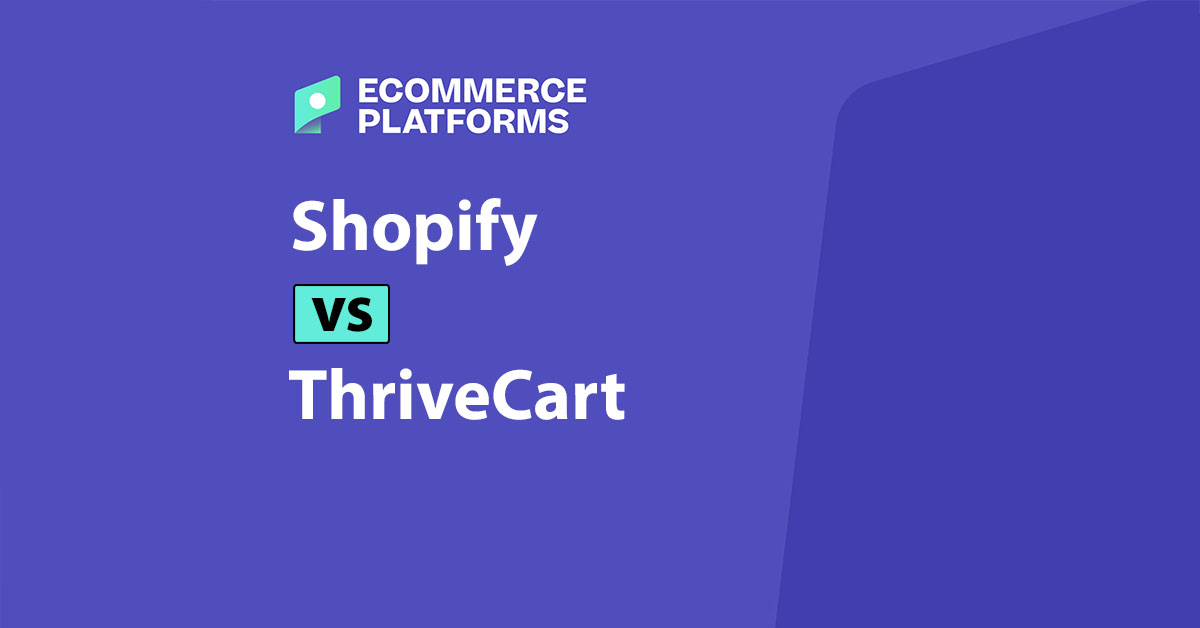
Shopify’s pricing structure is tiered, offering scalability as a business grows. The core plans, when billed annually, provide a significant discount.
- Basic: $39/month ($29/month billed annually)
- Shopify: $105/month ($79/month billed annually)
- Advanced: $399/month ($299/month billed annually)
- Shopify Plus: Custom pricing, starting from $2,300/month
Shopify provides a risk-free introductory period with a free trial, followed by an attractive promotional rate of $1 per month for the initial three months. This significantly lowers the barrier to entry and allows merchants to test the platform without substantial upfront commitment—a stark contrast to ThriveCart’s approach. A crucial detail often overlooked is Shopify’s surcharge for third-party payment gateways, which can range from 0.6% to 2% on top of standard processing fees, depending on the plan. Opting for Shopify Payments eliminates this surcharge.
ThriveCart’s Pricing
ThriveCart’s pricing has evolved, with its primary offerings being:
- Standard: $495 one-time payment. This plan includes core checkout functionality, order bumps, one-click upsells, and basic integrations.
- Pro: Formerly a one-time upgrade, now part of the Pro+ annual subscription.
- Pro+: $295 per year. This tier unlocks the native affiliate center, advanced analytics, and other premium features.
- Ultimate Bundle: $985 one-time payment. This bundle historically included lifetime access to all current and future features, though its current availability and specifics should be verified directly with ThriveCart.
ThriveCart’s key pricing advantage is its complete absence of platform transaction fees. Merchants pay only their chosen payment processor’s standard rates (e.g., Stripe, PayPal). This direct control over payment processing can be beneficial for revenue management. It’s important to note that ThriveCart does not offer a free trial; instead, it relies on a money-back guarantee. The duration of this guarantee can vary and should be confirmed on ThriveCart’s official checkout page.
The Actual Math
Comparing costs over time is essential. Shopify’s Basic plan, billed annually, amounts to approximately $348 per year. ThriveCart Standard, at a $495 one-time fee, theoretically breaks even around 17 months into usage compared to Shopify Basic. This initial calculation makes ThriveCart appear more cost-effective for long-term use.
However, the equation changes significantly when considering advanced features. If an affiliate program is a necessity, users must upgrade to ThriveCart Pro+ at $295 per year. Over a three-year period, this would total $495 (initial) + $295 (year 2) + $295 (year 3) = $1,085. In comparison, Shopify Basic over three years totals approximately $1,044 ($348 x 3). The cost advantage of ThriveCart’s one-time payment model diminishes considerably once recurring annual fees for advanced features are factored in. The "pay once" narrative holds true primarily for users who can operate exclusively within the confines of the Standard plan.
The Winner: ThriveCart, if you can live on the Standard plan.
ThriveCart Standard at $495 with no recurring fee offers the most compelling pure-cost proposition in this comparison, especially given the absence of platform transaction fees. However, the moment Pro+ features, such as the native affiliate center, are required, the "pay once" benefit largely dissipates. Moreover, Shopify’s risk-free trial and introductory $1 per month offer provide an unmatched entry point that ThriveCart cannot match.
2. Best for Selling Online: Shopify
This is where the comparison becomes starkly divergent, and it is the most critical factor for most online sellers. Shopify is designed to be the central hub for an entire e-commerce operation.
What Shopify Gives You
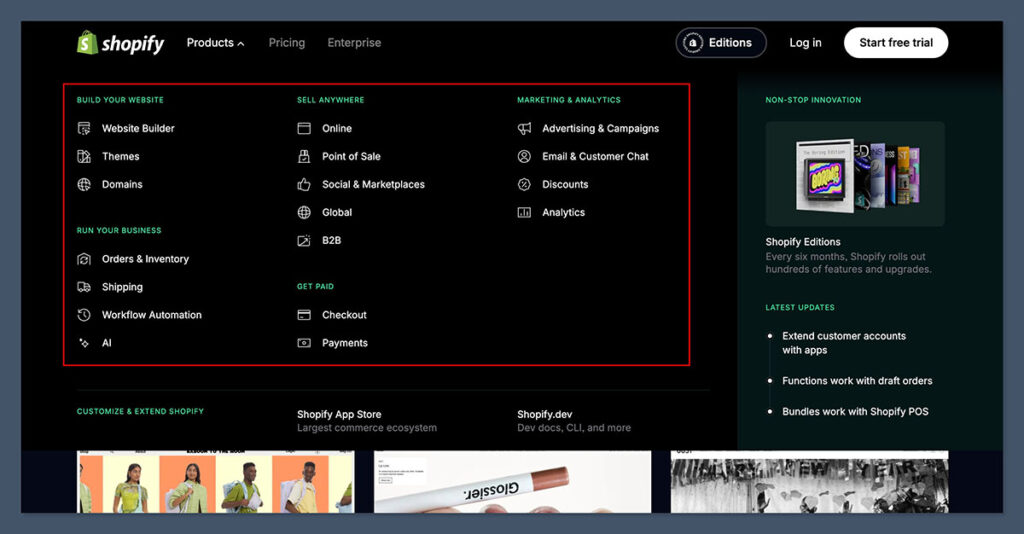
Shopify is engineered as a comprehensive commerce operating system. It provides:
- A browsable storefront: Featuring collections, product pages, and a fully customizable site builder.
- Native inventory management: Supporting multiple locations for sophisticated stock control.
- Advanced shipping tools: Including carrier-calculated rates on higher-tier plans.
- Point-of-Sale (POS) system: For seamless integration with physical retail operations.
- Multichannel selling: Direct integration with platforms like Amazon, Etsy, Instagram, TikTok, and Google.
Every Shopify plan includes unlimited products, unlimited bandwidth, and built-in abandoned cart recovery. The platform also natively handles fraud analysis, tax calculation, gift card issuance, discount code generation, and customer account management. For businesses dealing with physical goods, these are not optional luxuries but essential operational components.
The extensive Shopify App Store is another significant asset, boasting thousands of applications that can extend functionality. However, this vast ecosystem often translates to additional monthly costs for features that might be native to other platforms, such as advanced reviews, loyalty programs, or subscription management.
What ThriveCart Gives You
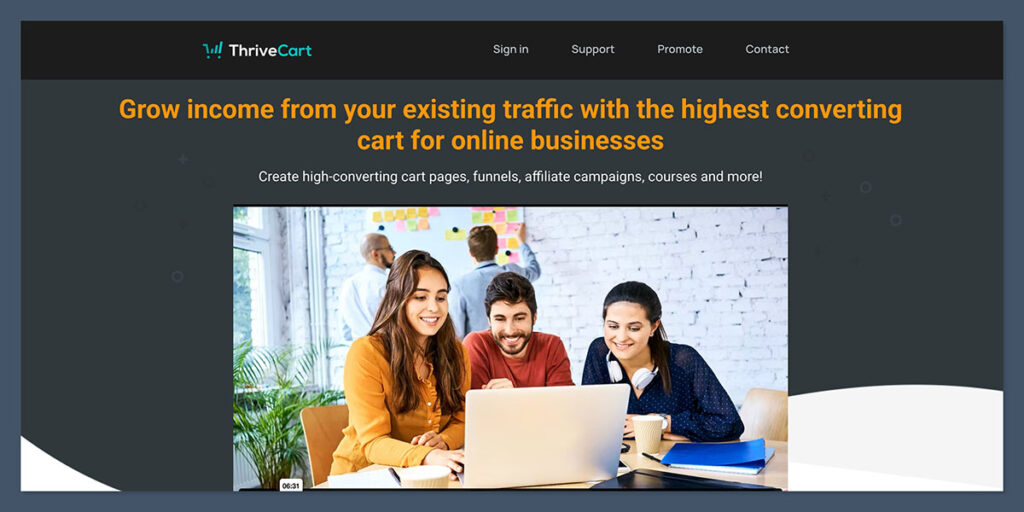
ThriveCart, by design, does not provide a comprehensive online store. It lacks a product catalog for browsing, collections, or a general website builder. Its core offering is a highly optimized checkout page, which can be presented as a standalone page, embedded on another site, or linked from marketing materials.
Within its defined scope, ThriveCart excels. It supports various pricing models, including one-time payments, subscriptions, split payments, and "pay-what-you-want" options. While it accommodates physical products by allowing the input of shipping weights and dimensions and integrating with fulfillment providers, this is an add-on rather than a core competency. It is ill-suited for managing a diverse inventory of physical goods, such as a 200-SKU apparel store.
ThriveCart’s true strength lies in its integrations. It offers direct connections to popular course platforms like Kajabi, Teachable, and Thinkific, as well as email marketing services such as ActiveCampaign, ConvertKit, Mailchimp, and Drip. Its Zapier integration extends its connectivity to a vast array of other applications.
The Winner: Shopify, and it is not close for general e-commerce.
For businesses that require a product catalog, robust inventory management, and sophisticated shipping solutions, ThriveCart is not a viable alternative. Shopify manages the entire e-commerce stack natively. ThriveCart is a specialized tool that presumes the existence of an external website and a dedicated traffic generation strategy.
3. Best for Conversion Optimization: ThriveCart
Here, the roles reverse significantly. ThriveCart was meticulously engineered for a singular purpose—optimizing the sales conversion process—and it performs this function exceptionally well, often outperforming Shopify’s native capabilities in this specific area.
What ThriveCart Includes Natively
ThriveCart’s out-of-the-box functionality for maximizing order value is its primary differentiator:
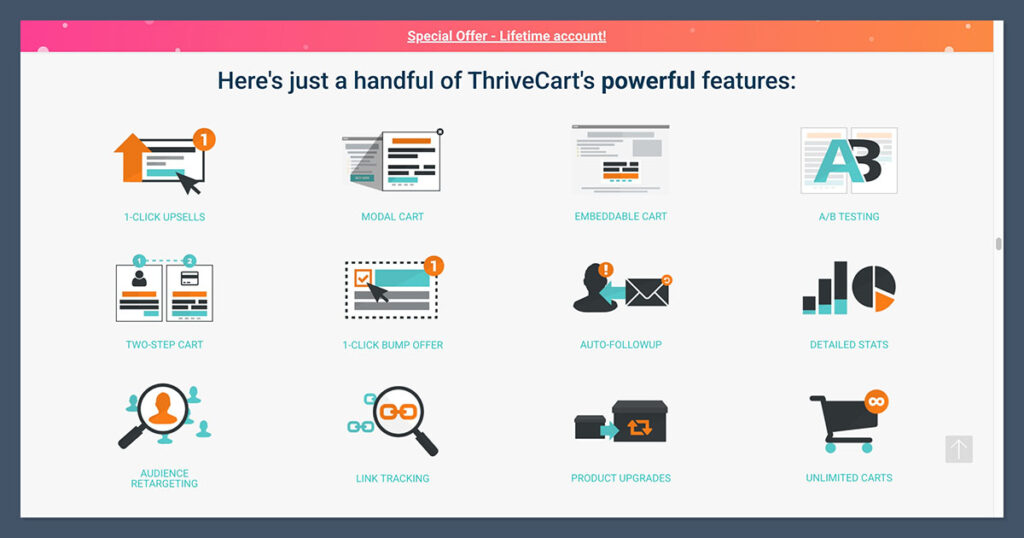
- Unlimited Order Bumps: Add-ons presented before the main purchase.
- Unlimited One-Click Upsells: Additional offers presented immediately after the initial purchase, without requiring re-entry of payment details.
- Unlimited Downsells: Offers presented if a customer declines an upsell.
- Split Testing: A/B testing of checkout pages and offers to identify the highest-converting variations.
- Affiliate Center (Pro+): A robust platform for managing and paying affiliates.
- Course Hosting (Learn/Learn+): Integrated capabilities for delivering online courses.
How Shopify Compares
Shopify’s native checkout is renowned for its speed, security, and high conversion rates, further enhanced by the convenience of Shop Pay’s one-tap checkout for returning customers. Shopify itself claims its checkout outperforms competing platforms on average.
However, features like order bumps and one-click post-purchase upsells are typically handled through third-party applications on Shopify. These apps often incur monthly fees ranging from $10 to $100 or more. Checkout page customization is also restricted unless on the Shopify Plus plan, which offers checkout extensibility. For digital sellers focused on optimizing a single sales funnel, the reliance on multiple paid apps for these conversion-enhancing features represents a significant incremental cost and complexity.
The Winner: ThriveCart owns the checkout optimization space.
Order bumps, one-click upsells, downsells, and split testing are standard features in ThriveCart, whereas they require additional app subscriptions on Shopify. Businesses whose model hinges on driving traffic to a single high-margin offer and maximizing average order value will find ThriveCart purpose-built for their needs.
4. Best for Marketing and Growth: Shopify
A high-converting checkout is only effective if customers can find it. This is where Shopify’s broader ecosystem provides a significant advantage, while ThriveCart’s specialized focus can present limitations.
SEO and Content
Shopify offers a robust suite of native SEO tools, including a blog, editable meta titles and descriptions, image alt text, automatic sitemaps, and clean URL structures. This enables merchants to build organic search traffic directly to their stores. Furthermore, Shopify’s product catalog integration with AI-driven shopping surfaces is rapidly becoming a valuable acquisition channel.
ThriveCart, lacking a storefront or content creation capabilities, has no inherent SEO functionality. Its checkout pages are not designed for organic search ranking. If organic search is a key component of a marketing strategy, ThriveCart cannot serve as a standalone solution.
Sales Channels
Shopify integrates seamlessly with a multitude of sales channels, including Instagram, TikTok, Facebook, Google, Amazon, Etsy, and eBay, synchronizing inventory across all platforms. ThriveCart does not offer multichannel selling capabilities, as it does not maintain a central product catalog for synchronization.
Email and Automation
While Shopify offers Shopify Email for basic campaigns and automations, ThriveCart does not provide native email marketing services. However, its behavioral rules are highly sophisticated. These rules allow for the tagging of customers and the triggering of automations in external email platforms based on specific actions, such as the chosen payment option, whether an order bump was accepted, or if a subscription payment failed.
The Winner: Shopify possesses the acquisition engine.
Shopify facilitates customer acquisition through organic search, social commerce, and marketplaces. ThriveCart’s role is primarily to convert traffic that is already being directed to it. This fundamental difference defines their respective purposes and strengths.
5. Easiest to Use: It Depends on the Job
Neither platform presents significant usability challenges, but their ease of use is contingent on the specific task at hand.
Shopify
Shopify’s onboarding process is streamlined, guiding users through essential setup steps with a clear checklist. Adding products, selecting themes, and configuring payments are generally straightforward. The site editor employs a section-based approach, which ensures design consistency and prevents layout breakage but offers less granular control for highly customized designs without coding. The primary complexity in Shopify often arises from managing a growing number of installed apps, each with its own settings and billing, which can lead to a cluttered administrative interface.
ThriveCart
ThriveCart’s interface is more focused, making it quicker to learn. Building a checkout page is remarkably fast: select a template, customize elements, attach upsells and order bumps, connect a payment gateway, and publish. A functional, conversion-optimized checkout can be live in under an hour. The challenge with ThriveCart lies in assembling the surrounding ecosystem. It assumes the existence of a sales page, website, email platform, and content delivery system. While the checkout setup is simple, integrating it into a complete business workflow requires managing multiple external tools.
The Winner: ThriveCart for building a single checkout, Shopify for running a business.
ThriveCart achieves faster deployment due to its narrower scope. Shopify requires a more involved setup but consolidates numerous business functions into a single platform. The choice here depends on the user’s preference for managing multiple specialized tools versus a single, integrated solution.

6. Best Design and Templates: Shopify
Shopify offers an extensive library of themes, catering to a wide range of retail categories. Many of these themes are free and robust enough for immediate launch. Premium themes typically involve a one-time purchase rather than a recurring subscription, with costs generally ranging from $100 to $400. All Shopify themes are designed to be responsive and are customizable through the intuitive section editor.
ThriveCart’s templates are specifically designed for conversion-optimized checkout pages, not for overall brand aesthetics or website design. While these templates are clean, tested, and mobile-friendly, and can be edited without code, they are confined to the checkout experience. The overall brand look and feel must be established on the platform hosting the sales page, which ThriveCart does not provide.
The Winner: Shopify, because ThriveCart is not in this race.
Shopify provides a comprehensive system for designing an entire online storefront. ThriveCart offers a well-designed checkout interface, but it does not contribute to the broader brand design or website presentation.
7. Best for Affiliate Programs: ThriveCart
This is another significant area where ThriveCart demonstrates a distinct advantage, often prompting Shopify users to integrate ThriveCart for this specific functionality.
ThriveCart’s Pro+ tier includes a fully integrated native affiliate center. Affiliates gain access to their own portal, links are tracked automatically, commissions are calculated on all sales (including upsells and bumps), and payouts can be automated via PayPal. The platform also offers a joint venture feature for revenue sharing with partners, making it a powerful tool for creators launching products with affiliate support.
On Shopify, affiliate management is typically handled by third-party applications. While many of these apps are effective, they represent an additional monthly expense, usually between $50 and $200, and operate independently of the core checkout process.
The trade-off for ThriveCart’s native affiliate functionality is its inclusion in the Pro+ tier, which is priced at $295 per year. While this is still generally more cost-effective than many Shopify app equivalents, it is not part of the initial one-time payment for the Standard plan.
The Winner: ThriveCart, comfortably.
A native affiliate center with automated payouts, seamlessly integrated into the checkout process, at an annual cost of $295, offers superior value compared to most Shopify app solutions. For entrepreneurs who rely heavily on affiliate marketing for product launches, this feature alone can justify the adoption of ThriveCart.
8. Best for Support and Stability: Shopify
Shopify provides 24/7 customer support via live chat, with options for escalation to dedicated human advisors. It also maintains an extensive Help Center, an active community forum, and a vast network of agencies and freelancers proficient in the platform. Priority support is reserved for Shopify Plus merchants. While Shopify has phased out email support, which some users find inconvenient, its overall support infrastructure is unparalleled.
ThriveCart’s support is accessible through a helpdesk and ticket system, supplemented by documentation and a user community. While adequate, it does not operate at the same scale or availability as Shopify’s 24/7 service.
A more critical consideration is platform stability. ThriveCart has undergone multiple ownership changes. Historically, long-time users reported periods of downtime, unreliable payment gateway connectivity, and limited support before the platform stabilized under new management. While development has since resumed and the product is actively maintained, this history is a relevant factor, particularly concerning the long-term viability of a "lifetime" license. The structural risk associated with any one-time payment model warrants careful consideration.
The Winner: Shopify, on both support and platform risk.
Shopify offers round-the-clock support and the most extensive partner ecosystem in the e-commerce industry. While ThriveCart’s support is reasonable, its ownership history presents a valid reason for caution when considering a prepaid lifetime access model.
How We Compared Shopify and ThriveCart
The evaluation of Shopify and ThriveCart was conducted across eight weighted categories, with feature and pricing data meticulously extracted from each vendor’s current public documentation and cross-verified against multiple independent sources. All pricing figures were confirmed against live pricing pages to ensure accuracy, a crucial step given ThriveCart’s recent shift in its Pro tier from a one-time upgrade to an annual subscription, a detail often misrepresented in older reviews.
| Criterion | Weighting | What We Assessed |
|---|---|---|
| Sales & Checkout Features | 30% | Checkout capabilities, upsells, bumps, subscriptions, split testing, cart recovery |
| Store & Catalog Features | 20% | Storefront, product catalog, inventory, shipping, multichannel selling |
| Value for Money | 15% | Total cost of ownership over one, three, and five years, including add-ons and fees |
| Marketing & SEO | 12% | Organic search capability, email tools, sales channels, affiliate management |
| Ease of Use | 10% | Onboarding, editor usability, time to a live, sellable page |
| Design & Templates | 5% | Template quality, customization depth, mobile responsiveness |
| Support | 5% | Channels, availability, documentation, partner ecosystem |
| Platform Stability | 3% | Ownership history, uptime record, development activity |
Shopify vs. ThriveCart: Our Verdict
For any entrepreneur building a comprehensive e-commerce business, Shopify stands as the superior choice. It provides an integrated solution encompassing a storefront, product catalog, inventory management, shipping, SEO capabilities, and multichannel selling, all backed by 24/7 support and the most robust partner ecosystem in the industry. ThriveCart does not attempt to replicate these foundational e-commerce functionalities.
However, for sellers focused on digital products, online courses, or coaching services, ThriveCart warrants serious consideration. Its checkout optimization features surpass Shopify’s native offerings, its affiliate center is exceptionally well-executed, and the $495 Standard license, with its absence of recurring fees, presents a significant cost advantage for businesses that do not require a full storefront.
Two critical caveats temper ThriveCart’s "lifetime deal" proposition. Firstly, the true "lifetime" aspect is primarily confined to the Standard plan; the Pro+ tier, which includes the vital affiliate center and other advanced features, renews annually at $295. Secondly, the absence of a free trial necessitates an initial purchase, with evaluation relying on the refund window.
The most practical advice for those uncertain between the two platforms is to leverage Shopify’s free trial and its $1 per month introductory offer. This allows for the validation of the need for a storefront with minimal financial outlay. If, upon building out a Shopify store, the realization dawns that the business model is centered around a single offer, a streamlined funnel, and an affiliate program, ThriveCart remains a viable and effective solution, and the decision to purchase it will be based on a clear understanding of its specific strengths.
Frequently Asked Questions
Can ThriveCart replace Shopify entirely?
ThriveCart can only replace Shopify if you are selling a limited number of digital products and have no need for a browsable storefront. ThriveCart lacks a product catalog, site builder, inventory system, and SEO capabilities. It is a checkout tool, not a full e-commerce platform. If customers need to browse, filter, and add multiple items to a cart, Shopify is the required solution.
Can I use Shopify and ThriveCart together?
Yes, many sellers successfully integrate both platforms. A common strategy involves running the main store on Shopify while utilizing ThriveCart for specialized sales funnels, such as selling high-margin digital products, courses, or affiliate offers. While direct integration is limited, requiring data reconciliation, there is no technical barrier to operating them in parallel.
Is ThriveCart’s lifetime deal actually lifetime?
The Standard plan, priced at $495, is a genuine one-time payment with no recurring fees. However, the Pro+ tier is not: it renews annually at $295 from the second year onwards and includes features like the affiliate center. ThriveCart previously offered a one-time Pro upgrade, but this has been replaced by the annual subscription model, making older reviews quoting a one-time Pro price outdated.
Does ThriveCart charge transaction fees?
No, ThriveCart does not charge any platform transaction fees on any of its plans. Users connect their own payment processor (Stripe, PayPal, Authorize.net) and pay only that processor’s standard rates. Shopify also waives platform transaction fees when using Shopify Payments but imposes a surcharge of 0.6% to 2% if a third-party gateway is used.
Which is cheaper over three years?
Shopify Basic, billed annually, costs approximately $1,044 over three years. ThriveCart Standard alone costs $495 one-time, making it significantly cheaper. However, if the Pro+ tier is necessary for features like the affiliate center, the three-year cost approaches $1,085, slightly exceeding Shopify Basic. The cost-effectiveness hinges entirely on whether one can operate solely within ThriveCart’s Standard plan limitations.
Does ThriveCart have a free trial?
No, ThriveCart does not offer a free trial or a free tier. Evaluation requires an initial purchase, with the option to request a refund within the guarantee period if the platform does not meet expectations. The stated refund window can vary, so it’s advisable to confirm the terms directly on ThriveCart’s checkout page. In contrast, Shopify provides a no-credit-card-required free trial, followed by a promotional $1 per month rate for the first three months.
Can I sell physical products with ThriveCart?
Technically, yes. ThriveCart allows for the input of shipping weights, prices, and dimensions and integrates with some fulfillment providers. However, it lacks robust inventory management, a product catalog, and comprehensive shipping rate calculation. It is suitable for selling a single physical product through a funnel but is not designed for managing a diverse range of physical goods.
Which one is better for selling online courses?
ThriveCart is generally the superior choice for selling online courses. It includes a built-in course builder and handles the checkout, upsells, and affiliate program within a single tool. While Shopify can facilitate course sales through third-party apps, this typically involves stacking multiple subscriptions. For businesses where course hosting is the primary focus, a dedicated course platform might offer a more specialized and superior teaching experience than either Shopify or ThriveCart.