Reverse Engineering the Claude AI Mascot A Technical Deep Dive into High Precision Web Animation Replicas

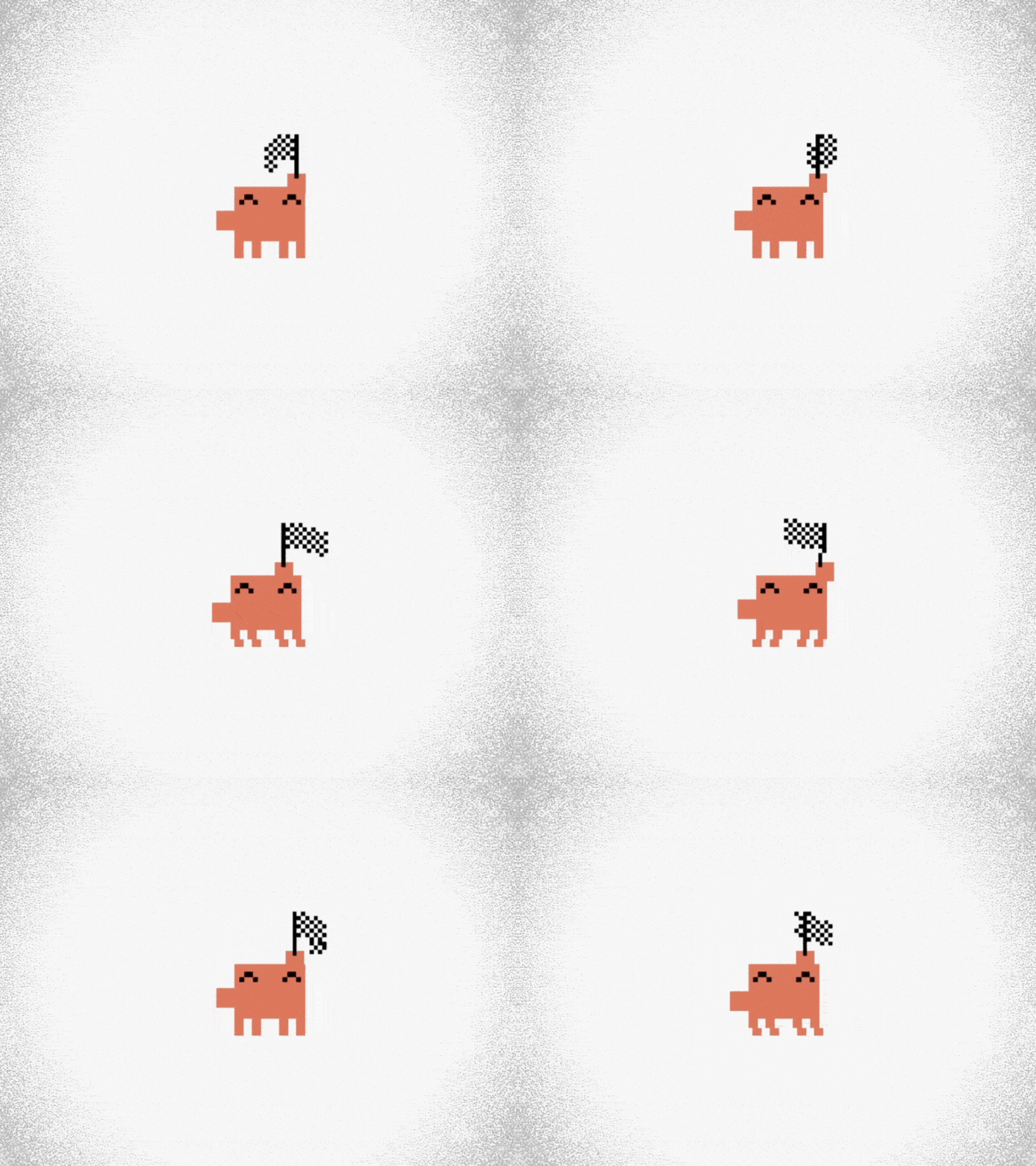
The emergence of artificial intelligence as a dominant force in the global technology sector has necessitated a shift in branding strategies, moving away from cold, industrial aesthetics toward more approachable and human-centric designs. Among the most notable examples of this trend is the Claude mascot, a pixelated, four-legged character utilized by Anthropic to personify its Claude AI model. While these animations are primarily distributed as video loops on social media platforms, a significant technical milestone was recently achieved by developer Ayotomcs, who successfully reverse-engineered and reconstructed four distinct mascot animations using only code-based web technologies. This project, completed over a four-day intensive development sprint, utilized Scalable Vector Graphics (SVG), the GreenSock Animation Platform (GSAP), and the React framework to create exact replicas of the original mascot’s movements, offering a profound look into the mechanics of high-fidelity web animation.
The Evolution of AI Branding and the Pixel Mascot
As large language models (LLMs) like Claude, GPT-4, and Gemini become integrated into daily workflows, the companies behind them have faced the challenge of "humanizing" the interface. Anthropic’s choice of a pixel-art mascot serves a dual purpose: it evokes a sense of nostalgia for the early computing era while maintaining a clean, minimalist aesthetic that scales well across various digital resolutions. The mascot’s animations—ranging from a simple walk to a celebratory confetti toss—are characterized by a sophisticated sense of weight, momentum, and personality.
The project undertaken by Ayotomcs was not merely a creative exercise but a rigorous technical challenge in reverse engineering. By slowing the original social media clips to 30% of their original speed and capturing every individual frame, the developer was able to deconstruct the "timing and easing" that give the mascot its lifelike qualities. The decision to rebuild these animations using code rather than traditional video files or GIFs represents a growing trend in front-end development toward performant, resolution-independent assets that can be manipulated in real-time.
Technical Methodology: From Pixels to Rectangles
The reconstruction of the Claude mascot relies entirely on <rect> elements within an SVG container. Unlike traditional vector art that might use complex paths or curves, the mascot is built from a collection of rectangles arranged to form a character. This structural choice mirrors the original pixel-art style while allowing for granular control over every "pixel" via CSS and JavaScript.
To drive the motion, the developer employed GSAP, a robust JavaScript library known for its high-performance animations. The technical implementation utilized three primary GSAP functions:
- gsap.to(): Used for continuous tweened motion, such as the body swaying or legs stretching.
- gsap.set(): Employed for instant frame swaps, essential for the "sprite-sheet" style movements where a character part must change shape immediately.
- gsap.timeline(): The central orchestrator used to sequence complex movements, ensuring that eyes, limbs, and environmental effects remain in perfect synchronization.
Case Study 1: The Physics of "Walking Claude"
The "Walking Claude" animation is arguably the most complex of the set, involving a sequence of looking around, crouching, and leaping. The primary technical hurdle identified during the development was the management of the character’s legs during a "lean" motion. In the original animation, the legs tilt and stretch to convey the weight of the body shifting. However, when using standard SVG scaling, the legs would often extend below the intended "ground" line, breaking the illusion of solid contact.
To solve this, the developer implemented a <clipPath>, which effectively masked any part of the leg rectangles that extended past the floor coordinates. Furthermore, the "jump" sequence required a deep understanding of parabolic motion. The horizontal movement was executed with a linear progression, while the vertical movement followed a sine.out easing for the ascent and a power3.in easing for the descent. This subtle difference in easing functions simulates the effects of gravity, providing the mascot with a sense of mass.
Case Study 2: Hybrid Animation in "Flag Waver"
The "Flag Waver" animation presented a different challenge: the interaction between a flexible object (the flag) and a rigid character. Because pixel art cannot be easily "tweened" (mathematically interpolated) without losing its sharp edges, the flag was created as a series of 12 distinct illustrations.
This resulted in a hybrid animation model. While the mascot’s body sway was handled via GSAP transforms, the flag itself functioned as a sprite sheet. A key technical detail in this reconstruction was the synchronization of the mascot’s hand with the flag’s frames. To ensure the flag remained "attached" to the wrist, the developer mapped the hand’s X-coordinates to an array of values that shifted in opposition to the flag’s wave, preventing any visual drift. This required a frame-by-frame adjustment of the svgOrigin and transform values to maintain a consistent anchor point.
Case Study 3: Synchronized Timelines in "Confetti Claude"
The "Confetti Claude" animation involved the management of three independent yet synchronized timelines. The animation features the mascot stomping in a rhythmic cycle while two separate bursts of confetti are fired from its hands.
The developer utilized a 125ms loop for the stomping motion, consisting of eight distinct SVG illustrations. The confetti bursts were treated as separate entities, using their own set of eight sprites. To create the illusion that the mascot was physically throwing the confetti, the developer introduced specific delays into the confetti timelines. The first burst was delayed by one frame duration to align with the mascot’s first hand-raise, while the second burst was delayed by six frame durations to align with the opposite stomp. This precise timing ensures that the environmental effects feel like a direct consequence of the character’s actions.
Case Study 4: The Complexity of "Gym Claude"
Despite appearing simple, the "Gym Claude" animation—featuring the mascot performing dumbbell curls—was the most labor-intensive. It eschewed almost all automated tweening in favor of a 36-frame manual sequence. The developer illustrated every position of the mascot picking up, lifting, and lowering the weight.
The "human" feel of this animation comes from the variable hold times. A uniform frame rate would make the motion appear mechanical and robotic. Instead, the developer programmed specific delays into the GSAP timeline:
- The Lift: Frames representing the peak of the curl were held for 270ms to simulate the "effort" of lifting a heavy object.
- The Repetition: A 400ms pause was inserted between repetitions to allow the character to "reset."
- The Loop: A 1.5-second delay was added at the end of the sequence before the animation restarted.
Chronology of Development
The project followed a structured timeline that highlights the efficiency of modern web development tools:
- Day 1: Research and Asset Creation. The developer identified the source material and began the process of frame-by-frame deconstruction. This involved creating the base SVG structures for the mascot.
- Day 2: Core Motion Implementation. Work began on "Walking Claude," focusing on the physics of the jump and the implementation of the clip mask.
- Day 3: Hybrid and Sprite Logic. The "Flag Waver" and "Confetti Claude" animations were developed, requiring the creation of multiple sprite frames and the logic to sync them with GSAP timelines.
- Day 4: Fine-Tuning and Optimization. The final "Gym Claude" frames were illustrated, and the variable timing logic was implemented. The project was then integrated into a React environment for final testing and deployment.
Industry Implications and Technical Analysis
The successful replication of these animations has broader implications for the field of web design and brand identity. Traditionally, complex character animations were the domain of motion designers using tools like Adobe After Effects, with the final output being a heavy video file. By demonstrating that these same results can be achieved through SVG and GSAP, this project highlights several advantages:
- Performance and Scalability: SVG-based animations have a negligible file size compared to high-resolution video. Furthermore, because they are vector-based, they remain crisp at any zoom level or screen resolution.
- Accessibility and SEO: Unlike video files, SVG code is readable by screen readers and can be indexed by search engines, contributing to a more accessible web.
- Dynamic Interactivity: Code-based animations can be made interactive. While these replicas are currently loops, the underlying structure allows for the mascot to react to user input, such as mouse hovers or click events, in ways that a pre-rendered video cannot.
Reactions and Community Impact
The project has garnered significant attention within the web development community. GreenSock, the creators of the GSAP library, officially recognized the work, awarding the developer a merchandise bundle for the technical excellence displayed in the replication. This recognition underscores the value of "creative coding"—the intersection of traditional animation principles and modern software engineering.
In an era where AI is often viewed through the lens of complex algorithms and data processing, projects like the Claude mascot reconstruction remind the industry of the importance of the user interface. The mascot is more than a decorative element; it is a bridge between the user and the machine. By mastering the code behind the mascot, developers are able to exert greater control over the "personality" of the AI products they build.
Conclusion
The reconstruction of the Claude AI mascot serves as a definitive case study in the power of modern front-end technologies. Through the strategic use of SVG, GSAP, and React, Ayotomcs has proven that the nuanced, weighted motion of professional character animation can be successfully translated into the language of the web. As AI companies continue to compete for user trust and engagement, the role of high-quality, performant animation will only grow in significance, making the technical insights gained from this project a valuable blueprint for future digital branding.