Replacing Fragile Configuration Dictionaries with Python Dataclasses for Structured Application Data


The evolution of modern software architecture has shifted significantly toward modularity and type safety, yet many developers still rely on the archaic practice of using nested dictionaries to manage configuration data. This approach, while initially convenient, often leads to "configuration rot," where silent errors, misspelled keys, and inconsistent data shapes propagate through complex systems. As Python applications scale, the lack of a formal schema for internal data structures frequently becomes a bottleneck for reliability. Since the introduction of the dataclasses module in Python 3.7, developers have been equipped with a robust, standard-library solution to replace these fragile dictionaries with structured, readable, and maintainable models.
The Problem with Loose Dictionary Configurations
The reliance on dictionaries for configuration is a common pitfall in data engineering and batch-processing pipelines. In a typical scenario, a configuration dictionary might define parameters for a job, such as batch sizes, retry logic, and output formats. Because dictionaries do not enforce a schema, a simple typographical error—such as config.get("batchsize") instead of config.get("batch_size")—may pass silently. In a production environment, this could lead to the system defaulting to an unintended value without triggering an alert.
These "quiet failures" are costly. When three or four different modules consume the same dictionary, any inconsistency in how they interpret or modify that data creates a state of fragmentation. Debugging such issues often requires tracing execution across multiple files to determine where the data structure diverged from its expected shape. This lack of visibility is why, according to recent industry developer surveys, runtime type errors and data integrity issues remain the leading causes of downtime in Python-based backend systems.
A New Paradigm: The Dataclass Approach
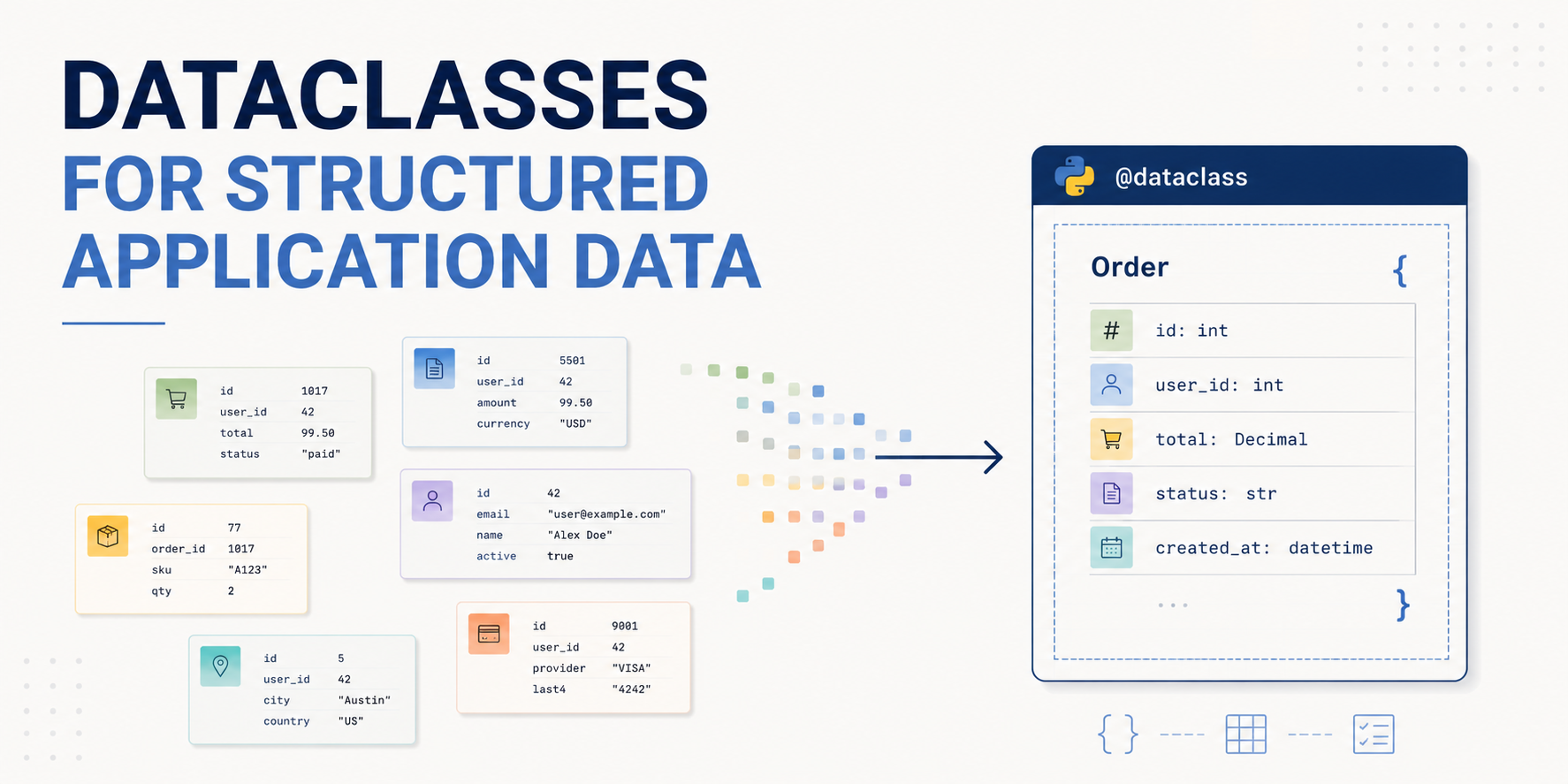
Python’s dataclasses decorator offers a declarative approach to data management. By defining a class with typed fields, developers create a contract that both humans and IDEs can verify. When a class is decorated with @dataclass, Python automatically generates the __init__, __repr__, and __eq__ methods, effectively eliminating the need for repetitive boilerplate code.
Crucially, the use of dataclasses shifts the burden of validation from runtime string-key lookups to compile-time or static analysis. If a developer attempts to access an attribute that does not exist, modern IDEs and static type checkers like mypy or pyright will flag the error immediately. This transition from "loose strings" to "hard attributes" represents a fundamental upgrade in code hygiene.
Chronology of Data Modeling in Python
The progression of data modeling in the Python ecosystem reflects the language’s maturity:
- Pre-2018 (The Dictionary Era): Reliance on raw
dictstructures andcollections.namedtuple. These provided minimal structure but lacked flexibility, particularly regarding default values and mutability. - 2018 (PEP 557): The introduction of the
dataclassesmodule in Python 3.7. This provided a standardized way to define data-heavy classes, allowing for type annotations and mutable default values viafield(default_factory=...). - 2020-Present (The Pydantic Era): The rise of third-party libraries like Pydantic, which introduced runtime data validation and serialization. This has created a clear hierarchy: standard
dataclassesfor internal, trusted data; and Pydantic for untrusted input at the system boundaries.
Implementing Nested Composition
As applications grow, a single class often becomes insufficient. The "God Object" pattern—a single class holding fifty unrelated fields—is as problematic as a massive, monolithic dictionary. The solution is composition. By breaking configurations into smaller, logical blocks, such as RetryPolicy, OutputConfig, and JobConfig, developers can create a hierarchical structure that is easier to unit test and maintain.
When using composition, it is vital to remember that Python does not perform recursive type conversion automatically. If a dictionary is passed to a constructor expecting a nested dataclass, the dataclass will store the dictionary as-is. This is a design choice that preserves performance and keeps the library lightweight. Consequently, developers must write explicit instantiation logic or custom from_dict factory methods to ensure the hierarchy is correctly materialized.
Enforcing Invariants and State Management
One of the most powerful features of dataclasses is the __post_init__ hook. While the initializer handles basic value assignment, __post_init__ allows for custom validation logic. For instance, if a batch_size must be greater than zero or a retry_limit must fall within a specific range, these invariants can be enforced immediately upon object creation.
Furthermore, the frozen=True parameter provides a mechanism for immutability. By freezing a configuration object, developers ensure that once a job has been initialized, its parameters cannot be altered by downstream functions. This prevents "action at a distance" bugs, where one function inadvertently changes a global configuration value, causing unpredictable side effects elsewhere in the application.
Serialization and the Boundary Principle
The interface between a system and the outside world—such as loading configuration from a JSON file or sending data to an API—is the most common point of failure. While dataclasses.asdict() provides a quick way to serialize data, it is not a "magic bullet" for complex objects like datetime or Decimal.
Industry best practices suggest that serialization should be handled with intentionality. Rather than relying on automated recursive serialization, developers should define clear mapping functions. This ensures that the data structure is explicitly translated from the application’s internal representation to the wire-format representation, allowing for custom encoding of complex types.
Comparative Analysis: Choosing the Right Tool
The selection of a data modeling tool depends heavily on the "trust level" of the data.
| Feature | dict |
dataclass |
Pydantic |
|---|---|---|---|
| Best Use Case | Ephemeral, short-lived data | Trusted, internal structures | External, untrusted input |
| Validation | Manual (if any) | __post_init__ hooks |
Automatic coercion/schema |
| Performance | High (native) | High (low overhead) | Moderate (validation overhead) |
| Dependencies | None | None (Stdlib) | Third-party required |
For internal state management, dataclasses provide the best balance of performance and structure. They impose zero overhead on the production runtime while offering significant benefits in terms of developer productivity and code clarity.
Broader Implications for Engineering Teams
The adoption of structured data models is not merely a stylistic preference; it is an organizational necessity. Teams that move away from raw dictionaries report faster onboarding times for new engineers, as the codebase serves as its own documentation. When an object’s shape is defined in a class, new developers can instantly see what fields are available and what types are expected, without needing to run the code or parse legacy JSON logs.
In large-scale systems, the shift to dataclasses facilitates better testing. Because dataclasses support equality comparison out of the box, asserting the state of a configuration object in a unit test becomes trivial. Instead of checking if config["key"] == "value", a developer can simply compare two objects: assert config == expected_config.
Ultimately, the transition from dictionaries to dataclasses represents a shift toward defensive programming. By making data structures explicit, developers create a contract that guards against the most common class of runtime errors. While the initial investment in defining classes may seem like extra effort, the long-term dividend in system stability, reduced debugging time, and improved code readability is immense. In a professional environment, where code is read far more often than it is written, clear and structured data models are one of the most valuable assets a team can maintain.