Meta Navigates Pivotal Q1 2026 with First-Ever User Decline Amidst Soaring Revenue and Massive AI Investments

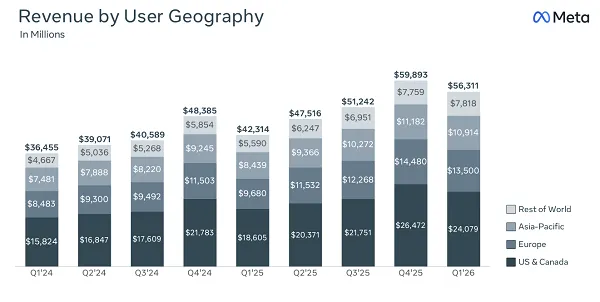
Meta Platforms Inc. has reported its performance for the first quarter of 2026, revealing a period of significant strategic shifts and contrasting financial metrics. The technology giant, which has aggressively pivoted towards an AI-centric future, announced a notable milestone: a slight but unprecedented drop in its daily active user (DAU) count across its family of applications. Despite this dip in user engagement, the company simultaneously posted robust revenue growth, largely driven by increased advertising impressions and higher ad prices. This mixed report underscores Meta’s ambitious, costly bet on artificial intelligence, a strategy that is both fueling impressive financial returns in the short term and necessitating substantial operational adjustments.
Unprecedented User Contraction: A Closer Look at the 3.56 Billion
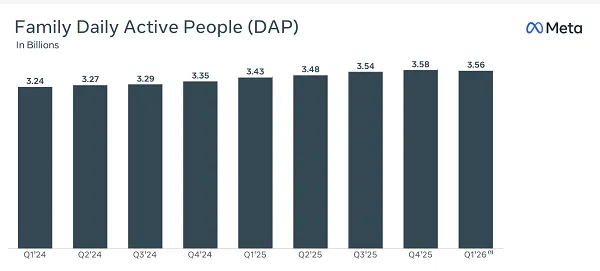
For the first time in its history, Meta’s daily active user count experienced a decline, settling at 3.56 billion across its suite of applications, including Facebook, Instagram, WhatsApp, and Messenger. This figure represents a marginal decrease from the 3.58 billion DAU reported in the preceding quarter, Q4 2025. While seemingly minor, this contraction carries significant symbolic weight for a company long defined by its relentless user growth trajectory. The dip comes despite Meta’s continued efforts to expand its user base through new offerings like Threads, its microblogging platform, and the recently launched Meta AI app, both designed to capture new demographics and increase engagement within its ecosystem.
Meta attributed this unexpected user decline to a confluence of external factors and evolving regulatory landscapes. Foremost among these were internet disruptions experienced in Iran, which significantly hampered access for users in the region. Such disruptions, often politically motivated, can severely impact the connectivity and reach of global platforms. Simultaneously, the company cited restrictions on access to WhatsApp in Russia as a contributing factor. Russia has progressively tightened its grip on foreign social media and messaging applications, culminating in a ban on WhatsApp alongside other Meta platforms like Facebook and Instagram. This move is part of a broader governmental strategy to promote state-owned messaging tools and exert greater control over information flow, effectively severing millions of users from Meta’s services.
Adding to these geopolitical challenges, Meta acknowledged potential user attrition in Australia following the implementation of new social media restrictions aimed at protecting teenagers. Global regulatory bodies are increasingly scrutinizing the impact of social media on youth, leading to stricter age verification processes and content controls. While these measures are intended to foster safer online environments, they can inadvertently lead to a decrease in reported user numbers as platforms adjust to new compliance requirements. The combination of these factors paints a picture of a company navigating an increasingly fragmented and regulated global digital landscape, where sustained organic user growth can no longer be taken for granted.
Revenue Surge Defies User Dip: The Advertising Powerhouse
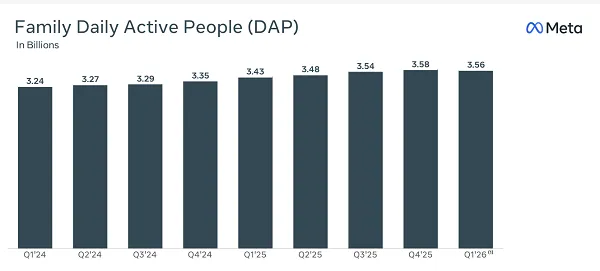
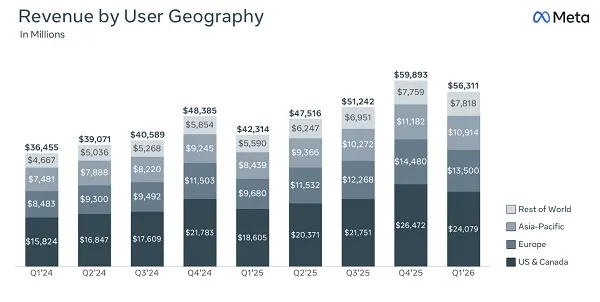
In stark contrast to its user figures, Meta’s financial performance for Q1 2026 was exceptionally strong. The company reported a substantial revenue of $56.31 billion for the quarter, marking an impressive 33% increase year-over-year. This significant growth underscores Meta’s enduring power as a digital advertising giant, demonstrating its capacity to monetize its vast user base effectively, even in the face of a slight contraction. The ability to generate such robust revenue despite fewer daily active users points to a sophisticated and optimized advertising engine.
Two primary drivers underpinned this revenue surge: a considerable increase in ad impressions and a notable rise in the average price per advertisement. Ad impressions delivered across Meta’s family of apps grew by 19% year-over-year. This indicates that advertisers are placing more ads, or Meta is integrating more ad placements into its user experience, across its various platforms. This could manifest as more ads in Instagram feeds, Facebook Reels, or within other content streams. Concurrently, the average price advertisers paid per ad increased by 12% year-over-year. This rise in ad pricing can be attributed to several factors: strong demand from advertisers, Meta’s continued enhancements in ad targeting capabilities (often AI-powered), and potentially a shift towards higher-value ad formats such as video or interactive ads that command premium rates.
The resilience of Meta’s advertising revenue in Q1 2026 reflects a broader trend in the digital advertising market, which continues to be a dominant force for businesses seeking to reach consumers. Despite macroeconomic uncertainties, digital ad spending has shown remarkable robustness, with platforms like Meta benefiting from their extensive reach and advanced targeting tools. For Meta, this robust advertising performance is critical, providing the financial bedrock necessary to fund its ambitious and capital-intensive investments in artificial intelligence. The increased ad load and higher prices, while effective in boosting the top line, also highlight the delicate balance the company must maintain between monetization and user experience to prevent potential long-term disengagement.
Strategic Pivot to AI: Investment, Innovation, and Strain
Meta’s Q1 2026 report cannot be fully understood without acknowledging its overarching strategic commitment to artificial intelligence. CEO Mark Zuckerberg has repeatedly emphasized that AI is the company’s foremost priority, a strategic pivot that entails unprecedented levels of investment. Meta is pouring hundreds of billions of dollars into developing and deploying AI infrastructure, a monumental undertaking that includes building vast data centers, acquiring cutting-edge GPUs, and recruiting top-tier AI talent globally. This massive expenditure is aimed at embedding AI across all facets of Meta’s operations – from enhancing ad targeting and content recommendation algorithms to developing advanced generative AI capabilities and powering its metaverse ambitions.
The scale of this investment is directly reflected in Meta’s soaring operational costs. Total costs and expenses for Q1 2026 reached $33.44 billion, representing a significant 35% increase year-over-year. This substantial rise is largely attributable to the aggressive ramp-up in AI-related research, development, and infrastructure. The company’s vision for AI extends beyond mere operational improvements; it envisions AI as the foundational layer for future products and services, including more intelligent virtual assistants (like Meta AI), sophisticated Llama large language models, and immersive experiences within its Reality Labs division.
The financial strain imposed by these AI investments is palpable. Meta is currently in a phase where it must invest heavily upfront, with the expectation of significant returns in the long run. This necessitates a careful balancing act between aggressive spending on future growth engines and maintaining profitability. It also explains some of the operational adjustments the company has undertaken, such as staff reductions in certain divisions, as it seeks to rationalize costs where possible to free up capital for its AI endeavors.
Operational Adjustments and Headcount Dynamics
In response to the colossal financial outlay required for its AI initiatives and a broader push for efficiency, Meta has continued to implement significant operational adjustments. The company has publicly announced several rounds of staff cuts, following its "year of efficiency" in 2023. These layoffs, including specific reductions within its Reality Labs division, are part of a strategic effort to streamline operations, reduce overheads, and reallocate resources more effectively towards its core AI priorities. By trimming less critical or underperforming segments, Meta aims to create a leaner, more focused organization capable of executing its AI vision.
Despite these targeted layoffs, Meta’s overall headcount experienced a modest 1% increase year-over-year. This seemingly contradictory trend highlights the company’s strategic reallocation of human capital. While some divisions saw reductions, there was aggressive hiring in specialized AI-related roles, including AI researchers, engineers, and data scientists. This influx of AI talent is crucial for developing and deploying the advanced models and infrastructure necessary to realize Meta’s long-term ambitions. The shift in headcount underscores a fundamental transformation within the company, moving resources from less strategic areas to those deemed critical for future innovation and competitive advantage.
Within this context, the Reality Labs division, Meta’s arm responsible for metaverse development, showed a slight reduction in losses during Q1 2026. This indicates that the staff cuts and efficiency measures implemented within this segment are beginning to yield results, even as the division remains a significant long-term investment. While the metaverse vision remains a core part of Meta’s distant future, the immediate focus has clearly shifted to AI as the foundational technology that will enable both its current advertising business and future immersive experiences.
Broader Implications and Future Outlook
Meta’s Q1 2026 report is a testament to a company in dynamic transition, grappling with both immediate challenges and immense long-term opportunities. The first-ever decline in daily active users, while minor in scale, serves as a critical indicator of market saturation in some regions and the increasing impact of geopolitical and regulatory headwinds. Sustaining user growth will require Meta to innovate beyond its traditional growth drivers and navigate an increasingly complex global environment. The company faces the continuous challenge of balancing an optimized ad load with a positive user experience, ensuring that increased monetization does not alienate its vast audience.
Conversely, Meta’s robust revenue growth, driven by an impressive increase in ad impressions and pricing, showcases the unparalleled strength of its advertising platform. This monetization engine is not only resilient but also demonstrates the potential for AI to enhance ad targeting and performance, thereby increasing value for advertisers. The billions being invested in AI are expected to further refine these capabilities, potentially unlocking new revenue streams and making Meta’s platforms even more indispensable for businesses.
The long-term success of Meta’s ambitious AI bets remains the most significant variable. The immense cost and the uncertain timeline for a full return on these investments present a considerable financial risk. However, the potential rewards are equally vast. If Meta successfully integrates advanced AI across its products, it could revolutionize user engagement, content creation, and personalized experiences, cementing its position at the forefront of the next wave of technological innovation. The company’s ability to adapt, evidenced by its aggressive shift towards AI and its operational rationalization, suggests a pragmatic approach to navigating a competitive landscape.
In conclusion, Q1 2026 marks a pivotal juncture for Meta. It highlights the company’s resilience in monetizing its vast platforms while simultaneously signaling the profound strategic reorientation towards artificial intelligence. Despite the unprecedented user decline, Meta’s continued ability to generate substantial revenue underscores its foundational strength. The success of its massive AI investments will be the defining factor in its future trajectory, determining whether it can sustain its dominance and innovate its way through an increasingly complex and regulated digital world. The coming quarters will be crucial in observing how these strategic bets begin to pay off and how Meta balances its pursuit of future technologies with the demands of its current business.