How to verify content indexation and retrieval in the era of AI-driven search engines

For over two decades, the "site:" search operator has served as the primary diagnostic tool for search engine optimization (SEO) professionals. By entering "site:domain.com" into Google or Bing, practitioners could instantly ascertain whether specific pages had been crawled and indexed. This method, while rudimentary, provided a critical window into the visibility of a website. However, as the digital ecosystem shifts toward generative AI-powered search and large language model (LLM) interfaces, these legacy diagnostic methods are becoming increasingly insufficient. Modern SEO requires a more nuanced approach to understand how content is being retrieved, cited, and processed by artificial intelligence, moving beyond simple index verification to a deeper analysis of retrieval mechanisms.
The Evolution of Indexing and Retrieval Diagnostics
The fundamental challenge in the current search landscape is that traditional search indices—which rely on boolean queries and keyword matching—are being augmented or replaced by RAG (Retrieval-Augmented Generation) systems. In these environments, a page might exist within an index but remain inaccessible to the conversational interface of a chatbot, or vice versa.
Historically, SEOs relied on the "site:" operator to confirm presence. If a page was missing, the diagnosis was straightforward: the page was either blocked by a robots.txt file, lacked internal linking, or had not yet been crawled by the search engine’s spiders. Today, the complexity has increased. An LLM may "know" of a page’s existence through its training data but fail to retrieve it during a live search query if the content is not deemed relevant, authoritative, or technically accessible to the model’s real-time crawling infrastructure.
A New Methodology for AI Retrieval Testing
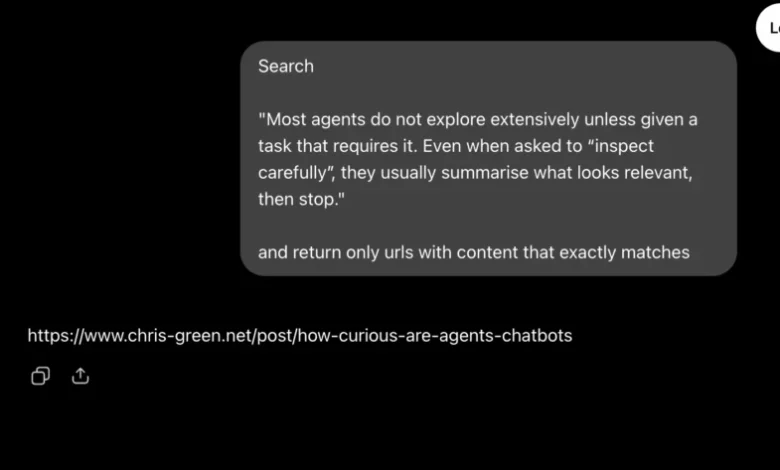
To bridge the gap between traditional indexing and AI visibility, professionals are adopting a "snippet-matching" technique. By taking a unique, substantive segment of text from a specific page and enclosing it in quotation marks within a prompt—such as "Search for ‘paste your snippet here’ and return any results which contain that exact text only"—users can force the AI to conduct a targeted retrieval.
This process functions as a proxy for how a search engine perceives the content’s uniqueness and indexability. When a chatbot successfully retrieves the exact source, it confirms that the page has been successfully indexed and is considered relevant enough by the system’s ranking algorithms to be included in its active retrieval pool.
Chronology of Search Verification Tools
The trajectory of search diagnostics has moved from simple to complex:
- The Early 2000s (The Operator Era): The introduction of the "site:" operator and the "cache:" command allowed for manual verification of database inclusion.
- The 2010s (The Console Era): The maturation of Google Search Console (GSC) and Bing Webmaster Tools (BWT) provided direct, server-side data, effectively ending the need for guesswork regarding crawl status and error codes.
- The 2024–2025 Transition (The AI Era): As platforms like ChatGPT, Perplexity, and Gemini integrated live web-browsing capabilities, the focus shifted from "is the page indexed" to "is the page retrievable by a generative agent."
Technical Implications of Retrieval Failures
If a page fails to appear during a targeted snippet search, the implications are significant. The failure typically stems from one of four primary areas:
- Discovery Bottlenecks: The search engine’s crawler has not yet discovered the page, often due to an absence of internal links or a lack of sitemap submission.
- Indexing Constraints: Even if discovered, the page may be excluded due to low quality, redundant content, or technical directives (such as "noindex" tags) that are strictly honored by the AI’s crawling agent.
- Retrieval Filtering: The system may have indexed the page, but the generative model’s internal weighting system deems the content insufficient to meet the criteria for a live, cited response.
- Temporal Delays: AI-driven search systems often operate on different update cadences compared to traditional web indices. A page that appears in Google Search may take significantly longer to propagate into the live retrieval databases of conversational AI agents.
Data-Driven Analysis of Search Visibility
Recent data indicates that the "source-call" mechanisms used by major AI chatbots are inconsistent. When testing a specific snippet, researchers have observed that a single prompt may yield different results across successive attempts. This variance occurs because AI search tools often draw from a distributed network of secondary indices.

To reach a statistically significant conclusion regarding a page’s retrieval status, analysts recommend performing the snippet test at least four to five times. If the result is inconsistent, it suggests that the page exists in a precarious state of indexation, potentially appearing in some data centers but not others. This is a common phenomenon for newly published content or sites with lower domain authority.
Industry Responses and Future Workflows
As this issue gains traction, the SEO community has begun developing specialized tools to automate these checks. The emergence of experimental projects, such as the "Exactly Matchy" browser extension, reflects a desire to formalize what was once a manual, time-consuming process. These tools work by automating the extraction of a page’s unique text and programmatically querying an LLM to confirm its presence.
However, industry experts caution against over-reliance on these workarounds. As stated in recent discussions among search practitioners, these methods are not a substitute for the comprehensive data provided by Google Search Console or Bing Webmaster Tools. They are merely diagnostic tools meant to supplement a robust technical SEO strategy.
Broader Impact on Digital Strategy
The inability of a page to be retrieved via an AI search query has direct economic consequences for businesses. If a page cannot be cited by a generative model, it will likely be excluded from the "answer" portion of a search result, which is increasingly where user intent is captured.
This necessitates a pivot in content strategy. The focus is shifting from "keyword density" to "retrievability and citation worthiness." Content that is distinct, high-value, and technically optimized for machine reading is significantly more likely to be retrieved. Conversely, generic or thin content is increasingly marginalized, as modern algorithms are better equipped to filter out information that does not provide a clear, unique answer to a user’s query.
Conclusion and Best Practices
While the "site:" operator remains a cornerstone of traditional SEO, it is no longer the definitive measure of a page’s reach. In an environment where AI-driven answers are becoming the primary interface for information consumption, verifying that a page is actually "retrievable" is the new benchmark for success.
For organizations looking to maintain visibility, the following workflow is recommended:
- Prioritize Official Data: Always defer to Google Search Console or Bing Webmaster Tools for definitive status reports on indexing and crawl errors.
- Conduct Targeted Snippet Tests: Use the manual snippet-search method to gauge how third-party AI models perceive and prioritize your content.
- Address Foundational Issues: If retrieval fails, focus on the fundamentals—ensure clear internal linking, improve site performance, and audit for technical barriers.
- Adopt Emerging Tools with Caution: While automated extensions can expedite the process, they should be treated as developer-grade tools. Always inspect the source code of any browser extension used to ensure it does not compromise site data or privacy.
As the landscape continues to evolve, the distinction between "indexed" and "retrievable" will likely become the most critical metric for search professionals, marking a new chapter in the ongoing effort to align web content with the sophisticated retrieval mechanisms of modern search technology.