Amazon Bridges Digital Advertising and Conversational AI Through Strategic Partnership with OpenAI to Bring DSP Campaigns to ChatGPT


The landscape of digital advertising is undergoing a profound structural evolution as retail media networks and conversational artificial intelligence platforms converge. In a significant development for the marketing industry, Amazon has announced a strategic partnership with OpenAI that will allow advertisers utilizing the Amazon Demand-Side Platform (DSP) to seamlessly extend their digital campaigns directly into ChatGPT. This collaboration represents a major milestone in the commercialization of generative AI interfaces, offering brands unprecedented access to the rapidly expanding advertising inventory housed within one of the world’s most popular conversational platforms.
Under the initial framework of this partnership, ChatGPT advertising inventory is being made available through the Amazon DSP as a managed service. This operational model ensures that Amazon provides comprehensive support to brands, helping them configure, launch, and optimize their campaigns within the AI environment without requiring them to interface directly with OpenAI’s native advertising infrastructure. While the initiative holds global implications for the future of digital marketing, the pilot program is strictly limited to the United States at launch, featuring a carefully curated group of early participants, including prominent national brands such as Delta Vacations.
The Genesis and Strategic Context of the Collaboration
To fully understand the weight of this partnership, one must examine the broader trajectories of both companies over recent years. Amazon has steadily solidified its position as an advertising powerhouse, leveraging its immense ecosystem of retail shopping data, Prime video streaming analytics, and third-party merchant insights to create one of the most effective targeting engines in digital history. The Amazon DSP has long served as a vital tool for brands seeking to reach targeted audiences across connected television, display, and audio channels.
Simultaneously, OpenAI has transformed ChatGPT from a groundbreaking research preview into a ubiquitous digital utility utilized by hundreds of millions of active users worldwide. As the platform scaled, the economic imperative to monetize this massive user base through non-intrusive advertising became increasingly clear. However, building an enterprise-grade programmatic advertising network from scratch presents formidable logistical, operational, and sales challenges. By partnering with Amazon, OpenAI gains immediate, frictionless access to a mature, highly sophisticated pool of advertisers who are already accustomed to managing large-scale programmatic budgets.
This synergy solves a primary pain point for modern marketers: fragmentation. As digital touchpoints multiply across social media, retail sites, streaming services, and AI chatbots, managing disparate ad servers and bidding systems becomes increasingly inefficient. By routing ChatGPT inventory through the Amazon DSP, the partnership bridges the gap between Amazon’s formidable retail intelligence and OpenAI’s conversational context, creating a unified workflow for media buyers.
Mechanics of the Integration: How the Amazon DSP and ChatGPT Bridge Works
From a technical and operational standpoint, the integration is designed to balance ease of use for marketers with strict platform governance by OpenAI. Advertisers leveraging the Amazon DSP can now tap into ChatGPT inventory on both a cost-per-click (CPC) and cost-per-mille (CPM) pricing basis. Furthermore, Amazon is introducing robust product feed ads that automatically generate dynamic ad assets by pulling directly from advertisers’ existing product catalogs.
When users interact with ChatGPT, sponsored placements will appear as distinct text and image units positioned neatly beneath organic conversational responses. To maintain transparency and user trust, these units will carry clear, prominent sponsored labels, distinguishing them from the AI’s unprompted narrative output.
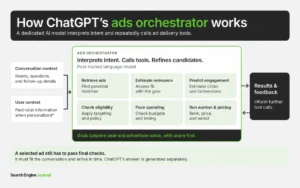
Despite Amazon’s role in facilitating the purchase and management of these campaigns, the partnership maintains a clear division of operational responsibilities. Buying through the Amazon DSP does not grant Amazon proprietary control over where or when an ad appears within a specific ChatGPT session. OpenAI retains absolute authority over ad delivery, relevance matching, and placement logic through its own proprietary systems.
This creates a distinct split in the architecture of the campaign: Amazon acts as the financial transaction layer and campaign-management gateway, while OpenAI acts as the sovereign publisher controlling the user experience and ad serving within its application.

Data, Measurement, and Attribution Capabilities
In the realm of digital advertising, robust measurement and attribution are non-negotiable requirements for enterprise brands committing substantial budgets to new channels. Recognizing this, the initial pilot program provides participating advertisers with comprehensive, aggregated performance reporting. Brands will have access to granular metrics including total impressions, click-through volumes, cost per result, CPM, and CPC figures.
However, the true value proposition of the Amazon-OpenAI integration lies deeper within the realm of audience insights. Advertisers stand to benefit from combining Amazon’s deterministic shopping and streaming data with ChatGPT’s contextual understanding of user intent. For example, a user inquiring about travel itineraries or vacation planning within ChatGPT could be served hyper-relevant ads informed by broader consumer behavior patterns captured across Amazon’s retail ecosystem.
This blending of retail intent and conversational intent opens up fascinating possibilities for both endemic brands—those that sell products directly on Amazon—and non-endemic brands, such as financial institutions, insurance providers, and service-based companies that do not sell physical goods on Amazon’s marketplace but regularly utilize its DSP to reach high-value audiences across the open web.
Broader Industry Implications and Market Reactions
Industry analysts and marketing executives have responded to the announcement with cautious optimism, viewing it as a logical next step in the maturation of generative AI commercial models. For non-endemic advertisers in particular, the partnership offers a low-friction entry point into conversational advertising without requiring a foundational retail presence on Amazon.
Furthermore, the collaboration signals a growing trend toward interoperability among major technology giants. Historically, walled gardens have sought to keep ad inventory and data tightly restricted within their own proprietary ecosystems. By opening ChatGPT inventory to an external DSP like Amazon’s, OpenAI is demonstrating a willingness to leverage established enterprise sales channels to accelerate its monetization timeline.
Conversely, this move reinforces Amazon’s strategic ambition to position its advertising technology as an indispensable utility across the entire digital landscape—extending far beyond its own e-commerce storefront and streaming properties. By positioning itself as a universal gateway to emerging ad channels, Amazon enhances the long-term utility and stickiness of its DSP for major media agencies and brands.
Future Outlook and What to Watch
As the initial U.S. pilot program unfolds, industry observers will be monitoring several critical variables to gauge the long-term viability and scalability of the partnership:
- Geographic Expansion: Will OpenAI and Amazon look to expand DSP access to international markets, and if so, what regulatory and privacy hurdles, such as the European Union’s General Data Protection Regulation (GDPR), will they need to navigate?
- Advertiser Adoption: How robust will demand be from large-scale enterprise brands, and will smaller, mid-market advertisers gain access to the inventory in subsequent phases?
- User Experience and Engagement: How will regular ChatGPT users respond to the introduction of sponsored text and image units beneath organic responses, and will ad load impact platform retention or satisfaction?
- Competitive Response: How will rival conversational AI platforms—such as Google Gemini, Microsoft Copilot, and Anthropic’s Claude—respond to this advertising model, and will they forge similar alliances with competing retail media networks or ad tech giants?
Bottom Line
The partnership between Amazon and OpenAI marks a defining moment in the evolution of digital advertising, successfully bridging the gap between transactional retail media and conversational artificial intelligence. While Amazon serves as the vital gateway and campaign-management layer for brands, OpenAI retains absolute control over its platform’s user experience and ad delivery. As the initial U.S. pilot progresses with early adopters like Delta Vacations, the marketing industry will be watching closely to see how this powerful convergence of data, intent, and AI shapes the future of brand discovery and consumer engagement.