Google Analytics Unveils Advanced AI, Attribution, and Budgeting Tools to Redefine Enterprise Marketing Intelligence

Over the past year, Google Analytics has introduced a comprehensive suite of advanced features designed to elevate digital analytics from historical reporting to predictive decision-making. These updates aim to provide finance, marketing, and executive leadership teams with sophisticated tools for Answer Engine Optimization tracking, multi-touch attribution analysis, cross-channel budgeting, and conversational data querying. As digital ecosystems evolve past traditional search engine optimization, these platform capabilities seek to bridge the gap between passive data collection and active strategic execution.
The rollout of these capabilities addresses structural shifts in how consumers discover brands and how organizations allocate marketing capital. Industry analysts note that contemporary analytics demands moving beyond last-click attribution toward predictive modeling that accounts for complex, multi-touch consumer journeys. Google’s latest feature deployments reflect this market reality, emphasizing forward-looking metrics, automated scenario planning, and unified data structures.
Tracking the Rise of Answer Engine Optimization
One of the most significant additions to the platform is the native integration of the AI Assistant channel within standard traffic acquisition reports. This development comes as retail and enterprise data highlights a fundamental transformation in search behavior. Major industry studies published in early 2026 by Adobe and Shopify indicated that traffic referred by conversational AI agents converts significantly better—often showing higher average order values and longer on-site engagement—than traditional organic search traffic, despite commanding a smaller overall volume share.
Historically, tracking traffic from artificial intelligence platforms required complex regular expression configurations. The new native channel group automatically categorizes traffic under the medium ai-assistant, providing immediate visibility into session counts, engagement rates, key event rates, and revenue generation. However, digital marketers face notable nuances and limitations. The categorization relies on a dynamic roster of large language models that fluctuate over time, and mobile or desktop application traffic often defaults to direct entry points if referral headers are stripped. Furthermore, search engine providers frequently classify their own integrated AI overviews under traditional organic search, leading many analysts to advocate for custom supplementary tracking mechanisms to capture the true footprint of conversational commerce.
Revitalizing Multi-Touch Attribution and Assisted Conversions
To counter the limitations of single-touch attribution models, Google Analytics has expanded its conversion attribution analysis capabilities within the advertising reporting suite. This update places renewed emphasis on assisted conversions, allowing teams to evaluate how upper-funnel and mid-funnel channels contribute to customer journeys that ultimately close through other touchpoints.
Rather than relying solely on last-click metrics, which can undervalue introductory channels like paid social or display advertising, the platform employs a refined funnel analysis to segment touchpoints into early, middle, and late stages. Analysts can quantify the exact share of data-driven conversion credit assigned across these phases. Industry experts stress that while assisted conversions provide vital context, they must be paired with macro and micro-conversion definitions to avoid data inflation and ensure accurate alignment with customer acquisition costs.
Predictive Cross-Channel Budgeting and Scenario Planning
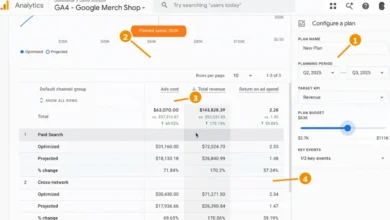
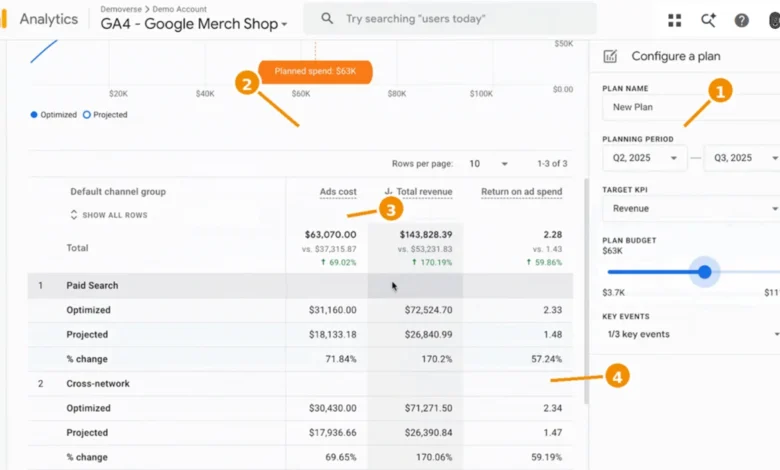
Moving from descriptive analytics to predictive strategy, the new Cross-Channel Budgeting tools allow organizations to model financial outcomes based on historical performance and seasonality. Located within the advertising section, the feature comprises project plans for tracking budget pacing and scenario plans for simulating resource reallocation between different acquisition channels.
By analyzing diminishing return curves and the relationship between spend and specific business outcomes, marketing teams can forecast the revenue impact of shifting capital—such as moving funds from paid social to paid search. Enterprise data integration has also been streamlined, allowing organizations to import campaign cost data directly from external platforms like Meta and TikTok. This unified cost visibility enables finance and marketing departments to ground their budget negotiations in empirical projections rather than intuition.
Conversational Analysis via Ask Advisor and Enterprise MCP Servers
To democratize data access for senior leadership and reduce the reporting burden on analytics teams, Google has introduced "Ask Advisor," a conversational interface accessible via the platform’s top navigation. This tool allows users to query complex datasets using natural language, translating intricate comparative analyses into immediate insights without manual report navigation.
For organizations seeking deeper integration, Google has released a Model Context Protocol (MCP) server for Google Analytics. This open framework enables enterprises to connect their analytics data directly to approved large language models, such as ChatGPT or Claude. By linking web performance data with internal media plans, promotional calendars, and customer relationship management systems, organizations can execute cross-functional queries that span the entire business ecosystem rather than remaining siloed within web analytics.
Structural Data Cleanliness and Customer Lifetime Value Segmentation
Complementing these major functional releases are foundational updates designed to resolve persistent data hygiene challenges. The new Source Group Consolidation feature automatically harmonizes disparate referral variations—such as multiple permutations of social media platform names—into unified streams retroactively, reducing reliance on manual regular expression rules.
Additionally, the platform now natively calculates a Lifetime Value (LTV) Percentile metric without requiring complex external database queries. This field allows brands to isolate the top percentile of high-value customers who disproportionately drive profitability, enabling marketing teams to build targeted audience segments for acquisition campaigns.
Strategic Implications for Enterprise Leadership
The cumulative effect of these updates represents a structural evolution in how enterprises utilize analytics software. By shifting the focus from historical reporting to predictive modeling, organizations can evaluate performance parameters before capital is deployed. Industry observers note that while automated tools and conversational interfaces reduce technical barriers, the core responsibility of the analyst remains unchanged: interpreting nuanced data, validating model assumptions, and translating algorithmic projections into defensible business strategy.