AI Workflows vs Agents: A Practical Framework for Architectural Decision Making

The rapid maturation of Large Language Models (LLMs) has introduced a confusing nomenclature into the software engineering lexicon, most notably the conflation of "AI agents" with "AI workflows." As organizations scramble to integrate generative AI into their operational stacks, the term "agent" has become an umbrella label applied to everything from static, rule-based automation scripts to complex, autonomous decision-making systems. This semantic ambiguity carries significant technical and financial consequences. Developing an autonomous agent when a deterministic workflow suffices often leads to increased latency, unpredictable costs, and, crucially, a lack of auditability. To optimize for production-grade reliability, engineers must distinguish between systems that follow a pre-scripted path and those that synthesize their own logic at runtime.
The Evolution of Automation and the Rise of Agentic Systems
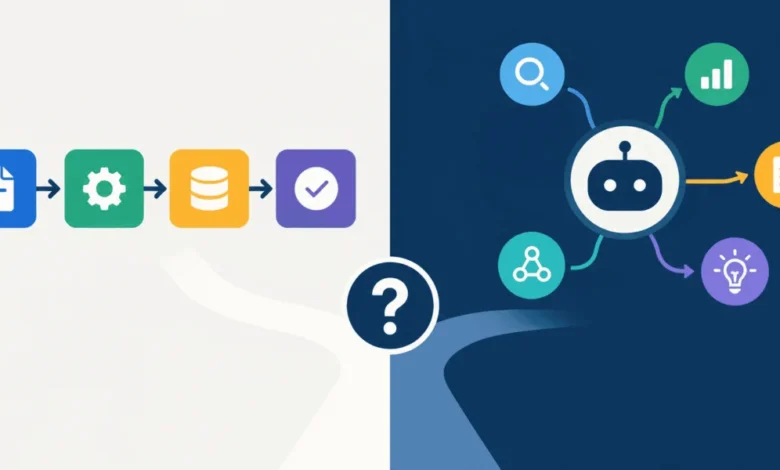
Historically, software automation relied on rigid, "if-then" logic. With the advent of Large Language Models, the paradigm shifted. Initially, developers used LLMs as discrete components within existing pipelines—for instance, using an LLM to classify a support ticket before routing it to a specific department. These are classified as AI workflows. In this model, the developer maintains total control over the control flow; the LLM is merely a tool that provides semantic intelligence at a specific junction.
The term "agent," however, implies a departure from this developer-defined trajectory. An agentic system is characterized by the model’s ability to "think" and iterate. Upon receiving a high-level goal, an agent evaluates its environment, selects appropriate tools from an available library, executes a task, assesses the output, and determines whether to proceed or pivot. This loop—often referred to as "plan-act-observe"—is the defining feature of an autonomous agent. While the power of such systems is undeniable in open-ended domains like complex data research or multi-step incident response, their non-deterministic nature presents significant challenges in enterprise environments where consistency is paramount.
Establishing the Decision Framework: The Flowchart Test
The most effective litmus test for determining the necessity of an agentic architecture is the "Flowchart Test." If a lead engineer can map the entire logic of a business process—including all possible branches and failure states—on a whiteboard before the model is invoked, the project should be architected as a workflow.
The implications of this distinction are profound. A workflow is inherently predictable. Because the paths are fixed at design time, developers can implement rigorous error handling, unit tests, and compliance checkpoints at every step. Conversely, agents operate in a "black box" environment. Because the LLM determines the next step at runtime, testing an agent requires probabilistic validation rather than deterministic verification. For industries bound by strict regulatory oversight, such as finance or healthcare, the inability to trace an agent’s decision-making process can be a liability.
Comparative Analysis: Efficiency and Resource Allocation
Data from recent enterprise deployments suggests a clear trend regarding resource consumption. Autonomous agents, by virtue of their iterative nature, consistently exhibit higher token consumption and latency compared to optimized workflows. In a multi-step investigation of a production outage, an agent may invoke an LLM dozens of times to parse logs, query databases, and verify metrics. Each step increases the cost of the operation and adds cumulative latency that can degrade user experience.
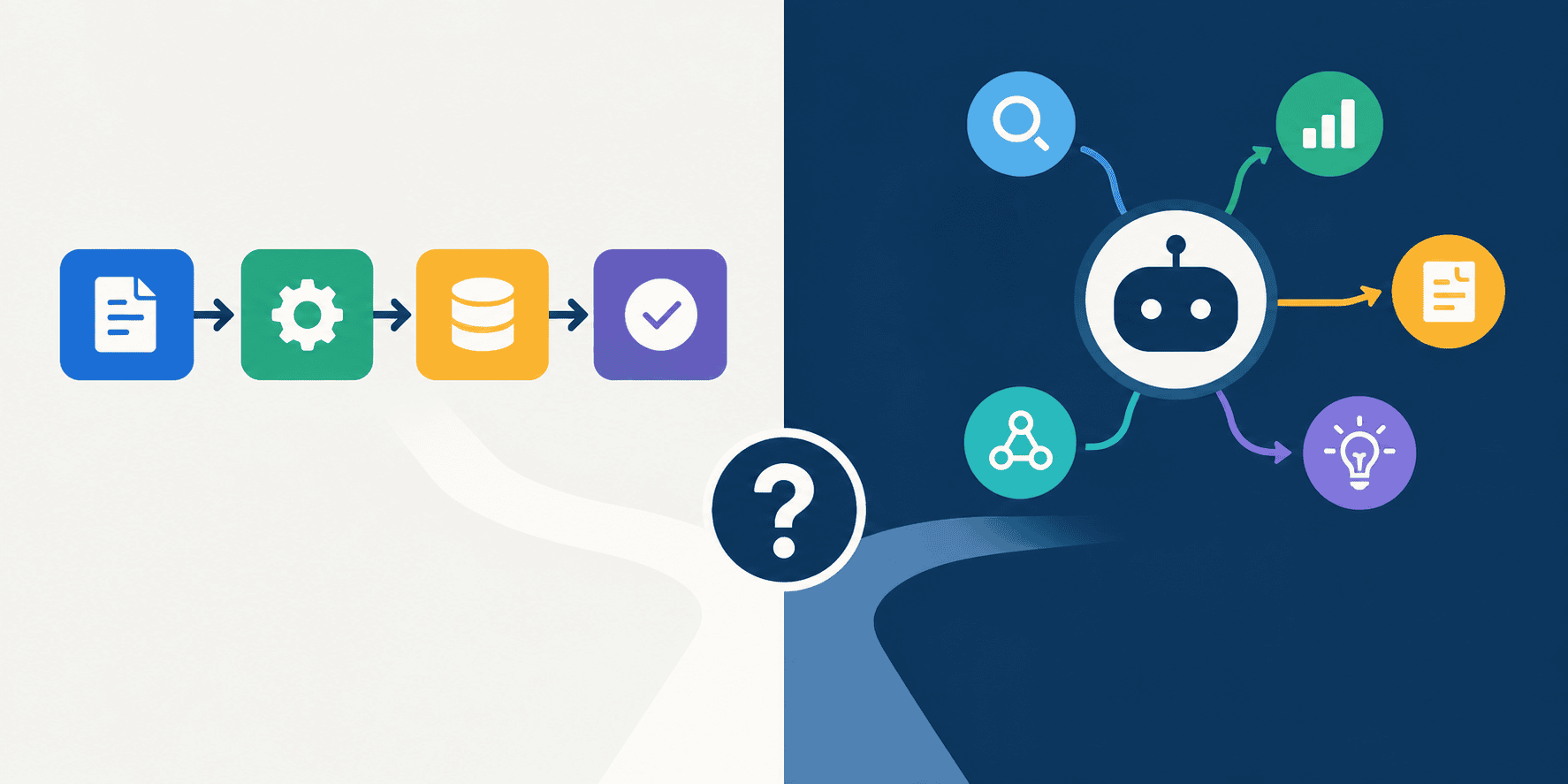
Conversely, a well-structured workflow treats the LLM as a specialized processor. By using a workflow to route the task through a series of deterministic filters and small, specific LLM calls, the system achieves the same result with significantly fewer tokens and much tighter execution times. This is particularly relevant for high-volume applications like customer support automation, where the objective is to resolve inquiries accurately while minimizing the cost per ticket.
Chronology of AI Integration: From Simple Pipelines to Autonomy
The industry’s approach to AI has progressed through distinct phases over the past 24 months:
- The Integration Phase (2023): Developers focused on "LLM-in-the-loop" workflows. Models were used primarily for text extraction, sentiment analysis, and basic summarization, embedded within legacy software architectures.
- The Tool-Use Phase (Early 2024): Frameworks allowed models to call APIs. This enabled systems to retrieve information from external databases, effectively creating "augmented workflows" where the LLM could fetch data but still operated within a fixed sequence.
- The Agentic Phase (Late 2024–Present): The emergence of autonomous loops, where models utilize reasoning chains (such as ReAct) to solve complex, multi-step problems without human intervention in the middle of the process.
This evolution has created a "complexity trap." Developers often assume that because agents represent the technological frontier, they are superior for all tasks. This is a fallacy. Sophistication in software is not measured by the autonomy of the system, but by the efficiency and reliability with which it solves a specific user problem.
Practical Guidelines for System Architecture
Before writing a single line of code, architects should evaluate their use case against four key criteria:
- Input Predictability: If the range of inputs is known and finite, a workflow is superior. If the input is open-ended—such as a user asking for a comprehensive research report on an obscure topic—an agent is appropriate.
- Compliance and Auditability: For processes requiring a clear audit trail, workflows provide a linear, documentable path. Agents, which may take circular or divergent paths to arrive at the same answer, are significantly harder to audit.
- Budgetary Constraints: Agents are "reasoning-heavy" and inherently expensive. If the application handles millions of requests, the cost of agentic reasoning can quickly become prohibitive.
- System Reliability: Workflows allow for "human-in-the-loop" interventions at specific, predictable points. In an agentic system, injecting human oversight is complex, as it requires the agent to pause its internal reasoning loop, wait for external input, and then resume—a process that often disrupts the model’s context.
Industry Implications and Future Outlook
The current trend toward "agentic workflows" represents a synthesis of these two schools of thought. By embedding small, agentic "islands" within a larger, deterministic workflow, organizations are finding a middle ground. For example, a loan processing system might function as a rigid workflow for document verification and identity checks but switch to an agentic model when it encounters an unusual discrepancy in a document that requires creative reasoning.
This hybrid approach allows developers to retain the benefits of predictability while leveraging the power of LLM reasoning where it is truly needed. As the tooling ecosystem matures, the focus will likely shift away from building "general-purpose agents" toward building "task-specific systems" that intelligently switch between deterministic and autonomous modes.
Ultimately, the goal for any engineering team is to reduce the "entropy of execution." An agentic system introduces a high degree of entropy because its path is discovered, not defined. By defaulting to a workflow—and only introducing agentic capabilities when the complexity of the task forces a departure from fixed logic—engineers can build AI systems that are both powerful and maintainable. The most successful AI implementations in the coming years will not be those that use the most autonomous models, but those that exercise the most disciplined control over how those models are deployed.
Related posts: