The management of a WooCommerce catalog has historically been a labor-intensive endeavor, requiring store owners to navigate individual product editing, complex bulk updates, and the manual implementation of custom code for even minor functionality adjustments. However, the emergence of AI-driven tools like Novamira Pro—which bridges the gap between large language models such as Claude and the WordPress database—is fundamentally shifting how administrators maintain their e-commerce infrastructure. By providing AI with direct access to WooCommerce’s underlying schema, developers and store owners can now automate repetitive tasks ranging from pricing adjustments to the diagnostic repair of broken product data.

The Evolution of AI-Integrated E-commerce Administration
Traditionally, WooCommerce administrators have relied on a combination of built-in bulk editing tools, third-party CSV importers, and custom PHP snippets to manage their stores. While these methods are effective, they lack the agility required for rapidly changing market conditions. The integration of artificial intelligence into the WordPress ecosystem marks a transition from static toolsets to dynamic, agentic workflows.
Novamira Pro serves as a conduit between the Claude AI model and the WordPress backend. Unlike standard AI plugins that act as superficial interfaces, this system provides the model with read-and-write access to core WooCommerce data points, including product attributes, shipping classes, and scheduled sales. This allows the AI to function not just as an assistant, but as an active manager capable of executing complex logic directly within the PHP environment and the site’s database.

Chronology of an AI-Driven Store Build
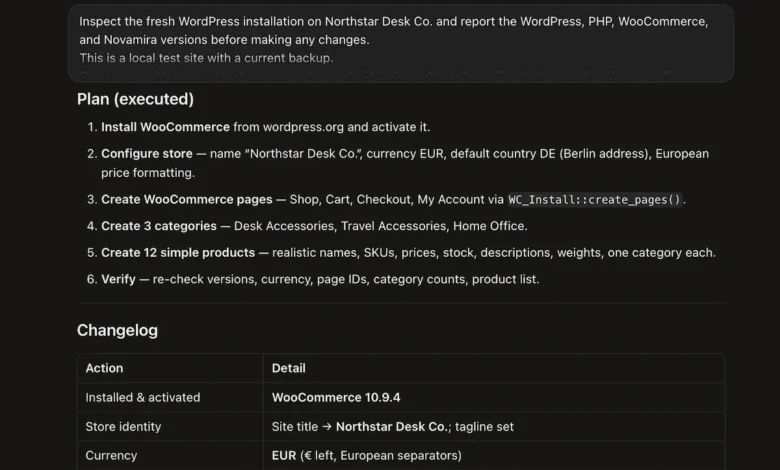
To understand the practical implications of this technology, a controlled experiment involving a fresh WordPress installation provides a clear baseline. In a recent workflow simulation, a test store—Northstar Desk Co.—was constructed to evaluate the efficacy of AI in handling end-to-end management tasks.
Phase 1: Infrastructure Deployment
The process began by tasking Claude with the automated creation of the store’s architecture. By providing a structured prompt, the AI was directed to install the necessary plugins, establish essential WooCommerce pages, and define specific categories for desk and travel accessories. Within approximately 15 minutes, the AI populated the catalog with 10 to 15 simple products, complete with metadata, SKUs, and stock levels. This initial phase demonstrated that AI agents can significantly reduce the "onboarding" time for new e-commerce projects by bypassing the repetitive clicking inherent in the standard WooCommerce setup wizard.

Phase 2: Strategic Pricing Adjustments
Once the catalog was established, the second phase involved a bulk pricing adjustment. The goal was to increase the prices of items within the "Desk Accessories" category by 9%, with a requirement to round the final figures to a psychological price point of .99. The AI first generated a comprehensive preview table, allowing the administrator to verify the proposed changes against existing sale prices and stock status before committing to the database. This "human-in-the-loop" verification step is critical, as it ensures that automated changes do not inadvertently override existing promotional campaigns.
Phase 3: Promotional Scheduling and Conflict Resolution
Scheduling a category-wide sale highlighted the limitations and subsequent problem-solving capabilities of current AI agents. When tasked with applying a 20% discount across the "Home Office" category, the AI correctly identified that certain fields—specifically those governing sale duration—were not readily accessible within the standard product schema. Rather than failing, the system proposed a programmatic workaround, demonstrating the ability of advanced models to troubleshoot their own technical constraints.

Phase 4: Diagnostic Auditing and Self-Healing
The fourth stage of the workflow focused on maintenance. To test the system’s diagnostic accuracy, several products were intentionally corrupted: categories were unassigned, SKUs were deleted, and descriptions were removed. The AI was instructed to conduct an audit of the entire store. It successfully identified the missing data points and, in cases where inference was safe, reconstructed the descriptions and categories. This capability underscores the potential for AI to act as a permanent site-maintenance engineer, constantly scanning for data inconsistencies.
Phase 5: Custom Feature Development
The final phase involved extending the site’s functionality. The objective was to display a "Sale ends" notice on product pages. Instead of modifying the theme’s core files—a practice that often leads to errors during updates—the AI generated a standalone, modular plugin. This isolation of code ensured that the new feature could be toggled off or removed without compromising the stability of the parent theme.

Comparative Analysis: Free vs. Pro
The distinction between Novamira’s free and professional tiers lies primarily in operational consistency and context retention. While the free version allows for basic PHP execution and database interaction, the Pro version offers a deeper specialization that maintains the AI’s understanding of the store’s specific conventions over long periods.
Data from the workflow tests suggest that while the Free version is suitable for occasional, one-off tasks, the Pro version is better suited for high-frequency environments. The ability of the Pro tier to "remember" the store’s internal logic prevents the AI from needing to re-learn or re-verify the site’s schema in every session, thereby increasing the reliability of the output.

Broader Implications for the WordPress Ecosystem
The integration of AI agents into WooCommerce is likely to alter the competitive landscape for small-to-medium-sized e-commerce businesses. Previously, the cost of hiring a developer to perform routine maintenance or to build small, custom features was a significant barrier to growth. By democratizing access to database management and code generation, tools like Novamira Pro empower store owners to manage complex operations with the efficiency of a larger development team.
However, industry experts advise caution. Despite the impressive capabilities demonstrated in these workflows, the reliance on AI for database manipulation requires a robust backup strategy. Because not all automated actions can be easily reversed, maintaining a "local-first" testing environment is essential. Before deploying any AI-generated code or bulk changes to a production site, developers should mirror their database to a staging server to ensure the AI’s logic aligns with existing site architecture.

Official Stance and Future Development
The development team behind Novamira continues to refine the tool’s ability to interface with WooCommerce’s vast array of custom fields. User feedback, particularly regarding field exposure and schema mapping, remains the primary driver for future updates. As the tool matures, it is expected that more complex operations—such as variable product management and sophisticated inventory forecasting—will move from manual, labor-intensive processes to fully automated, AI-monitored tasks.
For the average e-commerce merchant, the shift represents a movement toward "autonomous administration." As the industry continues to integrate these agents, the role of the store manager will increasingly move away from data entry and toward high-level strategy, leaving the technical execution of bulk updates and feature development to the AI. This evolution suggests a future where the overhead of running a digital storefront is significantly reduced, allowing for greater focus on customer acquisition and product development.