Every single website on the internet achieves its absolute peak performance, aesthetic appeal, and structural integrity on the exact day it is officially launched. After months of painstaking development, rigorous testing, and the final merging of code branches, a web property goes live as a pristine digital artifact. However, the harsh reality of digital product management dictates that it will never reach that level of perfection again. This inevitable decline does not stem from catastrophic system crashes or sudden server failures. Instead, it is driven by the relentless march of time, shifting market conditions, evolving competitor strategies, and the gradual misalignment between a static web presence and the dynamic enterprise it represents. Within a year of deployment, even the most meticulously engineered website begins to resemble a period piece. It is not necessarily broken, but it is fundamentally behind the curve. Digital teams across every industry are acutely familiar with this slow decay, often treating it as an immutable law of nature.
For decades, the digital landscape has accepted that maintaining a website requires a continuous, exhausting cycle of human intervention, manual updates, and periodic redesigns that consume valuable time and engineering resources. However, emerging advancements in artificial intelligence and autonomous agent technology suggest that this paradigm does not have to remain the industry standard. Theoretically, a modern web platform should be capable of continuous self-improvement following its initial launch. Instead of drifting away from its peak performance day, an autonomous website could silently and continuously optimize itself while the original development and design teams pivot their focus toward core business initiatives and new product features.
To visualize this potential future, one must examine how autonomous agents operate in practical web environments. While human staff members sleep, an automated agent could detect that a recent design-system update failed to propagate correctly to the pricing page, automatically deploying a fix before the morning shift begins. Another specialized agent could scan the asset directory, identify a batch of uncompressed images uploaded during a rushed product release, and optimize them for faster loading speeds without sacrificing visual fidelity. A third agent might flag a subtle accessibility regression introduced by a newly integrated user interface component, either resolving the issue independently or filing a detailed, actionable report for human review. System administrators would wake up to a web property that is measurably superior to the previous day’s version, accompanied by a concise log of critical decisions that explicitly required human oversight. This represents the ideal vision of website autonomy—one focused on eliminating mundane chores rather than replacing human creativity.
Yet, as software developers and platform architects begin to take this technological promise seriously, they quickly encounter a fundamental psychological and operational hurdle that has very little to do with raw computing power or algorithm limitations. Despite the theoretical appeal of self-updating systems, user research and platform deployment data indicate that almost no one actually wants a website that changes entirely on its own without human boundaries.
The initial impulse when deploying capable artificial intelligence agents is to hand over complete administrative control of the web property. Allowing agents to autonomously write, edit, optimize, and publish content without friction sounds like the ultimate endpoint of web automation. Yet, this total delegation approach consistently encounters resistance when implemented in real-world enterprise environments. This phenomenon was documented extensively during the development of Fimo, an autonomous website platform designed to streamline digital asset management. Initially operating under the assumption that total autonomy was the ultimate goal, the platform’s creators observed that users consistently hesitated to grant unbridled control to AI agents.
This hesitation did not stem from a deep-seated distrust of artificial intelligence capabilities. Rather, it highlighted a fundamental organizational truth: a corporate website has no single, unified owner. Instead, it is a shared canvas managed by diverse stakeholders—including brand directors, UI/UX designers, front-end developers, copywriters, and compliance officers—each of whom demands a distinct level of autonomy and oversight. Consequently, the primary challenge in building autonomous web systems is not determining whether artificial intelligence can be trusted, but rather establishing precise boundaries regarding where the line of control should be drawn, and for whom.
Analyzing operational workflows within digital teams reveals that website maintenance tasks naturally divide into three distinct categories: rule-bound administrative chores, untouchable creative judgment calls, and highly subjective domain-specific decisions. The vast majority of everyday website maintenance falls into the first category, encompassing tasks that are repetitive, rule-driven, and entirely devoid of creative fulfillment. Maintaining strict accessibility compliance as page layouts evolve, propagating design-system tokens across hundreds of subpages, catching broken meta tags, compressing oversized media assets, and repairing broken hyperlinks caused by historical URL restructuring are all classic examples of low-level digital upkeep.
Historically, highly skilled engineers and designers have been forced to allocate a significant portion of their work hours to these repetitive chores. No digital professional is hired for their exceptional talent in spotting missing alternative text attributes or validating contrast ratios. Consequently, this category of maintenance represents work that teams are actively relieved to delegate. Artificial intelligence agents excel precisely in this domain because these tasks are defined by rigid rules rather than subjective taste. Deploying an autonomous agent to quietly maintain structural and technical health across an entire web property unattended does not threaten professional employment; rather, it successfully eliminates the tedious eighty percent of website management that drains team productivity. Acknowledging the sheer volume of maintenance tasks that belong in this operational bucket helps reframe website autonomy from an intimidating technological leap into a practical tool for shedding administrative burden.
At the opposite end of the spectrum lies the small percentage of work that digital professionals would refuse to delegate under any circumstances. This core domain represents the very reason creative teams exist. While an automated agent can evaluate a newly generated webpage against thousands of programmatic rules—verifying color contrast compliance, checking heading hierarchies, validating design tokens, and ensuring copy aligns with a predefined style guide—it fundamentally lacks the capacity to determine what a page should emotionally feel like. An algorithm cannot judge whether a newly shipped product narrative possesses genuine aesthetic quality or brand resonance. This nuanced judgment is precisely why human designers, writers, and strategists are employed, and no amount of algorithmic advancement will remove this responsibility from human oversight.
When professionals initially resist the concept of website autonomy, they are instinctively reacting to the fear of losing control over this creative core. Their protective instinct is entirely correct. The critical analytical mistake lies in assuming that an entire website is composed exclusively of this high-level creative work. In reality, creative judgment accounts for only a fraction of web operations, while the vast majority consists of routine maintenance. However, because that small creative fraction carries disproportionate importance for brand identity, automating everything without guardrails feels instinctively counterproductive.
Between the clear-cut administrative chores and the untouchable creative core lies a vast middle ground that automated products cannot universally resolve, because the boundary line cuts across different organizational roles in unique ways. Consider a practical scenario often encountered during web redesigns: modifying the default user interface theme to dark mode upon visitor arrival. An artificial intelligence agent can execute this structural code change in a matter of milliseconds. The true dilemma centers on determining which stakeholder holds the authority to mandate such a change.
For the brand designer who safeguards the company’s visual identity, establishing a default theme is not merely a technical setting; it is an intentional statement regarding how the corporate brand wishes to be perceived during a visitor’s initial impression. The designer will invariably demand direct control over this aesthetic decision. Conversely, for the front-end developer tasked with managing user experience metrics and reducing eye strain, enabling dark mode by default is a straightforward configuration with a clear performance rationale—precisely the kind of routine modification they would gladly delegate to an autonomous agent. Applying the exact same change to the identical web property reveals that the designer and developer draw their boundaries of autonomy in entirely opposite locations.
This divergence demonstrates that identical tasks carry vastly different amounts of subjective judgment depending on the professional role of the stakeholder. What represents a strategic brand decision for one individual constitutes a routine technical chore for another. Consequently, software products cannot ship with a single, universal automation setting that satisfies all participants, because the definition of appropriate automation is intrinsically linked to where individual professional value resides. Effective web platforms must therefore provide granular, per-task, and per-person controls, allowing organizations to abandon rigid global settings in favor of precise, customizable boundaries.
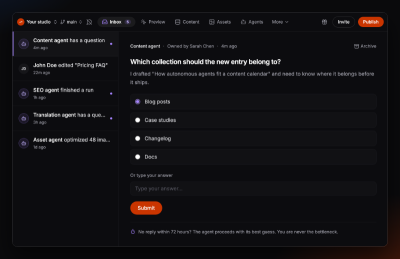
Recognizing that the threshold for autonomy is highly personal transforms the fundamental architecture of web management software. A simple binary toggle allowing users to choose between manual approval and full delegation is insufficient. Because the ideal boundary depends entirely on the specific functions performed by an agent, the agent itself must become the primary unit of control. Rather than selecting from a rigid menu of pre-programmed behaviors, modern digital teams must be empowered to compose custom agents, explicitly defining the operational boundaries and access privileges assigned to each digital assistant.
Organizations can construct specialized agents from scratch or adapt existing templates to align with internal governance standards. For instance, a team might deploy an accessibility compliance agent with full authority to run and publish updates completely unattended, while simultaneously pairing it with a strictly supervised content generation agent that requires mandatory human sign-off for any brand-facing copy changes. Furthermore, these agents must not remain static. By leveraging machine learning models, modern autonomous agents continuously adapt based on historical task execution and direct human feedback. The operational boundary established during the initial deployment phase does not remain fixed indefinitely. Tasks that initially required rigorous human review can gradually transition to automated delegation—not because human oversight standards were lowered, but because the autonomous agent systematically earned organizational trust over time.
In operational practice, successful adoption of autonomous web infrastructure rarely involves flipping a global switch to activate full autonomy on day one. Instead, the implementation follows a measured, incremental trajectory. Teams typically begin by delegating minor, low-risk operational tasks, closely monitoring agent performance, and progressively expanding automation privileges as confidence grows. Modern platforms facilitate this trust-building process by maintaining comprehensive execution histories, detailed system logs, and side-by-side visual comparisons of pre- and after-change states. Trust in automated systems does not emerge from abstract acceptance of artificial intelligence; rather, it develops empirically when administrators review historical logs and witness an agent successfully resolving complex maintenance tasks that human staff members might otherwise have overlooked. As agents consistently prove their reliability, the administrative bottleneck that once paralyzed web publishing operations is systematically dismantled.
Industry analysts and IT directors frequently voice immediate concerns regarding the security and predictability of autonomous systems altering web properties without direct human oversight. However, this perspective overlooks the profound structural risks associated with the traditional alternative: the completely frozen website. A static web property that remains untouched for months does not inherently provide greater security or operational stability. Instead, it quietly falls behind market standards, evolving security protocols, and shifting consumer expectations in a gradual decay that often goes unnoticed until the digital footprint no longer accurately reflects the enterprise it represents.
The primary objective of web autonomy was never designed to alienate human professionals from their digital creations. Rather, its ultimate purpose is to eliminate systemic digital decay. By delegating rule-bound administrative chores to specialized artificial intelligence agents, creative teams reclaim the bandwidth necessary to focus their human judgment on the critical operational decisions that genuinely demand their expertise. Modern organizations must embrace granular, trust-based automation architectures, establish operational boundaries where human value is maximized, and allow autonomous agents to shoulder the overwhelming burden of routine maintenance, ensuring that corporate web properties remain as dynamic, innovative, and competitive as the businesses driving them forward.