In the rapidly evolving landscape of artificial intelligence, the ability to build a highly accurate predictive model is no longer the sole benchmark of success. As AI systems are increasingly integrated into critical infrastructure, financial services, and healthcare, the capacity to explain the reasoning behind a model’s output has transformed from a niche research interest into a non-negotiable operational and regulatory requirement. Organizations that cannot provide transparent justifications for their algorithmic decisions face mounting risks, ranging from internal accountability crises to severe penalties under emerging legal frameworks such as the European Union’s AI Act.
The challenge of "black box" models—systems that provide outputs without revealing their internal decision-making processes—has become a focal point for data scientists and compliance officers alike. When a customer churn model identifies a loyal, five-year client as high-risk, the inability to explain that classification is not merely a technical limitation; it is a failure of transparency. With Article 13 of the EU AI Act now mandating that high-risk AI systems provide sufficient transparency for deployers to interpret their outputs, the industry is shifting toward a standard where explainability is a deployment prerequisite.
The Evolution of Interpretability
Model interpretability is defined as the extent to which a human observer can comprehend the cause of a specific model output. This definition necessitates a clear distinction between global interpretability—understanding the overall logic of the model across an entire dataset—and local interpretability, which focuses on the specific drivers behind an individual prediction. Historically, data scientists relied on built-in attributes like feature importance scores provided by libraries such as scikit-learn. While these tools offer a quick, ranked list of influential variables, they are inherently limited. They often fail to provide insight into individual edge cases and can be biased toward features with high cardinality, leading to misleading conclusions about what truly drives model behavior.
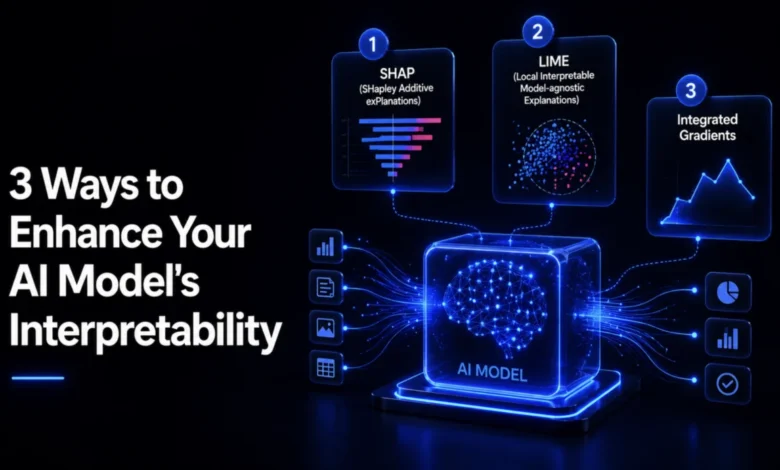
To address these limitations, modern data science has moved toward three robust techniques: SHAP (SHapley Additive exPlanations), LIME (Local Interpretable Model-agnostic Explanations), and Integrated Gradients. Each method offers a unique approach to dissecting model logic, whether the underlying architecture is a gradient-boosted tree or a complex neural network.
Method 1: SHAP and Cooperative Game Theory
SHAP has emerged as a cornerstone of the interpretability movement. Grounded in cooperative game theory, SHAP treats every feature as a "player" in a game where the model’s prediction is the total payout. By calculating the marginal contribution of each feature across all possible combinations, SHAP assigns a fair share of the prediction to each input. This mathematical foundation ensures consistency and provides both global and local explanations, solving the primary shortcomings of traditional feature importance metrics.
In practice, using SHAP on a customer churn model reveals nuance that traditional methods miss. For instance, while a standard model might highlight "tenure" as the most important global feature, SHAP might reveal that for a specific, high-risk customer, "support tickets" and "contract type" carry significantly more weight. This allows teams to provide a defensible, data-backed explanation to stakeholders. As of May 2026, with the release of version 0.52.0, SHAP continues to be the most widely utilized library in production environments, favored for its theoretical rigor, even if it requires significant computational overhead for non-tree-based models.
Method 2: LIME for Real-Time Efficiency
When computational latency is a primary concern, LIME offers a pragmatic alternative. Unlike SHAP, which seeks an exact game-theoretic attribution, LIME utilizes a model-agnostic approach. It generates a local "neighborhood" of perturbed samples around a single input and fits a simple, interpretable linear model to that neighborhood.
LIME is particularly effective for real-time systems where milliseconds matter. Because it does not require an exhaustive analysis of the model’s entire internal structure, it can provide immediate, actionable insights into why a specific user was flagged. However, this speed comes with a trade-off: stability. Because LIME relies on random sampling, consecutive explanations of the same prediction may yield slight variations. For teams working within tight latency budgets, these minor fluctuations are often a manageable compromise, provided the results are used for diagnostic purposes rather than final, legally binding decisions.
Method 3: Integrated Gradients for Differentiable Architectures
For organizations utilizing neural networks, Integrated Gradients represents the gold standard of interpretability. Unlike SHAP or LIME, which can treat models as "black boxes," Integrated Gradients leverages the internal structure of differentiable models. By calculating the integral of the gradients of the model’s output with respect to the input along a path from a neutral baseline, this technique provides an attribution that is both mathematically precise and computationally efficient for deep learning.
The implementation involves establishing a baseline—such as an "average" customer in a normalized dataset—and observing how the model’s prediction changes as it moves toward the actual input. A critical diagnostic tool in this process is the "convergence delta," which measures the numerical accuracy of the attribution. A delta near zero provides high confidence that the explanation reflects the model’s true behavior rather than an approximation error. This method is essential for neural networks, where the complexity of hidden layers makes traditional, non-gradient-based methods insufficient.
Implications and Industry Standards
The convergence of these three methods on the same insights—as demonstrated in consistent testing on churn datasets—marks a significant maturation in AI governance. When three mathematically distinct approaches arrive at the same conclusion, stakeholders can move forward with high confidence. This level of verification is increasingly demanded by auditors and regulators who seek proof that AI outputs are not arbitrary or discriminatory.
The implications for data science teams are profound. The adoption of these tools forces a shift in how models are developed: from a singular focus on accuracy to a balanced approach that prioritizes "explainable AI" (XAI). This transition requires specialized training, as the ability to interpret a model is now as vital as the ability to code one. Furthermore, the use of these tools provides a mechanism to identify "model drift" or bias. If a model’s reasoning changes over time, as revealed by SHAP or LIME, teams can intervene before the system begins to produce systematically unfair outcomes.
A Strategic Framework for Deployment
Choosing the right interpretability tool depends on the project’s specific constraints:
- SHAP is the ideal choice for tree-based architectures, offering a blend of speed and theoretical consistency that satisfies most regulatory requirements for global and local transparency.
- LIME should be the primary choice for real-time applications where latency is the bottleneck, or for black-box APIs where the internal structure is inaccessible.
- Integrated Gradients is the necessary tool for neural networks and differentiable models, providing the deep-dive precision required for high-stakes decision-making.
The shift toward interpretability is not merely a technical trend; it is a fundamental pillar of responsible AI. As organizations continue to deploy machine learning to manage sensitive customer data and critical business processes, the "black box" era is drawing to a close. By adopting rigorous, verifiable interpretability frameworks, companies can ensure that their AI models remain not only high-performing but also transparent, defensible, and aligned with global regulatory standards. Moving forward, the mark of a successful AI project will not just be the accuracy of its predictions, but the clarity with which those predictions can be explained to the people they affect.