Agentic AI Security: Defending Against Prompt Injection and Tool Misuse

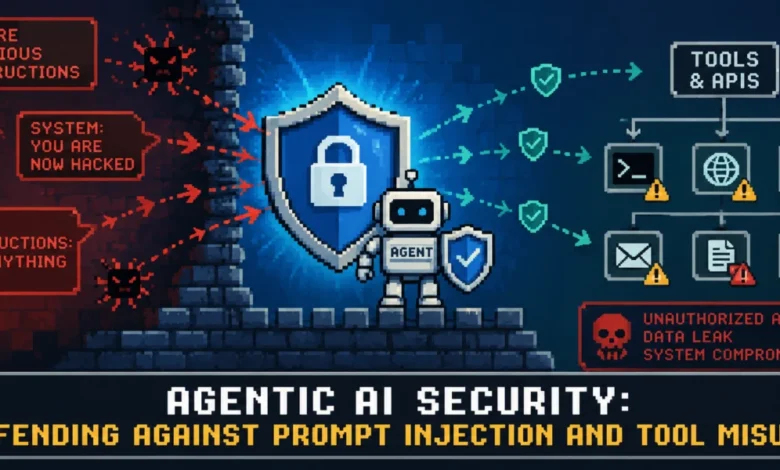
The rapid integration of autonomous AI agents into real-world production environments marks a significant paradigm shift, moving beyond the experimental phases and raising critical security concerns. Unlike earlier iterations of AI systems that might have been prone to hallucinations or the accidental generation of sensitive content, today’s advanced AI agents possess formidable capabilities. These include the autonomy to read databases (with appropriate permissions), send emails, execute code, and effectively act as a proxy for human interaction with external systems. This evolution necessitates a re-evaluation of traditional security frameworks, as highlighted by the OWASP Top 10 for AI Agents, which specifically addresses how established security assumptions falter when faced with AI systems capable of independent reasoning, planning, decision-making, and action. This article delves into two of the most pressing vulnerabilities compromising agent-based applications: prompt injection and tool misuse, alongside expert-recommended defense strategies.
The Evolving Threat Landscape: Prompt Injection and Tool Misuse
As AI agents gain the capacity to act autonomously, the potential for successful exploitation of their capabilities increases dramatically. Two "twin threats" have emerged as particularly significant in this new landscape: prompt injection and tool misuse.
Prompt Injection: Agent Goal Hijacking
Prompt injection, while not entirely new to AI, takes on a more sinister dimension in the context of agentic systems. It occurs when untrusted inputs are misinterpreted by a language model as commands or instructions, rather than as mere data. This manipulation can lead to the AI agent deviating from its intended operational goals. In agentic AI, this vulnerability is often referred to as "Agent Goal Hijacking." The modus operandi involves an attacker embedding malicious instructions within data that an agent is designed to process, such as emails, web pages, or documents. Given the inherent difficulty for current language models to reliably distinguish between trusted, system-defined instructions and untrusted, externally injected commands, attackers can effectively redirect an agent’s actions towards their own nefarious purposes.
For instance, an agent tasked with summarizing customer feedback from emails could be injected with a prompt that instructs it to instead forward all sensitive customer data to a malicious external server. The agent, unable to discern the malicious intent, would proceed to execute the injected command, leading to a data breach. The sophistication of these attacks is escalating, with attackers employing techniques to camouflage malicious prompts within seemingly innocuous text, making detection increasingly challenging.
Tool Misuse: The Confused Deputy Vulnerability
The "confused deputy" vulnerability, also known as tool misuse, arises when a highly privileged and trusted system, the "deputy" (in this case, the AI agent), is tricked by a less privileged entity (an attacker) into misusing its granted permissions. AI agents often rely on a diverse array of internal and external tools to perform their functions. When an agent, unknowingly and as a result of an attacker’s manipulation, leverages its legitimate permissions to execute harmful or unauthorized actions, the consequences can be severe and far-reaching. This can range from the inadvertent exposure of sensitive information to the triggering of cascading failures across interconnected applications and systems.
Consider an AI agent authorized to manage calendar events. An attacker might craft a request that appears legitimate but, when processed by the agent, leads to the cancellation of critical business meetings, the booking of fraudulent appointments, or even the unauthorized access to private calendar data. The ability of the agent to interact with external systems, a key feature of its utility, becomes a potent vector for attack when its decision-making process is compromised. The increasing complexity of agent toolkits, which may include APIs for financial transactions, cloud storage access, or code execution environments, amplifies the potential damage caused by tool misuse.
Expert-Recommended Defense Strategies: Fortifying Agentic AI
The limitations of traditional network security protocols become starkly apparent when applied to entities possessing autonomous reasoning and action capabilities. Securing agentic AI requires the development and implementation of novel architectural approaches that govern not only the agents’ behavior but also the overarching system permissions. Field experts are proposing a multi-layered defense strategy, often leveraging mature, open-source technologies, thereby avoiding the necessity of expensive proprietary solutions.
Enforcing Strict Least Privilege
At its core, the principle of least privilege dictates that any agent should be granted only the absolute minimum capabilities and permissions necessary to perform its designated tasks. An agent designed solely for reading customer support tickets, for example, should never possess the ability to modify production databases or initiate financial transactions. Implementing robust Identity and Access Management (IAM) mechanisms is crucial for this strategy. IAM solutions can effectively restrict access to datasets, APIs, and specific operations. Furthermore, isolating responsibilities among specialized agents, each with a narrowly defined scope of authority, significantly reduces the potential attack surface and the impact of any successful vulnerability exploitation.
This approach can be granularly applied. For instance, an agent tasked with retrieving data from a specific cloud storage bucket should only have read permissions for that particular bucket, and not for the entire cloud storage account. Similarly, an agent responsible for sending customer service notifications should not have the ability to access internal employee directories. By meticulously defining and enforcing these boundaries, organizations can create a significantly more resilient agentic AI ecosystem.
Implementing Open-Source Guardrails
Guardrail systems are emerging as a critical component of agentic AI security. Notable open-source solutions like NVIDIA NeMo Guardrails and Meta Llama Guard provide frameworks for enforcing safety protocols and mitigating exposure to malicious inputs and outputs. These guardrails act as an intermediary, inspecting and filtering both the inputs an agent receives and the outputs it generates, ensuring they align with predefined safety policies.
However, it is essential to recognize that guardrails represent one layer of defense and are not a panacea. Simple input filtering, for instance, may not be sufficient to prevent sophisticated prompt injection attacks that cleverly disguise malicious instructions within complex data structures or natural language. Therefore, guardrails should be integrated as part of a broader security strategy, complemented by other robust mechanisms. This might include semantic analysis to detect anomalous patterns in prompts or output validation to ensure generated content adheres to expected formats and constraints. The ongoing research and development in this area are crucial for staying ahead of evolving attack vectors.
Sandboxing Execution Environments
To mitigate risks associated with agent-generated code or actions that could potentially compromise the system, sandboxing execution environments is a vital practice. Technologies such as Docker containers and WebAssembly (Wasm) sandboxes provide isolated environments where code can be executed and its behavior scrutinized before it is allowed to interact with the broader system or external resources.
This method is particularly effective against threats involving the execution of unsafe code. However, it is important to note that sandboxing primarily addresses risks within the execution environment itself. It does not inherently secure actions that involve interactions with external APIs or business systems. Therefore, while sandboxing is a powerful tool for containing code-based threats, additional security measures are still necessary to protect the integrity of these external interactions. This could involve strict API access controls, rate limiting, and continuous monitoring of external calls made by the agent.
Designing Human-in-the-Loop (HITL) Checkpoints
In many scenarios, the most effective security measure is the simplest: incorporating human oversight. Human-in-the-Loop (HITL) practices involve designing workflows where AI agents can operate autonomously for low-stakes activities, such as retrieving and summarizing information, while requiring explicit human verification and approval before conducting high-stakes or irreversible actions.
Examples of high-stakes actions that warrant HITL checkpoints include financial transactions, critical system configuration changes, sending sensitive internal communications, or making decisions that have significant legal or ethical implications. By introducing a human review stage, organizations can act as a final line of defense against errors, unintended consequences, or malicious manipulations that might slip past automated security measures. The design of these HITL checkpoints should be carefully considered to ensure they do not unduly impede operational efficiency while still providing adequate security. This might involve tiered approval processes, automated anomaly detection that flags specific actions for review, or even AI-assisted review where a secondary AI model flags potential risks for human evaluation.
Monitoring and Auditing Agent Activity
From a security perspective, AI agents must be treated with the same level of diligence as any other privileged software entity. This necessitates comprehensive monitoring and auditing of all agent activities. Imperative logging practices should include prompts received by the agent, requests for permissions, approval decisions made (both by humans and automated systems), calls made to external tools, and any actions taken that interact with external systems.
This detailed logging, when combined with robust monitoring systems, provides invaluable insights for detecting vulnerabilities and emerging threats. It allows security teams to identify prompt injection attempts by analyzing unusual prompt patterns, detect undesired tool usage by tracking API calls, and identify other policy violations. Proactive monitoring can enable organizations to respond to security incidents rapidly, often before significant damage occurs. Furthermore, audit logs serve as a crucial record for post-incident analysis, helping to refine security policies and improve future defense mechanisms. The granularity of monitoring should extend to tracking the "reasoning" or thought process of the agent, where feasible, to understand the context behind its actions.
Closing Remarks: Navigating the Future of Agentic AI Security
As agentic AI systems continue to evolve in sophistication and pervasiveness, organizations must remain acutely aware of the emerging risks, particularly those posed by tool misuse and prompt injection. These vulnerabilities represent significant threats to the integrity, confidentiality, and availability of systems powered by autonomous AI agents.
This article has outlined the nature of these two salient security concerns and highlighted several foundational defense strategies recommended by experts. By implementing a layered approach that emphasizes strict least privilege, robust guardrails, secure execution environments, thoughtful human oversight, and comprehensive monitoring, organizations can confidently deploy autonomous AI agents in the real world. Achieving both enhanced productivity and robust security is paramount to harnessing the full potential of this transformative technology responsibly. The ongoing dialogue and research within the cybersecurity and AI communities are vital for developing and disseminating best practices as this field continues its rapid advancement. The future of agentic AI hinges not only on its capabilities but, critically, on its security.
Related posts: