Wildfire Smoke Shadows World Cup Final as FIFA Faces Criticism Over Lack of Air Quality Contingency Plans

The most anticipated sporting event on the global calendar, the FIFA World Cup final between Argentina and Spain, is scheduled to take place this Sunday at MetLife Stadium, just outside New York City. However, an atmospheric crisis now threatens the integrity of the match and the safety of its participants. Dense wildfire smoke, originating from intensified blazes in Canada, has descended upon the American Northeast and Midwest, creating a hazardous environment that calls into question the readiness of soccer’s international governing body. Despite the visible deterioration of air quality, FIFA has yet to publicize a formal contingency plan or safety protocol specifically designed to protect the health of elite athletes and tens of thousands of spectators.
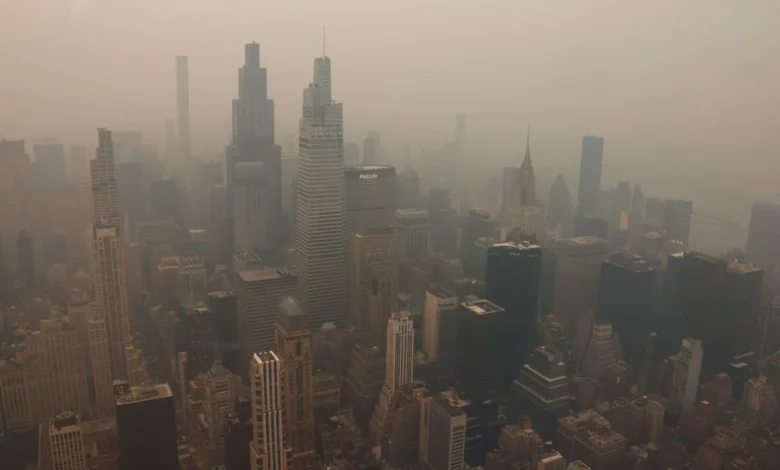
The environmental situation has evolved rapidly over the past week. Wildfire plumes have blanketed more than a dozen states, transforming the iconic New York City skyline into a hazy, orange-tinted landscape reminiscent of a dystopian film. On Thursday, New York state officials issued a sweeping health advisory as the Air Quality Index (AQI) surged into the “unhealthy” and “very unhealthy” categories. Residents were urged to limit outdoor exposure, yet the preparations for the world’s biggest game have continued largely unabated, highlighting a perceived disconnect between public health warnings and the commercial momentum of professional sports.
A Precarious Timeline: From Practice to the Pitch
The trajectory of this air quality crisis began early in the week when smoke from Canadian provinces began drifting southward, caught in a weather pattern that funneled particulate matter directly into the densely populated corridors of the East Coast. By Wednesday, visibility in the New York metropolitan area had dropped significantly, and by Thursday, the situation reached a critical threshold.
The Spanish national team, one of the two finalists, conducted an outdoor training session in New Jersey on Thursday despite the air quality alerts. Observers noted the hazy conditions surrounding the practice facility, raising immediate concerns among medical professionals. Dr. Courtney Howard, an emergency room physician and representative for the Global Climate and Health Alliance, emphasized the unique risks faced by soccer players. High-level athletes, she noted, move massive volumes of air through their lungs during intense physical exertion. When that air is saturated with wildfire smoke—composed of fine particulate matter known as PM2.5—the potential for internal inflammation and respiratory distress increases exponentially.
As of Friday morning, monitoring stations near the East Rutherford stadium reported air quality levels still lingering in the "unhealthy" range. While meteorological forecasts suggest a potential shift in wind patterns that could improve conditions to "moderate" by Sunday’s kickoff, the volatility of smoke plumes remains a significant variable. For a tournament that has lasted five weeks and spanned various climate-sensitive regions, this final hurdle represents the most direct confrontation between global sport and the realities of a changing climate.
The Physiological Stakes: Impact on Players and Fans
The health implications of playing a 90-minute (or longer) championship match in poor air quality are profound. Soccer is a sport defined by high-intensity interval sprinting and sustained aerobic output. During a match, a professional player can inhale more than ten times the volume of air that a sedentary person does. If that air is laden with wildfire smoke, the lungs are effectively acting as high-speed filters for toxic particulates.
Short-term symptoms of exposure include throat irritation, persistent coughing, stinging eyes, and severe headaches. For athletes, these symptoms can lead to reduced lung function and decreased performance. More alarmingly, the fine particulates in wildfire smoke can enter the bloodstream, potentially triggering cardiovascular stress.
The risk extends beyond the pitch to the 80,000 fans expected to fill the open-air stadium. MetLife Stadium, unlike some modern indoor arenas, has no retractable roof or climate-controlled seal. This leaves the crowd—including children, the elderly, and individuals with pre-existing conditions like asthma—completely exposed to the ambient environment. In a stadium of that size, medical infrastructure is already strained by standard emergencies; a mass respiratory event triggered by smoke would present an unprecedented logistical challenge for local health authorities.
Institutional Divergence: FIFA vs. Domestic Leagues
One of the primary criticisms leveled against FIFA in the lead-up to Sunday is its lack of a standardized air quality policy. This stands in stark contrast to several North American sports leagues that have already implemented rigid triggers for rescheduling or modifying play.
For example, the National Women’s Soccer League (NWSL) maintains a policy where an AQI of 101 (Unhealthy for Sensitive Groups) triggers mandatory hydration and cooling breaks, while an AQI exceeding 200 (Very Unhealthy) necessitates the postponement or cancellation of the match. Earlier this week, these protocols were put into action during a match at Citi Field in New York, where players were given additional breaks to mitigate the effects of the haze. Similarly, Major League Baseball (MLB) rescheduled a game in Philadelphia this week, and Major League Soccer (MLS) canceled a fixture in Chicago as smoke levels peaked.
In contrast, FIFA’s existing protocols focus almost exclusively on extreme heat. The governing body does have "Cooling Break" regulations, which were famously utilized during the 2014 World Cup in Brazil and the 2022 World Cup in Qatar. These rules allow for three-minute breaks in each half if the Wet Bulb Globe Temperature (WBGT) exceeds 32°C (89.6°F). However, when questioned by journalists regarding wildfire smoke, FIFA pointed to general "climate-related risk assessment" language rather than a specific AQI-based threshold for stopping play.
Expert Analysis: The "Bullet Dodged" Mentality
Nicholas Watanabe, a professor of sport and entertainment management at the University of South Carolina, suggests that FIFA’s lack of preparation is a gamble that may only pay off through sheer luck. He notes that while the current forecast might allow the game to proceed, the lack of a backup plan for an event of this magnitude is a glaring administrative failure.
"FIFA seems unprepared for these wildfires," Watanabe stated. He observed that the organization appears to be banking on the smoke dissipating just in time for the final. While this may save the Sunday schedule, it does little to address the systemic threat that climate-driven events pose to international sports. The "dodge a bullet" approach is increasingly untenable as wildfires become more frequent and severe across the globe.
The criticism is not limited to academics. Players themselves are beginning to vocalize their concerns about the intersection of sport and environmental safety. Trinity Rodman, a star in the NWSL who recently played in smoke-affected conditions, questioned the logic of playing through such hazards. Her sentiment was echoed by Tour de France leader Tadej Pogačar, who suggested that the entire global sporting calendar might need to be shifted to avoid the peak "danger seasons" of heat and smoke.
Broader Implications for the Future of Global Sport
The situation in New York serves as a microcosm for the future of the FIFA World Cup and other mega-events. As FIFA prepares for future tournaments—including the expanded 2026 edition which will feature 48 teams across Canada, Mexico, and the United States—the geographic diversity of host cities will expose the tournament to a wider array of environmental risks. From the heat of Monterrey to the potential smoke of Vancouver or Seattle, the 2026 tournament will require a level of environmental sophistication that FIFA has yet to demonstrate.
The lack of a "Plan B" for the Sunday final also highlights the economic pressures that often override safety concerns. The World Cup final represents billions of dollars in broadcast revenue, sponsorship deals, and tourism impact. Postponing such an event creates a "logistical nightmare" involving international travel, stadium security, and global television slots. However, critics argue that the "too big to fail" nature of the game should not come at the cost of player health.
Conclusion: A Wake-Up Call for Governing Bodies
As the clock ticks toward Sunday’s kickoff, the eyes of the world are on the skies over New Jersey. If the winds hold and the smoke clears, Lionel Messi and Lamine Yamal will lead their teams onto the pitch for a historic encounter. But even a successful match will not erase the questions raised this week.
The 2024 final may well be remembered not just for the goals scored, but as the moment when the world’s most powerful sporting organization was forced to reckon with the reality of a warming planet. The call for standardized, science-based regulations regarding air quality is growing louder. For FIFA, the lesson is clear: in an era of climate volatility, luck is not a sustainable strategy. Whether or not a "bullet is dodged" this weekend, the need for a comprehensive, transparent plan for climate risks is no longer optional—it is a prerequisite for the future of the beautiful game.