New report shows consumers are using AI more, which likely explains growing skepticism about its accuracy, automation, and influence.

The widespread adoption of artificial intelligence tools by consumers has reached unprecedented levels, yet this integration into daily life is paradoxically accompanied by a noticeable cooling of public enthusiasm and a rise in skepticism. A new study, Prophet’s "2026 AI-Powered Consumer Report," reveals that generative AI adoption has surged to 73% in 2026, a substantial leap from 45% just two years prior in 2024. This rapid acceleration underscores how quickly these sophisticated tools have transitioned from technological novelties to integral components of consumer routines, from information retrieval to creative tasks and customer service interactions.
The Rapid Ascent of Generative AI
From Niche to Ubiquitous: AI’s Inexorable Integration
The dramatic increase in generative AI adoption, nearly doubling in two years, signifies a fundamental shift in how individuals interact with technology. Tools like advanced chatbots, image generators, and content creation platforms have become increasingly accessible and intuitive, driving this swift assimilation. Initially, these platforms captivated users with their ability to perform complex tasks, generate creative content, and offer personalized experiences at a speed and scale previously unimaginable. This ease of access, coupled with extensive media coverage and early adopter evangelism, propelled generative AI into the mainstream consciousness, making it a ubiquitous presence across various digital touchpoints.
Key Drivers of Adoption: Convenience and Capability
Several factors have fueled this exponential growth. The proliferation of AI-powered features in existing popular applications and devices has significantly lowered the barrier to entry for many consumers. From smart assistants that streamline daily tasks to AI-enhanced search engines that provide more nuanced answers, and creative suites that democratize design and content production, the utility of AI has become undeniable. For many, AI offers compelling solutions for efficiency, productivity, and entertainment, allowing them to automate repetitive tasks, explore new creative avenues, or simply find information more quickly. The promise of an effortlessly enhanced digital experience was a powerful draw, encouraging experimentation and consistent use.
The Initial Wave of Enthusiasm: A Glimmer of the Future
In its nascent stages, generative AI was met with widespread excitement and optimism. Early users and industry observers alike heralded it as a transformative technology poised to revolutionize industries, redefine work, and fundamentally alter human-computer interaction. This initial period was characterized by a sense of wonder at AI’s capabilities, with many envisioning a future where intelligent systems seamlessly handled complex decisions and enhanced nearly every facet of life. Marketers, in particular, saw immense potential for creating hyper-personalized campaigns, automating customer interactions, and generating innovative content at scale, viewing AI as a key differentiator in a competitive landscape.

The Dawn of Disillusionment: A Shift in Consumer Sentiment
Cooling Enthusiasm and the Utility Perception
However, the Prophet report highlights a significant pivot in consumer sentiment. While adoption soars, overall consumer excitement surrounding AI has declined by 7%. This erosion of enthusiasm suggests that the initial awe and fascination have begun to wane, replaced by a more pragmatic view. Consumers are increasingly perceiving AI not as a magical innovation, but rather as a utilitarian tool – another piece of software designed to perform specific functions. For marketers, this shift carries profound implications. The mere presence of AI in a product or service no longer confers a competitive advantage; instead, the focus must pivot towards demonstrating tangible value, reliability, and ethical implementation. The novelty factor, once a powerful draw, has largely dissipated.
Gartner’s Trough of Disillusionment: Reality Sets In
This evolving perception aligns closely with Gartner’s Hype Cycle, a widely recognized model describing the maturity, adoption, and social application of specific technologies. The cycle posits that after an initial "Peak of Inflated Expectations," technologies often descend into a "Trough of Disillusionment," where interest wanes as experiments and implementations fail to deliver on exaggerated promises. The Prophet report suggests that AI is firmly entering this trough, as the public confronts the practical limitations, ethical dilemmas, and imperfect realities of these advanced systems. This phase is critical for the technology’s long-term viability, as it necessitates a re-evaluation of expectations and a focus on solving real-world problems rather than chasing unrealistic visions.
Eroding Faith in AI’s Grand Promises: A Realistic Outlook
Further evidence of this disillusionment is the 30% drop in the number of consumers who believe generative AI will become deeply interwoven into everyday life and autonomously manage most decisions. This significant decline indicates a growing public skepticism towards the grand, often utopian, promises once made about AI’s ultimate capabilities and societal integration. Instead of viewing AI as an all-encompassing intelligence that will simplify and optimize every aspect of existence, consumers are adopting a more measured and realistic perspective. They are recognizing that while AI offers powerful tools, it also comes with inherent limitations and potential pitfalls, suggesting a desire for human oversight and control in critical domains. This nuanced understanding reflects a maturing relationship between consumers and artificial intelligence, moving beyond blind acceptance towards a more critical engagement.
Rising Concerns: Accuracy, Misinformation, and Human Connection

The Accuracy Imperative: Trust Under Scrutiny
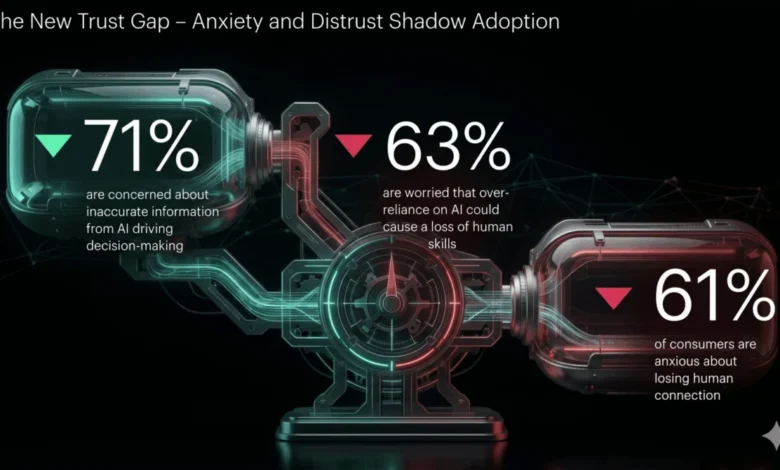
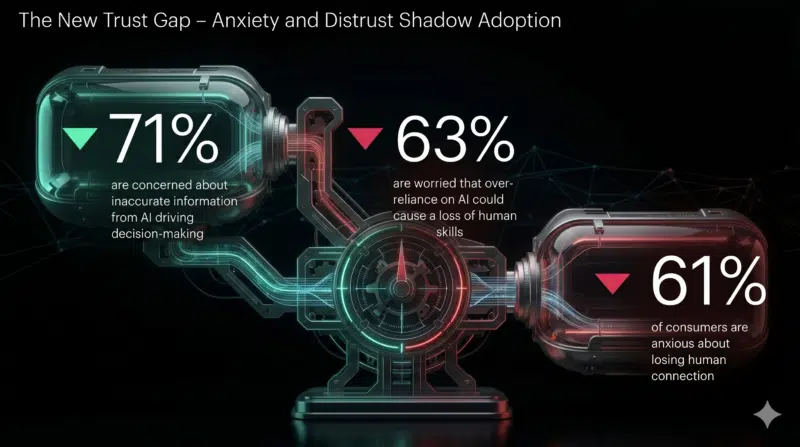
The widespread adoption of AI has inevitably brought its inherent flaws into sharper focus, leading to a surge in consumer anxieties. The report finds that a staggering 71% of consumers are now concerned about AI inaccuracies and the potential for misinformation. This concern is particularly acute as AI systems become more deeply embedded in sensitive and impactful areas of daily life, such as online shopping recommendations, crucial customer service interactions, and independent online research. When AI provides incorrect product information, delivers unhelpful or misleading customer support, or generates factually inaccurate summaries, the direct consequences on consumer trust and decision-making become starkly apparent. The reliability of AI outputs is no longer a theoretical debate but a practical concern impacting daily choices and experiences.
The "Hallucination" Factor and its Consequences: Undermining Credibility
A significant contributor to this accuracy crisis is the phenomenon of AI "hallucinations," where models generate confident but entirely fabricated information. These errors, often subtle and difficult to detect without external verification, can range from incorrect statistics to invented citations or non-existent products. As AI is increasingly used for tasks requiring factual integrity—from medical inquiries to financial advice or educational content—the implications of such inaccuracies are profound. The erosion of trust stemming from these inconsistencies poses a substantial challenge for AI developers and deployers, as consumers are less likely to rely on systems they perceive as unreliable or untrustworthy. Building robust mechanisms for fact-checking, source attribution, and transparency is becoming paramount.
The Desire for Human Touch: Combating AI Fatigue
Beyond concerns about accuracy, consumers are also expressing a clear preference for human interaction, especially when faced with complex or emotionally charged issues. About 62% of consumers reported feeling frustrated when companies completely remove human support, even if automated systems promise faster and more efficient resolutions. This "AI fatigue" highlights a fundamental human need for empathy, nuanced understanding, and problem-solving capabilities that current AI systems often struggle to replicate. While chatbots can handle routine queries efficiently, they frequently fall short when dealing with unique problems, expressing genuine concern, or navigating complex emotional states. The tension between the perceived efficiency of automation and the inherent value of human connection is creating significant pressure on brands to strike a delicate balance.
Broader Anxieties: Relationships, Creativity, and Authenticity
The report further suggests a growing undercurrent of anxiety among consumers regarding AI’s broader societal implications. Many are concerned about what the pervasive integration of AI could mean for the authenticity of human relationships, the future of creative expression, and the overall quality of everyday experiences. Questions arise about the impact of AI on genuine human connection if interactions are increasingly mediated by algorithms. There are also concerns about the devaluation of human creativity if AI can generate content indistinguishably from human artists. This deeper, more personal apprehension reflects a philosophical unease about AI’s potential to diminish unique human attributes and experiences, moving beyond mere functionality to the very essence of human existence.
Implications for Industry and Policy
A New Mandate for Marketers: From Novelty to Trust and Value
The findings of the Prophet report present a crucial juncture for the marketing industry. The initial gold rush mentality, where simply deploying AI was seen as innovative, is now obsolete. Marketers must shift their strategies from highlighting AI as a novelty to emphasizing its verifiable value, reliability, and ethical underpinnings. This necessitates a focus on transparency about AI’s role in consumer interactions, ensuring accuracy in AI-generated content, and strategically integrating human elements to complement, rather than completely replace, automated systems. Brands that can effectively communicate how AI enhances their offerings without compromising trust or human connection will be the ones that succeed in this maturing landscape. Building brand loyalty in the AI era will hinge on perceived trustworthiness and genuine utility, rather than technological flash.
The Challenge for AI Developers: Prioritizing Ethics and Accuracy
For AI developers and companies, the report serves as a stark reminder that technological advancement alone is insufficient. The emphasis must now unequivocally shift towards improving the foundational accuracy of AI models, mitigating biases, and designing systems with robust ethical safeguards. This includes investing more heavily in data quality, developing advanced methods for error detection and correction, and implementing human-in-the-loop processes where critical decisions or sensitive interactions require human oversight. The pressure is mounting for developers to move beyond performance metrics to prioritize responsible AI development that builds and maintains public trust, ensuring that the technology serves humanity rather than creating new problems.
Regulatory Scrutiny and Consumer Protection: The Call for Governance
The growing consumer skepticism and anxieties about AI accuracy and influence will inevitably intensify regulatory scrutiny. Governments and consumer advocacy groups worldwide are likely to demand greater transparency from AI developers and deployers regarding how these systems operate, how they handle data, and what measures are in place to prevent misinformation or harmful outcomes. Policymakers may explore new legislation to mandate ethical AI development, establish clear guidelines for AI usage in consumer-facing applications, and ensure avenues for consumer recourse when AI systems cause harm. The era of unchecked AI development is drawing to a close, ushering in a period where governance and accountability will play a more prominent role in shaping the technology’s future.
Balancing Efficiency with Empathy: The Hybrid Model Imperative
Ultimately, the report underscores the critical need for businesses to adopt a balanced approach to AI implementation. While the efficiency gains offered by AI are undeniable and often essential for scalability, these benefits must be weighed against the persistent consumer demand for human connection and empathy. A hybrid model, where AI handles routine tasks and augments human capabilities, leaving complex problem-solving and sensitive interactions to human agents, appears to be the most viable path forward. This strategic integration allows companies to leverage AI’s strengths while preserving the vital human touch that fosters trust, resolves nuanced issues, and maintains positive customer relationships. Businesses that master this delicate balance will be best positioned to thrive in the evolving AI-powered consumer landscape.
Expert Commentary and Future Outlook

Leading industry analysts observe that this "trough of disillusionment" is a natural and necessary phase for any groundbreaking technology. "The initial hyper-optimism was unsustainable," states Dr. Anya Sharma, a technology ethicist at the Institute for Digital Futures. "What we’re seeing now is a maturation of consumer understanding. People are no longer just impressed by what AI can do, but critically evaluating what it should do, and how reliably it performs those functions." This period of introspection is crucial for AI to move towards a "Slope of Enlightenment," where its true benefits and practical applications become clearer and more widely accepted.
The path forward for AI is not one of abandonment but of refinement and responsible integration. For AI to realize its full potential, sustained efforts must focus on fostering trust through transparency, ensuring accuracy in all applications, and designing systems that complement, rather than diminish, human experience. The imperative for developers, businesses, and policymakers alike is to collaborate on creating an AI ecosystem that prioritizes ethical considerations, robust reliability, and genuine human value. The future of AI hinges not just on its computational prowess, but on its ability to earn and maintain the trust of the very consumers it aims to serve.
The full Prophet "2026 AI-Powered Consumer Report" is available for review on Prophet’s official website, requiring no registration for access. MarTech, owned by Semrush, remains dedicated to delivering high-quality, factual coverage of marketing topics, with this article’s content contributed by an employee or paid contractor of Semrush Inc.
Related posts: