The Evolution of LLM Integration in Machine Learning
The landscape of machine learning has undergone a radical transformation over the past three years. Traditionally, machine learning pipelines relied on supervised learning, where models were trained on labeled datasets to perform specific tasks such as classification or regression. The advent of Large Language Models, particularly those utilizing transformer architectures, shifted this paradigm toward generative inference. However, integrating these models into production environments often presented a dilemma: utilize convenient but costly proprietary cloud APIs, or invest in the significant technical overhead of managing GPU-accelerated infrastructure.
Scikit-LLM emerged as a solution to this fragmentation. By allowing developers to utilize familiar .fit() and .predict() methods, it provides a layer of abstraction that makes LLMs behave like standard scikit-learn estimators. This enables developers to create zero-shot classification engines—systems capable of categorizing text based on semantic understanding without requiring a massive, labeled training set. When paired with local execution environments like Ollama, which allows for the deployment of models like Llama 3 on consumer-grade hardware, the result is a democratized approach to AI deployment that is both scalable and private.
Establishing the Technical Foundation
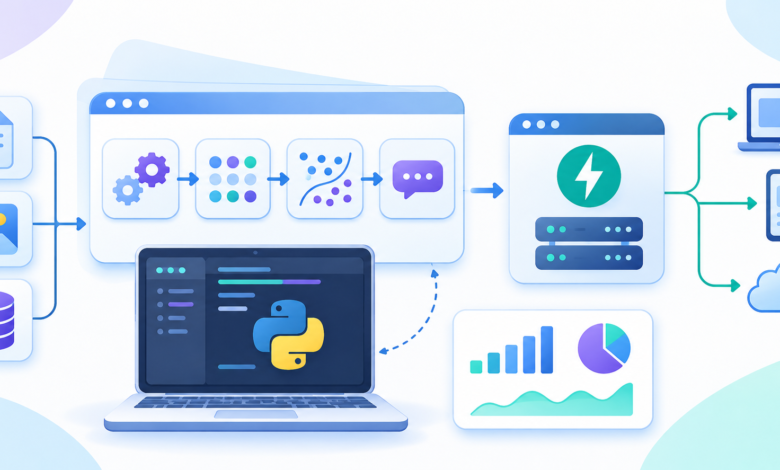
The deployment of a local inference pipeline requires a precise orchestration of software components. The foundational stack consists of Python 3.11, the Scikit-LLM library, FastAPI for web service management, and Ollama for local model hosting.
The process begins with environment configuration. Developers must ensure that all dependencies are strictly managed, typically through a virtual environment to prevent version conflicts. The installation of essential libraries—scikit-llm, fastapi, uvicorn, joblib, and pydantic—forms the backbone of the application. Once these libraries are provisioned, the focus shifts to model availability. Ollama acts as the interface between the application and the local LLM. By pulling a model such as llama3, developers create a persistent local endpoint that mimics the behavior of standard OpenAI-compatible APIs, allowing for a seamless transition from development to production.
Chronology of Pipeline Deployment
The implementation process follows a structured sequence: configuration, serialization, and serving.
-
Pipeline Training and Serialization: In the initial phase, a script—typically named
train.py—is executed. This script defines the zero-shot classifier and points the Scikit-LLM configuration to the local Ollama URL (typicallyhttp://localhost:11434/v1/). By calling the.fit()method with a small set of example labels and input texts, the model is initialized. Crucially, the pipeline is then serialized into a.joblibfile. This step is vital because it allows the model to be loaded into memory instantly when the API server starts, preventing the need to re-initialize the model with every incoming request. -
API Orchestration with FastAPI: The second phase involves
app.py, which serves as the entry point for the REST API. FastAPI is chosen here for its support of asynchronous operations. By utilizing anasynccontextmanagerfor the application’s lifespan, the model is loaded into the server’s memory once during startup. The endpoint, defined as a POST request at/predict, accepts JSON input. To ensure that the server remains responsive even during the computationally intensive inference phase, the code utilizesasyncio.to_thread. This offloads the blocking Scikit-LLM I/O to a background thread, ensuring that the API can handle multiple requests concurrently without degradation in performance.
Data Security and Operational Efficiency
One of the most significant implications of this architecture is the shift in data privacy. When using cloud-based APIs, sensitive corporate or user data must be transmitted to external servers, creating potential compliance risks under regulations such as GDPR or HIPAA. By moving to a local, self-hosted Ollama environment, data never leaves the local network. This isolation is a major selling point for financial services, healthcare, and legal sectors, where data sovereignty is a non-negotiable requirement.
Furthermore, the economic impact is substantial. Cloud LLM providers typically operate on a consumption-based pricing model, where costs scale linearly with the number of tokens processed. In a high-traffic environment, these costs can become unpredictable and prohibitive. Conversely, a local stack requires only the initial investment in hardware and energy, providing a fixed cost structure that is significantly more sustainable for high-volume inference tasks.
The Role of Deterministic Output in Production
While LLMs are often associated with creative, stochastic generation, their use in zero-shot classification requires a degree of determinism. Scikit-LLM addresses this by wrapping the model’s output within a structured classification framework. By providing the model with a predefined set of labels—such as "Battery Issue," "Positive Feedback," or "Hardware Damage"—the pipeline constrains the output, forcing the model to map input text to the most statistically probable category.
This behavior mimics traditional machine learning classifiers, making the output predictable and easy to integrate into downstream automated processes, such as ticketing systems, automated customer support triage, or sentiment analysis dashboards.
Broader Industry Implications and Future Outlook
The ability to wrap complex reasoning tasks in a standard REST API signals a maturation of the AI/ML industry. We are moving away from the era of "AI novelty" toward an era of "AI utility," where the focus is on reliability, latency, and cost-efficiency.
Industry analysts observe that as hardware acceleration for local LLMs improves—through advancements in quantization techniques and more efficient inference engines—the reliance on massive cloud-based models for specific, narrow-domain tasks will likely decrease. Developers are no longer restricted to the models offered by big-tech providers; they can choose the best-in-class open-source model that fits their specific performance and accuracy requirements, deploy it on-premises or on their own cloud instances, and manage it via standardized Python interfaces.
Final Considerations and Maintenance
Deploying a self-hosted inference API is not without its challenges. Developers must remain vigilant regarding:
- Model Resource Management: Local LLMs are memory-intensive. Monitoring the RAM and VRAM usage of the Ollama process is essential to ensure that the server does not crash under high load.
- Version Pinning: As both
scikit-llmandollamaare evolving rapidly, strict version control inrequirements.txtis necessary to prevent breaking changes from interrupting production services. - Latency Trade-offs: While local inference eliminates network transit time to a cloud provider, it is limited by the local hardware’s processing power. For extremely high-throughput applications, scaling might require clustering multiple instances of the API behind a load balancer, with each instance managing its own model worker.
Ultimately, the combination of Scikit-LLM and FastAPI represents a powerful, accessible, and robust toolkit for any developer looking to bridge the gap between cutting-edge LLM research and practical, high-performance production software. By taking control of the entire inference stack, organizations can ensure that their AI systems are not only intelligent but also efficient, secure, and entirely under their own jurisdiction.