The Ultimate 2026 Social Media Image Sizes Guide: A Comprehensive Standard for Digital Marketers


The digital landscape of 2026 demands absolute visual precision, as brands and content creators navigate an increasingly fragmented ecosystem of platforms, application programming interfaces (APIs), and display devices. In an era where visual identity serves as the primary touchpoint between an organization and its target audience, maintaining exact social media image dimensions is no longer merely a technical preference—it is a critical component of brand integrity and audience engagement. Recent benchmark data underscores the stakes: static imagery accounts for nearly half of all brand-generated content on major networks like Facebook, while emerging channels like Bluesky and Threads continue to shift user expectations toward dynamic, community-centric sharing. Consequently, failing to adhere to platform-specific pixel dimensions, aspect ratios, and file limits routinely results in compromised visual quality, aggressive auto-cropping, and diminished user trust.
Background Context and the Evolution of Multi-Platform Publishing
The challenge of cross-platform asset management has grown exponentially over the past decade. As social media networks evolved from simple text-and-image scrapbooks into immersive, multi-format media hubs incorporating ephemeral Stories, vertical video reels, and interactive carousels, the technical requirements for digital assets diverged wildly. In the early days of social media marketing, content teams could deploy a single square graphic across multiple channels with minimal degradation. Today, however, automated scheduling tools and native platform algorithms enforce strict boundaries.
For instance, Instagram’s API restricts feed images to aspect ratios strictly between 4:5 and 1.91:1, automatically rejecting assets that fall outside these parameters. Similarly, platforms like X (formerly Twitter), LinkedIn, and TikTok have continually refined their display architectures to optimize for mobile-first consumption. This divergence forces marketing departments to either manually re-export dozens of variations for a single campaign or leverage centralized asset management and resizing technologies to maintain workflow efficiency.
Comprehensive Platform Specifications for 2026
To combat the friction of multi-channel publishing, digital strategists rely on established baseline dimensions while tailoring assets to specific platform interfaces. Across the digital ecosystem, a universal feed size of 1080 by 1080 pixels (a 1:1 aspect ratio) remains the safest fallback for standard feed posts on networks such as Instagram, Facebook, LinkedIn, Bluesky, and Threads, as it displays cleanly without automatic cropping. However, platform-specific optimization requires a deeper dive into granular measurements:
Instagram continues to prioritize vertical real estate, recommending 1080 by 1350 pixels (4:5 ratio) for feed posts and carousels, alongside 1080 by 1920 pixels for Stories and Reels. Profile pictures on the platform display at 110 by 110 pixels, though uploading higher-resolution source files ensures clarity.
Facebook balances desktop and mobile rendering by utilizing 320 by 320 pixels for profile pictures, 851 by 315 pixels for business page cover photos, and 1080 by 1350 pixels for primary timeline image posts.
LinkedIn, catering to a global professional network exceeding 1.3 billion members, mandates 400 by 400 pixels for personal profile images and 1512 by 256 pixels for personal cover photos. Company pages on LinkedIn require distinct logo dimensions of 300 by 300 pixels and larger banner dimensions of 1128 by 191 pixels to maintain corporate credibility.
X maintains robust support for in-stream visual content, recommending 1600 by 900 pixels for primary post images, alongside 400 by 400 pixels for profile avatars and 1500 by 500 pixels for profile headers.
TikTok and Snapchat remain anchored in vertical storytelling, universally requiring 1080 by 1920 pixels for full-screen video and photo mode carousels, paired with compact profile imagery to fit circular interface overlays.
Emerging platforms such as Bluesky and Threads reflect the modern shift toward decentralized and conversational spaces. Bluesky supports high-resolution image rendering up to 4000 pixels following recent protocol updates, while maintaining standard 1:1 avatar crops and 3:1 banner configurations. Threads relies heavily on Instagram’s foundational architecture, smoothly integrating vertical and square imagery directly into its conversational feeds.
Data-Driven Analysis of Visual Strategy and Engagement
Industry analytics from major content benchmark reports highlight the direct correlation between image optimization and audience engagement. When brands deploy improperly sized assets, platforms intervene by cropping critical focal points, compressing resolution, or rendering images blurry. Data indicates that audiences interpret these technical oversights as a lack of attention to detail, directly impacting brand perception during initial consumer interactions. Furthermore, automated scheduling tools—which connect directly to platform APIs—enforce even stricter constraints than native mobile applications. Marketers who fail to align their source files with these programmatic rules frequently experience publishing errors, delayed campaigns, and suboptimal content distribution.
Industry Responses and the Shift Toward Centralized Workflows
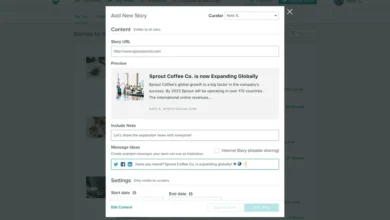
Digital marketing agencies and enterprise communications teams have increasingly spoken out regarding the administrative burden of asset resizing. Industry experts note that bouncing between disparate editing suites to manually resize creative assets for twelve or more distinct placements wastes valuable team hours each week. In response, technology providers have introduced integrated publishing and resizing ecosystems. Tools such as Sprout Social’s Landscape allow creators to input a single master asset and automatically export scaled variations tailored to every major social network. Furthermore, native integrations with design platforms like Canva and centralized digital asset libraries have become standard operating procedure for modern marketing departments, ensuring brand consistency and eliminating format-related publishing errors before they reach the public.
Broader Implications and Future Outlook
As social media algorithms continue to favor native, high-immersion visual formats, the demand for precise asset engineering will only intensify. The integration of high-definition multi-image carousels, expansive vertical feeds, and interactive ad units means that creative teams must adopt a design-once, adapt-intelligently framework. Organizations that invest in standardized creative guidelines, robust digital asset management systems, and automated resizing workflows will significantly reduce operational friction while maximizing the visual impact of their digital campaigns. Ultimately, mastering social media image dimensions is no longer a tactical afterthought—it is a foundational pillar of modern brand communication and digital survival.