AI Traffic Is Now a Revenue Powerhouse for Retailers While Readability Gaps Persist


The landscape of e-commerce is undergoing a fundamental shift as artificial intelligence transitions from an experimental curiosity into a dominant driver of consumer behavior and financial performance. Recent data from Adobe indicates that traffic referred by AI systems now generates 83% more revenue per visit than non-AI traffic, signaling a maturation in how consumers utilize large language models and generative AI tools to inform their purchasing decisions. In September 2026, the conversion rate for AI-referred traffic surpassed that of traditional search and social referrals by 90%, confirming that the path to purchase is increasingly being mediated by algorithmic intermediaries.
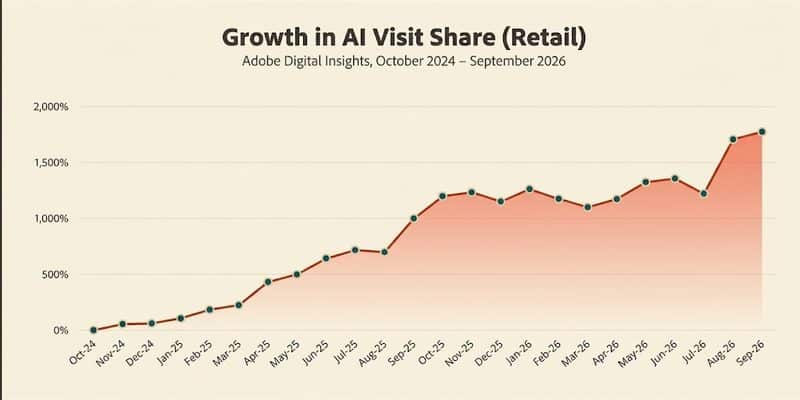
This surge in economic value represents a stark reversal from the previous year. In August 2025, AI-driven traffic actually lagged behind standard channels, converting at a rate 9% lower than non-AI sources. The rapid acceleration over the subsequent 13 months—marked by a 1,772% increase in AI-referred traffic since October 2024—suggests that users are becoming more proficient at using AI to conduct deep-funnel research, effectively shortening the customer journey once they arrive at a retailer’s digital storefront.

A Chronology of the AI Shift in Retail
The trajectory of AI-assisted shopping has moved through three distinct phases since late 2024. In the initial adoption phase, AI was largely utilized for broad discovery or entertainment, resulting in high traffic volume but low commercial intent. Retailers observed that while users were "browsing" via AI, the hand-off to the brand website was often disjointed, leading to the lower conversion rates seen in mid-2025.
By early 2026, the integration of shopping assistants into search engines and browser interfaces began to change the user behavior model. Consumers began performing complex, comparative research within the AI interface, effectively "pre-qualifying" themselves before clicking through to a product page. By September 2026, this shift reached a tipping point. The data reveals that AI-referred visitors are not merely casual observers; they exhibit higher engagement metrics, including 73% more time spent on site, a 25% increase in page views, and a 53% higher rate of adding items to their digital shopping carts.
This shift suggests that for the modern consumer, the retailer’s landing page is no longer the starting point of the discovery process. Instead, it serves as the final, critical touchpoint in a journey that begins with a conversational inquiry elsewhere.

The Readability Hurdle: Why Content Stalls
Despite the impressive growth in conversion, a significant technical barrier remains: the "readability gap." Adobe’s Citation Readability Score, a metric designed to measure how effectively AI systems can interpret, synthesize, and cite information from a website, reveals that the average U.S. retail homepage is only 63% understandable to current AI models. This means more than one-third of the content on these pages is effectively invisible or unusable to the AI assistants that are increasingly acting as the gatekeepers of digital traffic.
The implications of this are profound. If an AI cannot reliably "read" or cite a product’s specifications, price, or availability, it is less likely to recommend that product to a user seeking a specific solution. The disparity between categories is notable; electronics retailers, which often prioritize structured, technical, and informational content, lead the market with a 79% readability score. This success is largely attributed to their reliance on detailed specification sheets, troubleshooting guides, and formalized customer service documentation—content types that are inherently structured and easy for large language models to parse.
In contrast, general merchandise retailers lag significantly, with homepage readability scores averaging just 40%. This is frequently due to design-heavy, promotional, or navigation-oriented layouts that prioritize aesthetic impact over textual clarity. While visually appealing to human users, these pages often lack the semantic structure required for AI to accurately index the information, potentially causing these retailers to lose out on high-intent traffic.
Strategic Implications for Marketing Operations
For marketing departments, these findings mandate a shift in measurement strategy. The conventional reliance on raw traffic volume as a primary KPI is becoming obsolete. Because AI-referred traffic carries a significantly higher revenue-per-visit profile, teams must pivot to tracking post-click behavior as the true indicator of success.
Marketing operations teams are advised to evaluate AI traffic as a distinct acquisition channel, similar to how they would treat affiliate or paid search traffic. This requires granular segmentation of landing pages based on their "AI-friendliness." By A/B testing pages that have been optimized for readability—incorporating clear, descriptive, and structured data—against legacy pages, brands can determine the direct correlation between AI content accessibility and revenue growth.
Furthermore, the "finish line" strategy is becoming essential. If the consumer arrives at a site after extensive research in an AI assistant, they do not need to be "sold" on the product from the top of the funnel. Instead, the landing page must focus on the final transactional friction points: pricing, shipping, availability, and social proof. If these elements are not presented in a way that the user (and the preceding AI) can verify, the conversion rate will suffer.

The Future of SEO and AI Visibility
As the industry moves toward 2027, the relationship between search engine optimization and AI optimization is expected to converge. Traditional SEO has long focused on keywords and backlink authority; however, the new paradigm of "AI Optimization" focuses on context, clarity, and the ease with which an AI can synthesize information to provide a definitive answer to a user.
Industry analysts suggest that the retailers who win in the next phase of this transition will be those who treat their website content as a knowledge base for AI. This involves not only improving textual readability but also utilizing schema markup and structured data to explicitly define product relationships, policy details, and service protocols.
While the data provided by Adobe does not definitively prove that readability causes increased revenue, the correlation is too strong to ignore. The evidence suggests that as AI becomes the primary interface for the internet, the visibility of a brand will depend less on traditional search rankings and more on the ability of its content to survive the translation process into an AI-generated answer.

Broader Economic Impact
The dramatic rise in AI-referred conversion rates also highlights a shift in consumer trust. As users grow more comfortable with AI assistants, they are increasingly relying on these tools to filter the overwhelming volume of retail choices. This creates a "winner-take-all" dynamic where the brands that provide the clearest, most accurate, and most accessible data to AI systems will be the ones that receive the most traffic and, consequently, the highest revenue.
For smaller retailers or those with less technical infrastructure, this creates a new competitive challenge. The cost of failing to optimize for AI is no longer just a loss of visibility; it is a direct loss of revenue from a high-intent, high-conversion audience.
In conclusion, the data confirms that AI referrals have transitioned from a fringe traffic source to a core component of the retail revenue mix. The path forward for marketers is clear: prioritize content structure, audit the readability of high-value landing pages, and refine measurement models to reflect the unique behavior of the AI-empowered consumer. As the digital ecosystem continues to evolve, the ability to communicate with machines will become just as important as the ability to communicate with human shoppers.
Related posts: