Choosing an LLM Inference Optimization Technique: A Decision-Tree Approach

The Anatomy of the Inference Bottleneck
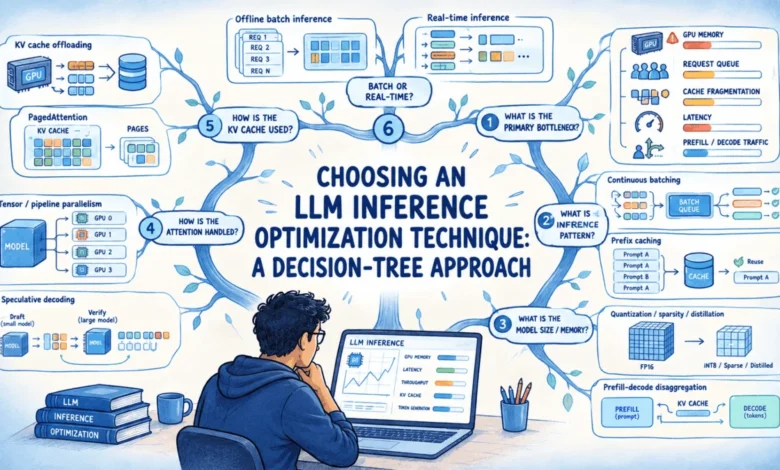
The modern LLM inference lifecycle is characterized by a high-intensity tug-of-war between compute resources and memory bandwidth. In a typical production environment, requests often queue behind long-form generations, causing a ripple effect that increases latency across the entire system. Simultaneously, GPU memory is frequently saturated by cached attention states—the KV (Key-Value) cache—leaving insufficient headroom for higher batch sizes.
Historically, the industry treated inference optimization as a monolithic challenge. However, current best practices suggest that developers must view optimization through a modular lens. Techniques are no longer "one-size-fits-all"; they are precision instruments designed to address specific hardware constraints. Understanding the underlying assumptions of each technique is the difference between a high-performing production cluster and a costly, underutilized infrastructure.
A Chronology of Optimization Development
The evolution of inference optimization has followed the rapid growth of transformer-based models.
- Early Phase (2020–2022): Initial focus centered on model compression, specifically static quantization and knowledge distillation. These were necessary to fit massive parameters into limited VRAM.
- The Scaling Phase (2022–2023): As chat-based interfaces exploded, the industry realized that naive batching was inefficient. This led to the adoption of continuous batching, which allowed new requests to join the inference pipeline without waiting for the entire batch to finish.
- The Memory Efficiency Phase (2023–2024): With the introduction of PagedAttention and KV cache management, the focus shifted toward preventing memory fragmentation. This enabled significantly higher concurrent user counts.
- The Advanced Architecture Phase (2024–Present): Current efforts involve disaggregation, where prefill and decoding phases are separated across different hardware nodes to balance compute-heavy prompt processing with latency-sensitive token generation.
The Six-Question Decision Framework
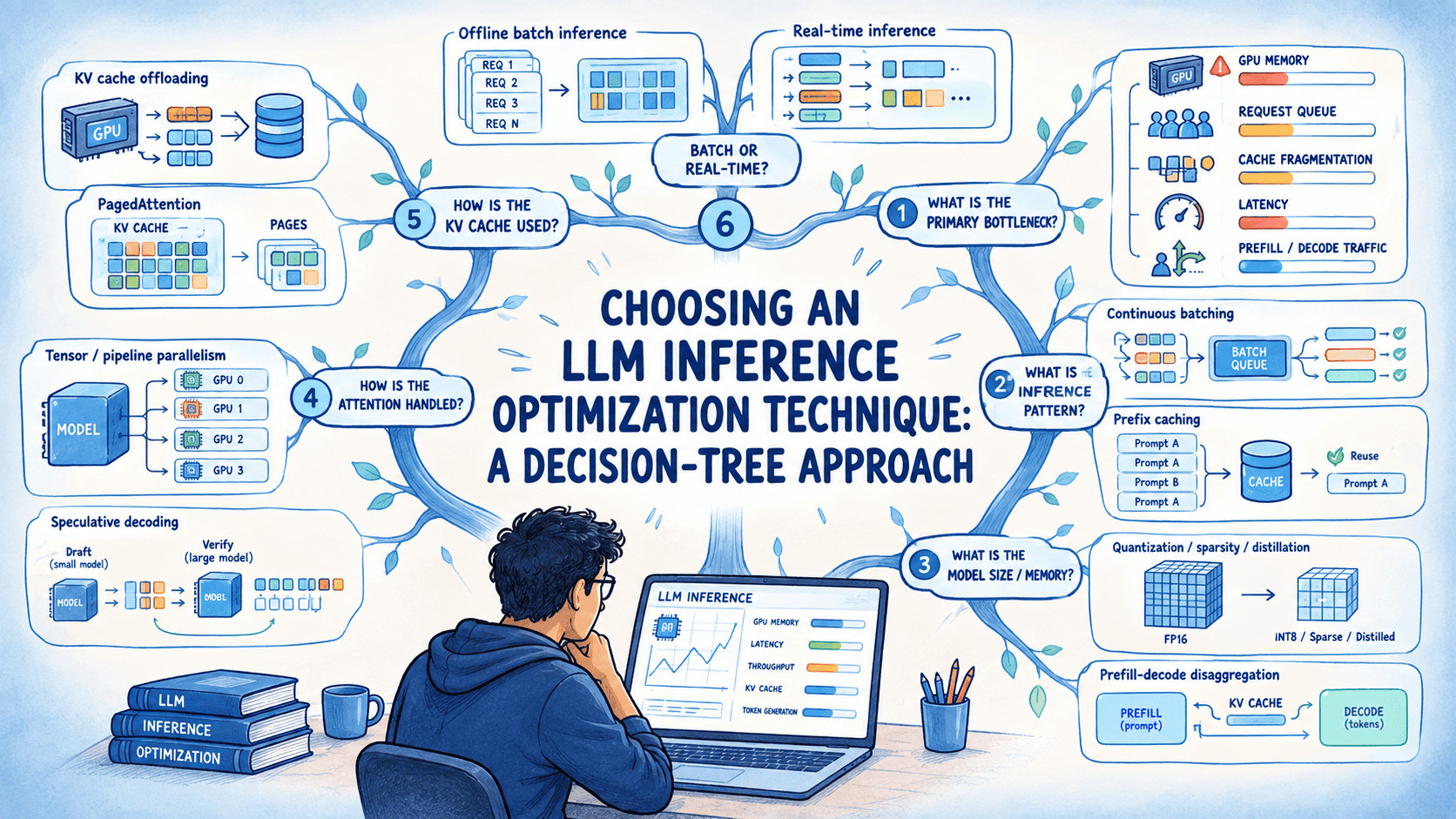
To determine the appropriate optimization strategy, engineers should apply a rigorous six-question diagnostic tree to their specific workload.
1. Hardware-Model Fit Assessment
The first step is determining if the model fits comfortably within the target hardware’s memory. If a model consumes 90% of GPU memory, there is no space for the KV cache, effectively capping the system at a batch size of one. In such cases, model-level compression—such as 4-bit quantization or sparsity-inducing pruning—is mandatory. These techniques function independently of the serving stack and establish the baseline capacity of the hardware.
2. Prompt Structure and Prefix Caching
In environments where users frequently interact with long, stable system prompts or recurring conversation histories, recomputing the KV cache for every turn is a massive waste of resources. Prefix caching allows the system to store and reuse the attention states of identical initial token sequences. This technique provides the highest leverage for RAG (Retrieval-Augmented Generation) and agentic frameworks where the "context" portion of the request remains static across multiple invocations.
3. Managing Variable Output Lengths
Production traffic is rarely uniform. A short, query-based request will finish seconds before a long-form code generation task. In naive serving environments, the short request waits for the long one to complete. Continuous batching solves this by allowing finished sequences to be replaced immediately by new requests, significantly improving GPU utilization rates.
4. Addressing KV Cache Fragmentation
Memory fragmentation is a silent killer of throughput. When an inference engine reserves a large, contiguous block of memory for every request based on the "maximum possible" output length, the majority of that space goes unused. PagedAttention, which draws inspiration from virtual memory management in operating systems, allows the KV cache to be partitioned into smaller, non-contiguous pages. This ensures that memory is allocated only as needed, effectively allowing for larger batch sizes.
5. Latency Sensitivity and Speculative Decoding
When the primary goal is reducing time-to-first-token or increasing the speed of token streaming, speculative decoding is the standard approach. By utilizing a smaller, "draft" model to predict a sequence of tokens that a larger "target" model then verifies in a single pass, systems can achieve significant speedups. The effectiveness of this approach, however, relies entirely on the draft model’s acceptance rate. If the draft model is inaccurate, the overhead of verification outweighs the performance gains.
6. Disaggregation at Scale
For high-traffic, enterprise-scale deployments, the contention between the prefill phase (processing the input) and the decode phase (generating the output) becomes a bottleneck. Prefill-decode disaggregation separates these tasks. By routing incoming requests to specialized "prefill nodes" and then passing the resulting KV cache to "decode nodes," organizations can independently scale their infrastructure to match the specific demands of their traffic profile.
Technical Implications and Performance Data
Industry analysis suggests that misapplying these techniques can lead to performance degradation rather than improvement. For instance, in a study of high-concurrency environments, enabling PagedAttention improved throughput by approximately 20–30% in scenarios where memory was previously the primary constraint. Conversely, attempting to implement speculative decoding on a workload with high variability and low model accuracy resulted in a 10% increase in latency due to the additional verification overhead.
Moreover, the "Quantization Trap" remains a common pitfall. Many developers apply weight-only quantization assuming it will lead to significant throughput gains. However, if the hardware continues to perform arithmetic at full precision (by dequantizing to 16-bit before computation), the theoretical gains of 8-bit or 4-bit weights are nullified. True optimization requires a holistic approach where activations and weights are quantized in tandem with hardware-aware kernels.
Strategic Recommendations
The path to optimized LLM inference is iterative. A typical, successful deployment strategy often begins with ensuring the model fits the hardware (Quantization) and that the serving engine is utilizing memory efficiently (PagedAttention and Continuous Batching). Only after these foundational layers are stable should an engineering team look to more advanced techniques like prefix caching or speculative decoding.
When a technique underperforms, the issue almost always resides in a mismatch between the technique’s assumptions and the reality of the workload. If the prefix cache hit rate is near zero, the issue is not the cache itself, but the non-deterministic nature of the prompts being fed into the system. If throughput gains are not manifesting, the bottleneck likely lies in an area the chosen technique was not designed to address.
Conclusion
The rapid commoditization of LLM serving engines has made advanced optimization accessible, but it has not made it trivial. The six-question decision tree serves as a vital diagnostic tool for engineering teams to avoid the "complexity trap." By systematically evaluating model fit, prompt structure, traffic patterns, memory management, and latency requirements, organizations can ensure that their inference infrastructure is not only fast and cost-effective but also capable of scaling alongside the evolving demands of generative AI. As the field moves toward more specialized hardware and distributed architectures, this rigorous, data-driven approach to inference will remain a hallmark of high-performance AI operations.