Why Cost Per Session and Vanity Metrics are Undermining Modern Marketing Strategies and Corporate Profitability

In contemporary corporate governance, the alignment between marketing expenditures and financial accountability remains a critical friction point between Chief Marketing Officers (CMOs) and Chief Financial Officers (CFOs). A strategic consulting engagement conducted for a multinational enterprise operating across 75 countries highlights a systemic vulnerability in how digital marketing performance is evaluated. During an early operational review, internal marketing sub-teams revealed that their primary key performance indicator (KPI) for campaign success was the Cost Per Session (CPS). This metric, designed merely to measure the cost-efficiency of driving anonymous web traffic, had been elevated to the status of a primary strategic objective.
The widespread reliance on traffic-centric metrics reflects a broader industry challenge: prioritizing operational activity over genuine business outcomes. For decades, traditional digital marketing frameworks have heavily relied on indicators such as impressions, views, and raw session volume. While these metrics provide quantifiable data on user reach, they fail to demonstrate economic value. Impressions and views, often described by analytics experts as superficial activity logs rather than true performance metrics, mask the underlying financial reality of marketing investments. When digital campaigns are optimized purely to shovel high volumes of cheap traffic onto corporate web properties, marketing organizations risk inflating their apparent productivity while actively eroding company profitability.
The Historical Evolution of Digital Attribution and Financial Scrutiny
Historically, the evaluation of advertising effectiveness has evolved through distinct operational phases. In the early era of digital advertising, rudimentary tracking mechanisms focused strictly on delivery metrics, such as banner ad impressions and click-through rates (CTRs). As web analytics matured in the 2000s, organizations began tracking conversion rates and direct online revenues, establishing a basic standard for outcomes-based measurement. However, as programmatic advertising, artificial intelligence-driven platforms, and walled-garden ecosystems like Google and Meta expanded over the past decade, performance measurement reverted to automated algorithmic outputs.
Platforms introduced advanced machine-learning campaign types, such as automated shopping and performance max suites, which optimized rapidly for intermediary metrics like cost per acquisition or session generation. While these automated tools successfully increased response rates and top-line order volumes, they often operated as black boxes. Consequently, corporate finance departments, tasked with defending overall enterprise budgets, found themselves unable to verify the true incremental profitability of these digital outlays. The core tension in modern enterprises thus crystallized: marketing organizations measured success through activity and immediate platform-reported revenue, whereas finance departments demanded accountability based on net profit margins and capital efficiency.
Deconstructing the Financial Impact: From Activity to Accountability
Evaluating marketing performance requires a progressive framework that transitions through three distinct analytical tiers: Activity, Outcomes, and Accountability. A comprehensive assessment begins by capturing the basic volume of engagement, such as website sessions and user interactions generated by paid search or email campaigns. While platforms frequently report high volumes of orders and top-line revenue from these channels, stopping the analysis at this surface level provides an incomplete picture.
To bridge the gap between marketing execution and corporate finance, organizations must advance to measuring Outcomes. This involves tracking macro-conversions, such as direct e-commerce sales, or calculating micro-conversions multiplied by average lead-to-offline conversion rates and average order values. Even in complex business sectors—such as business-to-business (B2B) markets with extended sales cycles or pharmaceutical industries where the ultimate outcome is a physician writing a prescription—estimating foundational economic value yields significantly more accurate insights than tracking mere traffic.
The ultimate test of digital marketing effectiveness, however, rests upon Accountability. This tier incorporates all direct financial inputs, including campaign media costs and the Cost of Goods Sold (COGS). When analyzing contemporary AI-powered ad campaigns alongside traditional channels like email marketing, a stark divergence often emerges between top-line revenue generation and bottom-line profitability.
Empirical Case Study: Revenue Versus True Profitability
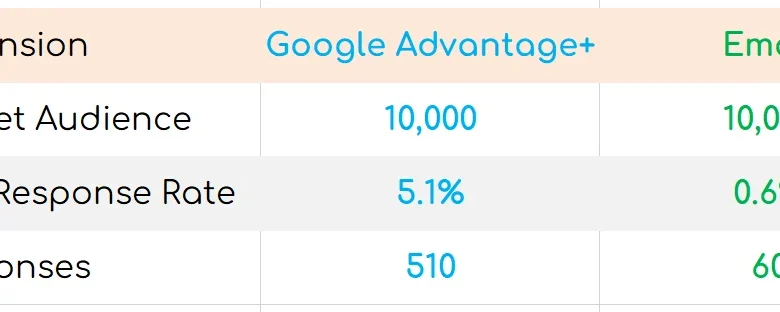
A comparative analysis of enterprise marketing channels demonstrates the critical difference between revenue-based metrics and profit-based metrics. In a representative multi-channel campaign evaluation involving an AI-powered automated advertising platform and traditional email marketing, the initial metrics heavily favor the automated platform. The automated ad campaigns generated 173 orders and $17,000 in revenue, compared to email marketing, which produced only 14 orders and $1,400 in revenue.
When evaluated solely on Return on Ad Spend (ROAS)—a metric that divides revenue by advertising cost without accounting for production costs—the automated platform appeared effective, albeit with a lower ratio than email. However, when applying Return on Investment (ROI), Profit on Ad Spend (POAS), and ultimately Profit on Investment (POI)—which deducts both campaign costs and COGS—the financial realities shifted dramatically.
The automated ad platform yielded a negative POI, returning approximately $0.70 in profit for every dollar spent, essentially functioning to subsidize the advertising platform’s sales commissions rather than corporate growth. Conversely, the email marketing channel delivered a robust profit of $5.70 for every dollar expended. This divergence proves that high top-line revenue generation can coincide with net capital destruction if underlying input costs and inventory expenses are ignored.
Strategic Recommendations for Corporate Restructuring of Ad Spend
To rectify misaligned marketing expenditures, governance structures must implement corrective protocols. Enterprises currently experiencing low or negative profit on investment from automated platforms should execute a structured operational pause:
- Immediate Budget Suspension: Temporarily reduce ad spend on underperforming algorithmic platforms to zero. While traffic and top-line revenue metrics will experience an immediate contraction, net enterprise profitability will begin an immediate recovery.
- Cross-Functional Audit: Convene internal media teams, external agency partners, and platform representatives to audit audience intent, targeting parameters, creative assets, and algorithmic configuration.
- Strategic Realignment: Deploy a rigorous three-part strategy focusing on available consumer intent, tactical audience matching, and the deployment of advanced AI features designed to drive high-intent engagement rather than broad, unqualified traffic.
- Phased Reinvestment: Gradually restore capital allocation only when campaigns demonstrate consistent, verifiable green profit-on-investment metrics that satisfy corporate financial standards.
The Obsolescence of Cost Per Session in an AI-Driven Search Environment
The persistence of legacy metrics like Cost Per Session is further invalidated by structural changes in digital search ecosystems. As search engines incorporate generative artificial intelligence interfaces, user behavior and traffic quality are undergoing fundamental transformations. Industry analysis indicates that referral traffic originating from AI-enhanced search results exhibits higher engagement levels and extended on-site durations, as users arrive with better contextual understanding.
Consequently, optimizing marketing funnels for low-cost, high-volume sessions actively harms long-term digital visibility and audience acquisition. Organizations that fail to transition their key performance indicators from volume-based efficiency metrics to value-driven engagement metrics risk misallocating corporate capital. For modern enterprises navigating the intersection of marketing and finance, establishing accountability through profit-oriented metrics remains the definitive safeguard against digital waste and the cornerstone of sustainable corporate growth.