The Evolution and Strategic Selection of WordPress Commenting Platforms for Modern Digital Publishers

The landscape of digital discourse on the web has undergone a profound transformation over the last decade. As website owners grapple with the dual challenges of community engagement and technical maintenance, the choice of a commenting platform has shifted from a trivial design decision to a critical pillar of site performance, security, and data sovereignty. Today, the marketplace for these tools has consolidated significantly, leaving publishers with a refined selection of high-performance solutions that prioritize user privacy, administrative efficiency, and speed.
Historical Context and Market Consolidation
The digital landscape was once dominated by a diverse array of third-party comment systems. In the early 2010s, platforms such as Livefyre and IntenseDebate were ubiquitous, promising to outsource the burden of spam management and interface design to specialized vendors. However, the industry faced a turning point when major stakeholders, most notably Facebook, retreated from providing external comment boxes to third-party sites. This retraction forced publishers to re-evaluate their reliance on external, proprietary ecosystems.

The market contraction was driven by several factors: the rise of strict data privacy regulations like the GDPR, the increasing importance of Core Web Vitals in SEO rankings, and a growing desire among site owners to retain ownership of their community data. What remains today is a mature sector where the survivors are those that successfully balanced ease-of-use with advanced moderation capabilities.
The Necessity of Dedicated Commenting Systems
For many WordPress users, the native comment system—long a staple of the platform—remains sufficient. When a site receives low traffic volume and operates with the support of anti-spam tools like Akismet, the overhead of an external platform may not be justified. However, the threshold for adopting a professional-grade solution is typically defined by the transition of comments from a secondary feature to a core component of the site’s value proposition.
A robust commenting platform provides critical infrastructure that the native system lacks, including AI-assisted moderation, real-time engagement tools, and advanced analytical dashboards. When a site reaches a scale where the moderation queue becomes a time-consuming burden or where user engagement requires features like threaded replies and social media integration, the limitations of the default WordPress form become apparent.

Critical Evaluation Criteria for Publishers
When selecting a commenting architecture, site administrators must navigate four primary technical and ethical considerations:
- Data Sovereignty and Portability: The most critical question is where the comment data resides. Ideally, comments should sync to the local WordPress database. This ensures that the content remains part of the site’s SEO footprint and protects the publisher against the potential shuttering of a third-party service.
- Spam Mitigation Methodology: Sophisticated platforms prevent spam at the point of origin rather than merely filtering it after it reaches the database. By closing the default comment endpoints, platforms can significantly reduce server load and administrative overhead.
- Financial Transparency: Business models vary between subscription-based services and ad-supported models. Publishers must determine whether their platform of choice monetizes their audience through data harvesting or advertising placements.
- Impact on Page Performance: Since comments are rendered on every page load, the weight of the associated scripts can significantly impact site speed. A platform that prioritizes asynchronous loading and lazy-loading is essential for maintaining high performance.
Leading Solutions: A Comparative Analysis
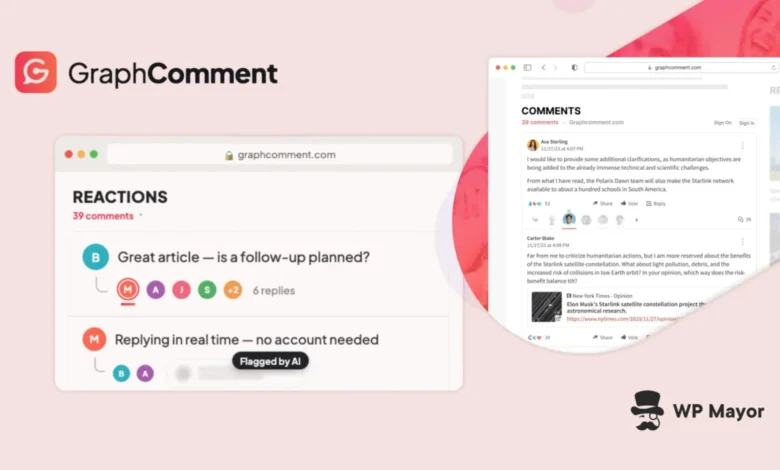
GraphComment has emerged as a frontrunner for publishers seeking a balance between community features and performance. By replacing the native WordPress comment system with a cloud-based infrastructure, it offers high-level moderation tools and AI-driven flagging. Crucially, its ability to sync comments back to the WordPress database ensures that publishers retain control over their content. Its "Bubble Flow" and "Bubble Rank" sorting mechanisms have set a new industry standard for displaying high-density discussions.

In contrast, wpDiscuz represents the pinnacle of self-hosted solutions. By building a high-performance, AJAX-powered system directly within the WordPress ecosystem, it avoids the dependency on external servers. This architecture is favored by technical publishers who prioritize data privacy and site speed above all else. Its standout feature—inline commenting—allows readers to attach feedback to specific segments of a post, a tool that has proven highly effective for educational and tutorial-heavy websites.
Disqus, while a legacy player, remains a standard for large-scale publishers with deep integration needs. Its strength lies in its existing network, which allows users to engage across multiple sites with a single identity. However, its adoption has been hampered by the intrusion of ads on its free tiers and concerns regarding page weight. For many publishers, the transition to newer, faster, and more privacy-conscious alternatives has become a strategic priority.
Finally, Jetpack Comments offers a streamlined, "set-it-and-forget-it" solution for smaller sites. As an extension of the Jetpack plugin, it integrates seamlessly with existing workflows. While it lacks the advanced moderation tools of competitors, it provides a functional, modern interface that is perfectly suited for medium-traffic sites that require simple, reliable performance without the complexity of a third-party integration.
Data and Performance Implications

Analysis of modern web performance metrics indicates that comment sections are often the largest contributors to cumulative layout shift (CLS) and total blocking time (TBT). As Google continues to prioritize user experience through its Core Web Vitals metrics, the choice of a commenting platform has direct implications for search engine rankings.
Data from independent performance audits suggests that self-hosted solutions like wpDiscuz, when configured with proper caching, offer the lowest latency. Conversely, cloud-based services like GraphComment, while requiring an external network request, provide superior spam protection that can indirectly improve performance by reducing the number of requests to the site’s database.
Looking Forward: The Future of Digital Discussion
The future of web commenting is moving toward decentralization and AI integration. As publishers face increasing pressure from automated spam bots and sophisticated AI-generated content, the role of AI-assisted moderation—such as the tools currently deployed by GraphComment—will likely become mandatory rather than optional.

Furthermore, the industry is seeing a shift toward "community-owned" metrics. Publishers are increasingly looking for platforms that allow them to extract, analyze, and own the data generated by their readers. The era of "renting" a community from a third-party provider is waning; in its place, we are seeing a focus on interoperable, high-performance tools that integrate with the publisher’s existing stack.
For the modern digital publisher, the task of managing comments has evolved into a strategic function. It is no longer just about allowing users to speak; it is about cultivating a space that is secure, fast, and representative of the brand’s values. By prioritizing data sovereignty and technical performance, site owners can ensure that their comment sections remain a destination for meaningful discussion rather than a vector for digital clutter. As the technological landscape continues to shift, those who invest in robust, adaptable commenting infrastructures will be best positioned to maintain the integrity of their digital communities.