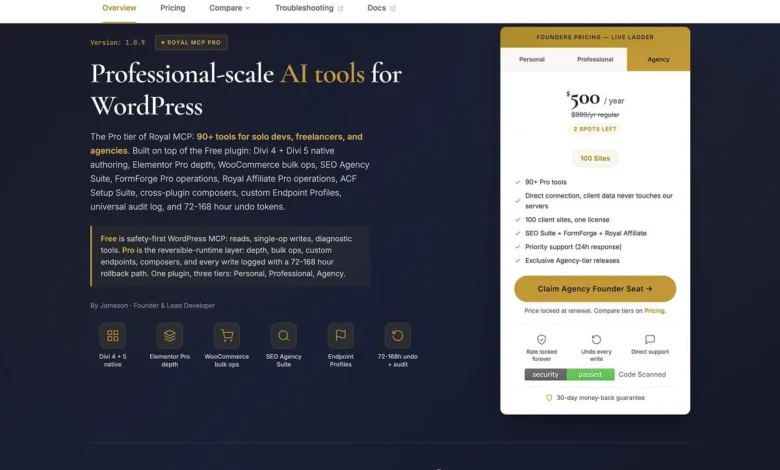
The landscape of artificial intelligence integration within the WordPress ecosystem is shifting from passive content generation toward active site management, marked by the recent introduction of Royal MCP Pro. As the Model Context Protocol (MCP) gains traction as a standard for connecting AI assistants to local data environments, Royal Plugins has positioned its latest release as a critical layer for professional site administration. This tool serves as a self-hosted MCP server, facilitating a secure, authenticated bridge between AI models—such as Claude, ChatGPT, and Gemini—and the underlying architecture of a WordPress installation. By providing an interface for over 300 distinct tools, the software allows for granular control over site operations, ranging from bulk WooCommerce management to complex SEO workflows.
The Technical Foundation of MCP in WordPress
At its core, the Model Context Protocol is an open standard that enables AI models to interact directly with local resources. Unlike traditional AI plugins that rely on third-party cloud intermediaries to parse site data, an MCP server operates within the user’s own infrastructure. Royal MCP Pro utilizes OAuth 2.0 with Proof Key for Code Exchange (PKCE) to ensure that the connection between the AI client and the WordPress database remains encrypted and direct. This architecture mitigates the privacy concerns often associated with AI-driven site management, specifically the risks of transmitting sensitive proprietary data through external middleware.
The growth of MCP-compatible tooling reflects a broader trend in web development: the transition from "AI-as-a-writer" to "AI-as-a-technician." While early AI plugins focused on generating blog posts or marketing copy, the industry is now moving toward automated technical maintenance. Data from recent industry reports suggest that agency-level users are increasingly seeking ways to automate repetitive tasks—such as metadata optimization, schema markup validation, and cache management—without the latency and security risks of cloud-based automation platforms.
Chronology and Development Roadmap
The development of Royal MCP Pro follows a rapid succession of updates within the WordPress ecosystem aimed at standardizing AI interaction. The free version of the plugin, currently hosted on the official WordPress repository, has already exceeded 10,000 active installations. This initial adoption provided the telemetry and user feedback loop necessary for the development of the Pro iteration, which focuses on safety and reliability for large-scale operations.

On September 2, 2026, the release of version 1.0.8 represented a significant milestone in the product’s lifecycle. This update introduced the "composer" feature, specifically the seo_optimize_for_launch tool. This function effectively collapses five distinct manual processes into a single, unified command. By chaining meta-optimization, schema verification, 301 redirect mapping, IndexNow protocol submission, and Google Search Console notification into one transactional action, the tool reduces the "surface area" for errors. In software engineering, such atomicity is crucial; if any single step in the chain fails, the entire process is rolled back, preventing the database from entering an inconsistent or partially updated state.
Risk Management and Reversibility
One of the primary inhibitors to the widespread adoption of AI-driven administrative tools is the fear of irreversible, catastrophic changes. When an AI client is granted write access to a database containing hundreds or thousands of products—as is common in e-commerce—a single hallucination or misinterpreted prompt can lead to significant financial loss.
Royal MCP Pro addresses these concerns through a two-fold strategy: comprehensive logging and tool-level reversibility. Every action taken by the AI is recorded in a detailed audit log, and for critical bulk operations, the system maintains a rollback mechanism. This feature allows administrators to revert changes within a defined window, typically 72 hours. This period is specifically chosen to accommodate both immediate error detection and delayed discovery, such as when a client identifies an issue during standard business hours following a weekend update. This level of oversight moves beyond basic access control, offering a safety net that is essential for agencies managing high-stakes client environments.
Industry Implications and Agency Adoption
For digital agencies, the economics of AI automation are clear. Maintaining a fleet of 50 to 100 websites often involves repetitive manual labor that is prone to human error. The shift toward a "founding member" pricing model for the Pro version suggests an effort to incentivize early adoption among power users. The pricing tiers, which range from single-site licenses to comprehensive agency-grade access, are designed to align with the scale of operations performed.
A fact-based analysis of the market indicates that agencies are increasingly moving away from "black box" automation tools. The preference for self-hosted solutions like Royal MCP Pro, which avoid third-party proxies, suggests that data sovereignty is becoming a primary requirement for professional services. By maintaining the integrity of the data within the site’s own environment, agencies can provide clients with assurances that their intellectual property and e-commerce data are not being cached or processed by unknown entities.

Evaluating the Competitive Landscape
The market for WordPress AI tools is currently saturated with plugins that focus on the quantity of tools exposed. However, the competitive advantage of Royal MCP Pro lies in its emphasis on "post-execution" stability. As more users grant AI clients write-level permissions, the focus of the industry is expected to shift toward safety features such as the aforementioned undo tokens, restricted endpoint profiles, and transaction atomicity.
The integration of custom endpoint profiles is another significant development. This allows site administrators to restrict the AI to specific tools based on the context of the user or the intent of the request. For instance, an AI assistant tasked with SEO optimization can be prohibited from accessing WooCommerce product pricing tools, thereby enforcing a "least privilege" security model that is considered best practice in enterprise software management.
Future Outlook and Conclusion
As the AI-WordPress interface matures, the role of human oversight remains paramount. The current paradigm of "human-in-the-loop" AI management requires that tools like Royal MCP Pro act as force multipliers rather than autonomous agents. While the technology is sophisticated enough to manage complex workflows, the responsibility for verifying logs and auditing changes remains with the site administrator.
The emergence of standardized protocols like MCP signals a shift toward a more interoperable web, where AI assistants can serve as specialized workers across a variety of platforms. For the WordPress community, the challenge will be to balance the speed and efficiency offered by these tools with the necessity of maintaining robust, error-free site performance. With the current availability of the Founding Member pricing, the window is open for agencies and site owners to integrate these capabilities into their workflows before the technology becomes a baseline industry requirement.
Ultimately, the success of Royal MCP Pro and similar initiatives will be measured by their ability to provide transparency in an era of increasing automation. By treating AI as a controlled, accountable component of the technical stack rather than a wild-card utility, developers are establishing the frameworks necessary for the next generation of professional web management. The combination of audit trails, transactional rollbacks, and secure, direct authentication protocols provides a compelling roadmap for the future of AI-assisted site administration. As organizations continue to scale their digital presence, the ability to safely automate routine tasks will distinguish the highly efficient agencies from those burdened by the constraints of legacy manual workflows.