Why Obsessing Over Generative Engine Optimization Is A Misguided Strategy For Modern Businesses


The rapid evolution of artificial intelligence has fundamentally altered the digital landscape, leading many marketing professionals to pivot toward Generative Engine Optimization (GEO). The prevailing logic suggests that as Large Language Models (LLMs) like ChatGPT become the primary interface for information retrieval, brands must prioritize visibility within these AI-generated responses. However, a comprehensive analysis of recent web traffic data suggests that this preoccupation may be misplaced. While AI is undeniably reshaping user behavior, the actual return on investment for businesses remains overwhelmingly tied to traditional search engines, specifically Google, as the web transitions into an agentic, action-oriented ecosystem.
The Data Gap: Analyzing Referral Traffic Patterns
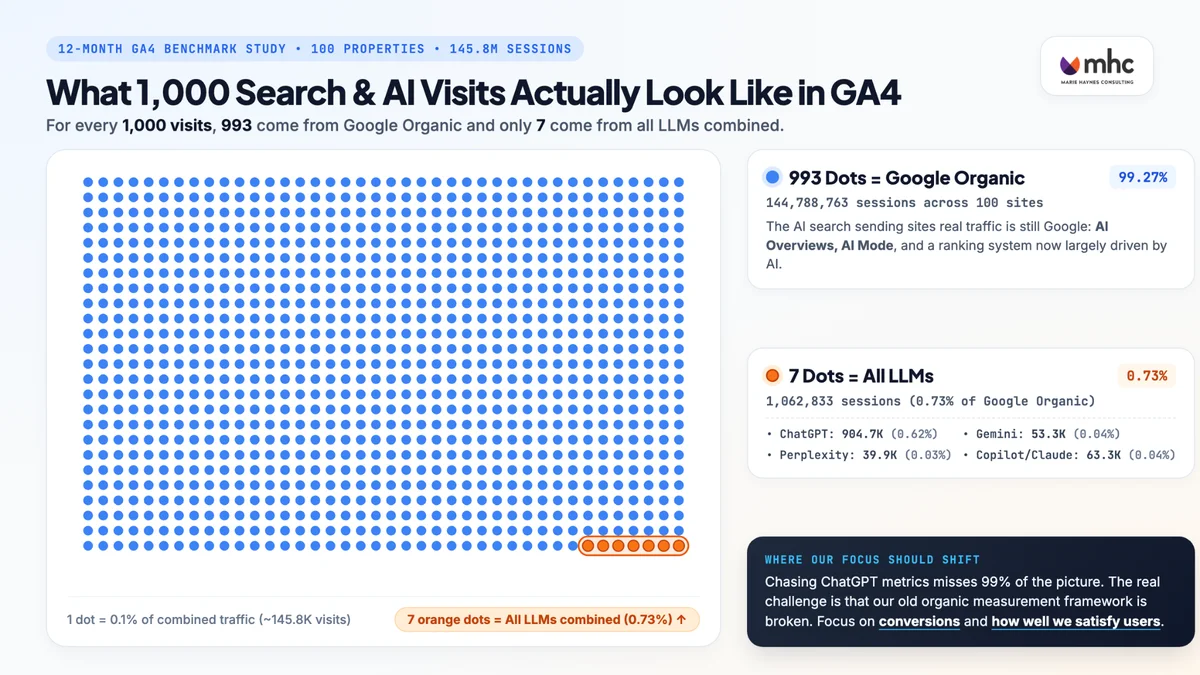
A granular examination of 100 diverse websites over a 12-month period, encompassing more than 145 million sessions, reveals a stark disparity between AI-driven traffic and established organic search channels. In this dataset, sessions originating from ChatGPT accounted for a mere 0.62% of the volume generated by Google Organic search. Even when factoring in the collective traffic from all other prominent LLMs, the total AI-referral share rose to only 0.73%.
This statistical reality highlights a significant disconnect between industry discourse and actual consumer behavior. While the prospect of being cited as an authoritative source within a chatbot’s output remains an intriguing branding goal, the volume of users currently navigating to websites via these tools is negligible compared to the massive, sustained traffic flow originating from traditional search engines.

The Conversion Paradox
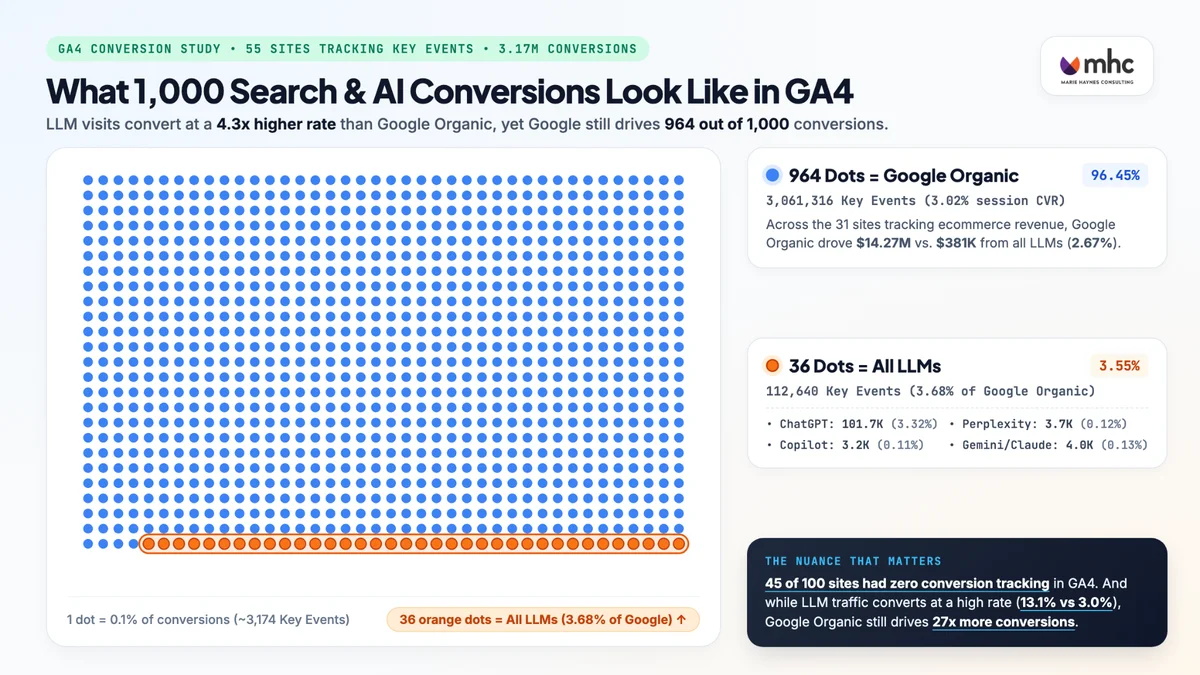
Beyond raw traffic volume, the efficacy of AI-referral traffic warrants closer scrutiny. Among the sites analyzed, 55 were actively tracking specific conversion events. While it was observed that visitors arriving from ChatGPT exhibited a conversion rate 4.5 times higher than that of Google organic visitors, the sheer scale of the latter remains dominant.
Google organic search drove 96.5% of total conversions across the entire cohort. In practical terms, the volume of conversions facilitated by Google outstripped those from all LLMs combined by a factor of 27 to 1. This suggests that while AI-referred users may possess higher intent, they represent a fraction of the total business opportunity, confirming that Google continues to serve as the primary engine for consumer acquisition.
Chronology of AI Traffic Growth and Plateau
The expectation that LLM-driven traffic would experience consistent, exponential growth has not materialized. Following the initial public release of ChatGPT, there was a measurable uptick in referral traffic as users experimented with the tool. However, data indicates that this growth trajectory flattened significantly following the release of GPT-5 in August 2025. Since that milestone, the volume of visitors sent from ChatGPT to third-party websites has entered a period of decline. This plateau suggests that LLMs are increasingly being used as "closed-loop" environments—where the model provides a final answer directly to the user—rather than as navigational conduits to the broader web.
The Shift Toward the Agentic Web
The future of search is no longer centered on the simple provision of links. Google’s leadership has explicitly stated that the objective of search is evolving into an "agent manager" model. This transformation shifts the search engine from a passive index to an active participant that coordinates tasks and executes transactions on behalf of the user.
This transition is characterized by several key technologies that businesses must understand to remain competitive:
1. The Universal Cart System
Google’s Universal Cart is a pivotal development in this shift. By aggregating products from various retailers into a single, unified checkout experience within Google Wallet, the platform effectively removes the necessity for a user to visit a brand’s website to complete a purchase. This system monitors price changes, inventory status, and promotions in real-time. For businesses, the implication is clear: visibility in the traditional sense is secondary to data-readiness in the Google Merchant Center.
2. The Universal Commerce Protocol (UCP)
Developed through a collaborative effort between Google, Shopify, and Stripe, the UCP provides an open discovery layer that enables AI agents to compare inventory across the web and execute native purchases. As this protocol gains adoption, the "Merchant of Record" relationship may remain with the business, but the point of interaction will move exclusively to Google-controlled interfaces. Technical SEO is therefore expanding to include agentic discovery endpoints, requiring a deeper mastery of product data schemas and interactive API integration.
3. WebMCP (Model Context Protocol)
WebMCP represents a technical breakthrough in how websites interact with autonomous agents. By exposing interactive functions—such as booking schedulers, loan calculators, or custom forms—directly to AI via declarative markup, websites can allow agents to perform complex tasks for users without manual navigation. This technology is currently in its nascent stages, but it signifies a departure from static web design toward a functional, machine-readable architecture.

Ambient Computing and Intelligent Eyewear
The upcoming integration of search into "Intelligent Eyewear"—a category currently being pioneered by Google through Android XR—marks a move toward ambient computing. By removing the screen as a barrier, search is poised to become a constant, contextual layer over reality.
This evolution introduces a "See it, Solve it, or Buy it" paradigm. For example, a consumer wearing smart glasses could request that an AI assistant identify a product, check its availability, and execute a purchase immediately. The commercial potential for service providers, such as maintenance professionals or specialized consultants, is substantial, as these agents could facilitate instant booking or troubleshooting in the field.
Strategic Recommendations for Business Adaptation
Given that current SEO practices often focus on "blue link" optimization or LLM citations, companies are encouraged to reorient their strategy toward the following four pillars:
- Data Integrity and Feed Management: Ensure that product and service data in platforms like Google Merchant Center is highly structured, updated, and optimized for AI ingestion.
- Interactive Tool Development: Explore the feasibility of WebMCP to expose your site’s most valuable interactive features to AI agents, thereby increasing the likelihood that your services are utilized during automated workflows.
- Conversion Tracking Over Keyword Ranking: Move away from vanity metrics like search rankings, which are increasingly volatile due to personalized AI results. Instead, focus on tracking bottom-line conversion events and user satisfaction metrics.
- Experimental Pilot Programs: Conduct low-lift, high-impact experiments to test how your business appears within AI-driven search surfaces. This includes testing local service scenarios and product bundling within automated systems.
Implications for the Future of Search
The web is undeniably in a state of flux. The transition toward an agent-first internet will likely render many legacy optimization techniques obsolete. However, the data confirms that Google remains the dominant gatekeeper of consumer attention and commercial activity.
Businesses that successfully navigate this era will not be those that attempt to "game" the LLMs of today, but rather those that prepare their infrastructure for the agentic systems of tomorrow. By focusing on high-quality data, seamless functional integration, and a deep understanding of how Google coordinates commerce, companies can ensure their offerings remain visible and accessible in an increasingly automated environment. The era of the link is ending; the era of the agent has begun, and the competitive advantage will go to those who prioritize structural readiness over passive visibility.