Google Analytics Unveils Advanced AI-Driven Features to Transform Enterprise Decision-Making and Multi-Touch Attribution

Over the past year, the development team behind Google Analytics (GA) has rolled out a sophisticated suite of capabilities designed to elevate web analytics from basic retrospective reporting to forward-looking strategic planning. These recent updates extend the platform’s utility well beyond traditional digital marketing metrics, providing critical financial and operational value to enterprise stakeholders, including finance departments and executive leadership.
While several of these advanced tracking capabilities are forward-facing—meaning they capture and process data exclusively from the moment of activation without historical data backfilling—industry analysts emphasize the urgency of immediate implementation. The integration of artificial intelligence, automated cross-channel budgeting, and granular conversion attribution marks a significant evolution in how organizations measure consumer behavior and allocate capital.
The Rise of Answer Engine Optimization (AEO) and AI Assistant Channels
As search engines evolve into conversational artificial intelligence platforms, digital traffic patterns have shifted correspondingly. Industry studies, including reports published by Adobe and Shopify in early 2026, indicate that while Answer Engine (AE) traffic typically accounts for a modest 1% to 5% of total sessions, its commercial value is disproportionately high. Adobe data revealed that conversions originating from AI assistants exhibit a 42% higher conversion rate, a 48% increase in time spent on product pages, and a 37% higher revenue per visit compared to traditional search traffic. Similarly, Shopify reported a 50% increase in product detail page conversions and a 14% boost in average order value.
To address this structural shift, Google Analytics has introduced the AI Assistant channel within its Default Channel Grouping, categorized under Reports > Acquisition > Traffic Acquisition. This feature automatically identifies traffic originating from conversational search and AI platforms, setting the medium to "ai-assistant" without requiring manual tagging from site administrators.
However, data integrity specialists note certain nuances and limitations in current tracking methodologies. Traffic originating from mobile applications, desktop software, and specialized in-app browsers often bypass standard referrer headers, frequently miscategorizing as direct traffic. Furthermore, industry observers have noted that traffic generated by Google’s native AI Overviews and AI Mode is currently aggregated under traditional Organic Search. Consequently, analytics professionals are advised to monitor platform definitions monthly—particularly given the fluid inclusion of models like Claude, DeepSeek, Copilot, and Grok—and apply supplementary custom channel groupings using regular expressions to capture the true volume of LLM-driven engagement.
Modernized Conversion Attribution and Funnel Analysis
Moving beyond traditional last-click models, Google Analytics has revived and refined Assisted Conversions within the Advertising > Conversion Attribution Analysis section. This feature provides a granular view of how individual marketing channels contribute to multi-touch consumer journeys before a final conversion event occurs.
By comparing the volume of last-click conversions against assisted conversions, marketing teams can reevaluate channels that operate primarily in the upper and middle funnels. For example, a channel that demonstrates minimal last-click attribution may be identified as a critical touchpoint in over a third of successful multi-touch conversion paths.
Complementing this is the refined funnel analysis report, which segments owned, earned, and paid touchpoints into early, middle, and late journey stages, alongside single-touchpoint paths. This capability allows enterprises to quantify the exact share of data-driven conversion credit assigned to each stage of the consumer lifecycle. Analysts caution, however, that conversion sets must be meticulously managed to avoid data distortion; maintaining a strict distinction between macro-outcomes (such as ecom transactions) and a focused set of micro-outcomes (such as newsletter sign-ups or software downloads) is essential to prevent inflated and misleading attribution metrics.
Cross-Channel Budgeting and Predictive Scenario Planning
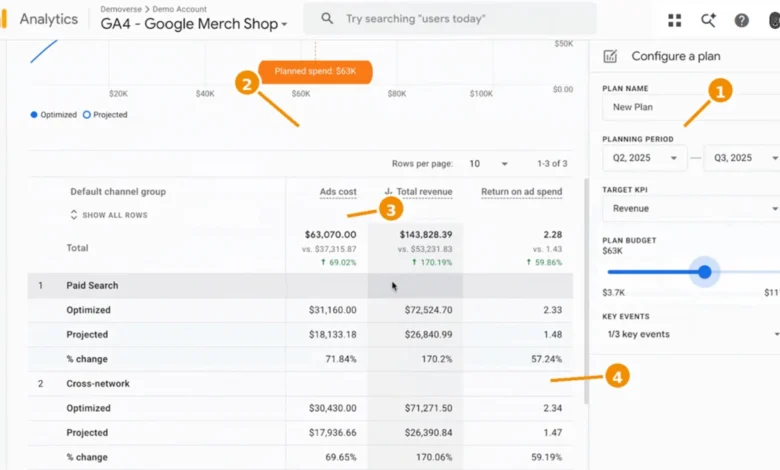
Bridging the gap between static reporting and active financial forecasting, Google Analytics has introduced Cross-Channel Budgeting tools within the Advertising section. Comprising Project Plans and Scenario Plans, these predictive features leverage historical performance data, seasonality, and external variables to assist marketing and finance teams in media planning.
Project Plans allow organizations to evaluate whether current spending paces are on track and what business outcomes they will yield at existing rates. Scenario Plans enable financial and marketing leaders to model the impact of reallocating capital between disparate channels—such as shifting funds from paid social to paid search—and observe projected changes in revenue and return on ad spend (ROAS).
To maximize the efficacy of these predictive models, comprehensive cost data integration is required. Recent updates have streamlined the importation of campaign data from external advertising platforms such as Meta and TikTok. While predictive models inherently contain margins of error based on historical anomalies, industry consultants recommend presenting these projections as strategic estimates rather than deterministic forecasts, enabling more resilient budgeting discussions with executive leadership.
Conversational Analysis via Ask Advisor and Model Context Protocols
To democratize data access across organizations, Google Analytics has integrated "Ask Advisor," a conversational analytics interface accessible via a search icon in the platform’s navigation window. Designed to lower the technical barrier for Extremely Senior Leaders (ESLs), the tool allows users to query complex performance metrics in natural language, generating detailed analyses regarding traffic anomalies, channel mixes, and product performance without requiring manual report generation.
For advanced technical teams seeking deeper data integration, Google has released an official Model Context Protocol (GA MCP) server. This open-source connector allows enterprises to bridge their Google Analytics data repository directly with approved large language models (LLMs) such as ChatGPT or Claude. By connecting GA data with external repositories—including media plans, promotional calendars, and offline customer sales data—organizations can execute comprehensive cross-functional analysis, identifying content gaps, evaluating competitor positioning, and streamlining decision-making workflows.
Broader Implications and Enterprise Readiness
The cumulative effect of these updates represents a structural shift from descriptive analytics—explaining historical performance—to prescriptive analytics, which actively drive future business outcomes. Additional features, such as Source Group Consolidation (which automatically unifies fragmented traffic sources like variations of Meta or Instagram into standardized streams) and LTV Percentile tracking (identifying top-tier customers based on lifetime value without requiring complex SQL queries in BigQuery), further empower marketing and finance professionals.
Industry experts emphasize that successful adoption of these advanced tools requires a systematic audit of tracking infrastructure. Organizations that transition from reactive reporting to predictive, AI-assisted analysis will be better positioned to optimize capital allocation, defend marketing investments against budget scrutiny, and secure higher strategic influence within the enterprise.