The Comprehensive Guide to UI Component Naming, Design Tokens, and Digital Taxonomies

In the realm of digital product design and software development, terminology serves as the fundamental architecture of communication. Yet, establishing a universal vocabulary across cross-functional teams remains one of the industry’s most persistent bottlenecks. Whether it is distinguishing between a navigation drawer and a sidebar, settling on a hexadecimal shade identifier, or establishing a scalable design token taxonomy, the words chosen dictate both the efficiency of the workflow and the intuitiveness of the final user experience.
Industry analyses frequently highlight that communication silos emerge early in the product lifecycle. Designers, software engineers, product managers, and copywriters often operate within distinct linguistic dialects. This disconnect leads to friction during handoffs, duplicated codebases, and ultimately, user confusion when interface nomenclature diverges from everyday user language. To combat these systemic challenges, a burgeoning ecosystem of open-source guides, community-driven repositories, and standardized frameworks has emerged to help organizations establish linguistic consistency.

The Roots of Linguistic Friction in Software Development
The challenge of naming UI elements is not merely aesthetic; it is cognitive. Human language shapes how individuals conceptualize problems and discuss solutions. When a team lacks a standardized vocabulary, ambiguity thrives. Names assigned to HTML classes, CSS properties, JavaScript functions, design tokens, and user interface features frequently fall into two dysfunctional extremes: they are either overly generic or excessively specific.
Overly generic labels—such as wrapper, container, item, or box—fail to convey structural or functional intent, forcing developers to inspect nested code to understand a component’s purpose. Conversely, overly specific names—such as homepage-hero-banner-blue-v2—hamper flexibility, reduce reusability, and quickly become obsolete as product requirements evolve.

To bridge this gap, modern design system engineering requires a deliberate taxonomy. Industry leaders have increasingly turned to standardized naming conventions that prioritize function, scalability, and platform-agnostic semantics over visual presentation.
Inspiration and Lexical Resources for Developers
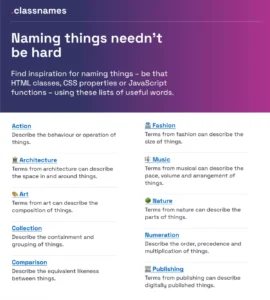
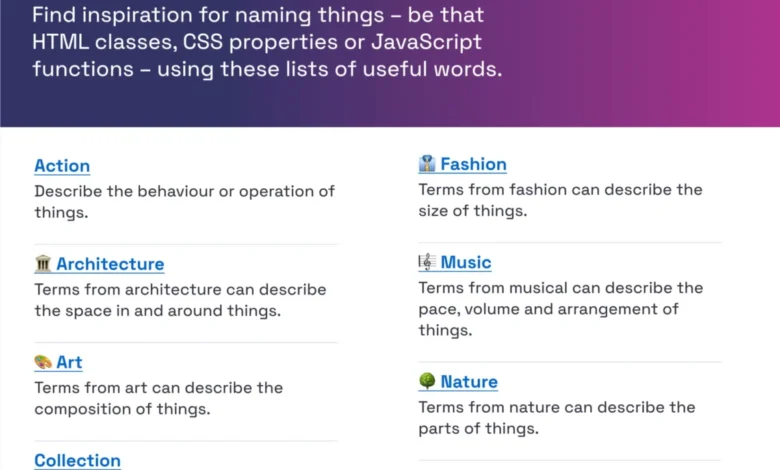
For developers and designers seeking to break away from habitual, repetitive naming conventions, specialized lexical tools have gained traction within the engineering community. Resources like Classnames, curated by web developer Paul Robert Lloyd, offer thematically grouped lists of terms designed to inspire developers when naming classes, variables, and functions.

Rather than relying on ad-hoc terminology, these directories provide structured vocabulary spanning behavioral descriptors, relational markers, and thematic groupings drawn from fields as diverse as architecture, publishing, fashion, and the dramatic arts. By expanding the linguistic palette available to development teams, organizations can craft more expressive and maintainable codebases.
Similarly, the challenge of naming colors has long plagued digital creators. To address the arbitrary nature of standard HEX and RGB values, David Aerne’s expansive color-names repository provides a crowdsourced dictionary comprising over 30,000 unique color identifiers. Paired with color-picking utilities and search interfaces, such repositories allow design systems to incorporate human-readable color naming, enhancing accessibility documentation and code readability.
Best Practices for Layer and Group Architecture

Beyond codebases, the internal organization of design files in collaborative environments such as Figma or Sketch requires rigorous discipline. Javier Cuello’s design guidelines on layer and component naming emphasize that effective structural nomenclature must be short, logically structured, universally understood, and decoupled from temporary visual properties.
Cuello’s framework outlines strict operational principles: layers should describe what an element is rather than what it looks like. For instance, designating a container as "Primary Action Button" rather than "Blue Rounded Rectangle" ensures that subsequent design iterations do not render the nomenclature inaccurate. Adhering to these best practices reduces cognitive load for developers inspecting design files and prevents the accumulation of technical debt within design system libraries.
Scaling Design Tokens Across Multi-Brand Ecosystems

As enterprises scale to support multiple brands, regional themes, and diverse product portfolios, the complexity of design token management multiplies exponentially. A notable case study in large-scale taxonomy is the architectural overhaul undertaken by Intuit, the parent company behind financial software platforms such as QuickBooks, TurboTax, Mailchimp, and Mint.
Faced with disparate legacy systems, Intuit’s design engineering team developed a flexible, multi-tiered design token taxonomy. This framework successfully separated brand-level themes from foundational primitive values, allowing disparate product teams to inherit centralized design logic while maintaining brand autonomy.
Building upon these systemic methodologies, organizations like the Vodafone UK Design System team have published comprehensive variables taxonomy maps. By orchestrating tokens across four distinct hierarchical layers—ranging from primitive values and brand themes to semantic roles and page-specific implementations—these maps provide absolute transparency. Developers and designers can trace any given variable back to its source, instantly understanding where a token is deployed and what functional role it serves.
Interactive tools such as Romina Kavcic’s Design Token Naming Guide and associated spreadsheet inventories further empower teams to configure customized naming structures. By defining clear parameters for components, categories, states, and roles, organizations can maintain bird’s-eye visibility over thousands of individual variables without losing structural integrity.
Standardizing UI Component Libraries
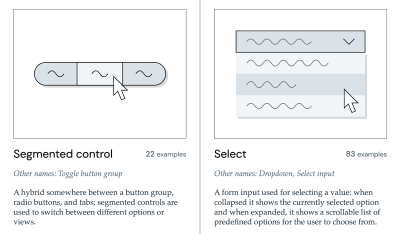
When establishing a new design system, reinventing the wheel regarding component nomenclature is rarely efficient. To streamline this process, Iain Bean’s Component Gallery aggregates real-world examples and alternative naming conventions for over 50 standard user interface components, ranging from accordions to visually hidden utility classes.

Observing how mature design systems—such as those maintained by government digital services, enterprise SaaS platforms, and open-source foundations—name and structure recurring UI patterns provides valuable benchmarking data. Complementary visual dictionaries, such as Name That UI, further assist junior designers and developers in aligning their internal terminology with established industry standards.
Feature Discovery and the User’s Lexicon
While internal naming impacts engineering velocity, external nomenclature directly influences product adoption and user engagement. Feature adoption relies on a predictable psychological funnel: a feature must first be discovered, subsequently understood, actively tested, integrated into existing user workflows, and finally retained.

Research conducted by UX strategist Erin Gannon highlights that poor feature discoverability is frequently rooted in internal corporate jargon. When product teams name new functionalities based on internal codenames or abstract architectural concepts rather than user-centric outcomes, discovery plummets.
Effective feature naming should be driven by the "job-to-be-done" framework, signaling clear value to the end user. Crucially, Gannon advises product teams to actively listen to how users describe their problems in their native language during user research sessions, subsequently reflecting that exact vernacular in interface copy and feature titles.
Methodologies for Naming Products and Services

At the highest level of abstraction, naming a new product, service, or major corporate initiative presents unique legal, linguistic, and branding hurdles. Open-source repositories like Onym serve as centralized clearinghouses for naming methodologies, brainstorming exercises, trademark vetting frameworks, and linguistic etymology resources. These structured toolkits help corporate innovation teams systematically evaluate potential nomenclature, avoiding common pitfalls such as negative cross-lingual connotations, trademark infringement, and obscure spelling conventions that hinder word-of-mouth growth.
Implications and Broader Industry Analysis
The ongoing industry-wide focus on naming conventions reflects a maturing digital landscape. As software systems grow in scale, the primary bottleneck in engineering and design is no longer technological capability, but cognitive coordination.

Miscommunications stemming from linguistic fragmentation cost enterprises countless hours of rework. When a designer refers to a modal as a dialog, a developer codes it as a popup, and a product manager labels it a prompt, technical debt accumulates rapidly.
Industry analysts emphasize that organizations investing in rigorous taxonomies, design token governance, and user-centric feature naming consistently report faster deployment cycles, improved accessibility compliance, and smoother cross-functional collaboration. By treating nomenclature as an intentional engineering discipline rather than an afterthought, digital teams can eliminate friction, align diverse mental models, and deliver more cohesive user experiences across every touchpoint of the digital ecosystem.