The Economics of Sports Marketing: How Global Brands Measure the ROI of Multi-Million Dollar Sponsorships

In an era of fragmented media consumption and digital ad-skipping, sports remain the final frontier of mass, synchronized live viewing. Recent broadcast data underscores this dominance, revealing that nearly all of the top 50 most-watched television telecasts in the United States are directly tied to sporting events. Outside of a handful of monumental cultural touchstones—such as the Academy Awards, the 50th-anniversary special of Saturday Night Live, and the Grammy Awards—live sports command virtually the entirety of peak American television attention. Even niche programming like a televised NFL weather delay regularly outperforms traditional entertainment formats.
This unyielding consumer appetite has triggered a corporate land grab. Streaming giants, legacy television networks, and global brands are pouring billions of dollars into acquiring broadcasting rights and team sponsorships. Yet, as marketing budgets face sharper scrutiny from Chief Financial Officers, a foundational question echoes through executive boardrooms: beyond the luxury hospitality suites and photo opportunities with elite athletes, what tangible business return does a multi-million-dollar sports sponsorship actually deliver?
The Shift Toward Mass Live Viewing and Corporate Inflow
The modern media landscape is defined by audience erosion across traditional scripted television and digital platforms. Consumers increasingly rely on on-demand streaming services, ad-blockers, and short-form video feeds, making it exceptionally difficult for brands to capture sustained, collective attention. Live sports bypass this barrier entirely. Fans tune in in real-time, emotionally invested in an unscripted narrative that cannot easily be paused or skipped.
Recognizing this shift, global corporations have integrated sports marketing into the core of their growth strategies. Investments span every conceivable touchpoint: stadium naming rights, team kit sponsorships, sideline perimeter boards, digital interview backdrops, and exclusive partnerships with high-profile athletes.
However, corporate enthusiasm has frequently outpaced analytical rigor. For decades, marketing executives have justified colossal expenditures—sometimes reaching tens of millions of dollars annually—using vanity metrics and superficial exposure counts. As economic headwinds tighten enterprise budgets, senior leadership is demanding empirical proof that these sponsorships drive enterprise value rather than merely elevating brand vanity.
Deconstructing the Fundamentals of Sports Marketing
Before deploying advanced analytics to measure financial impact, industry analysts emphasize that fundamental marketing laws apply just as rigorously to sports partnerships as they do to traditional media channels.
First, creative execution dictates success. If a brand’s creative narrative fails to register within the fleeting attention spans characteristic of modern digital platforms, logos plastered across a racing car, athletic jersey, or interview backdrop will suffer the exact same fate. Because viewers are primarily focused on the competition itself, passive corporate branding often registers as background noise.
Second, the psychological phenomenon of brand halo transfer—where the positive equity of an athlete or sports team transfers to an associated brand—requires sustained reinforcement. Sporadic advertising campaigns or one-off social media posts by sponsored athletes yield negligible results. Establishing a meaningful cognitive connection requires continuous frequency and integrated media deployment, ensuring that paid advertising amplifies the intrinsic value of the sports asset.
Finally, experiential marketing components, such as luxury hospitality tents at elite equestrian events or VIP corporate suites at Major League Baseball stadiums, are exceptionally effective at cultivating relationships with a select cohort of high-value clients. While these activations can successfully secure high-stakes business renewals, they lack the scalability required to drive broad-market enterprise growth.
The Five-Level Sports Marketing Measurement Playbook
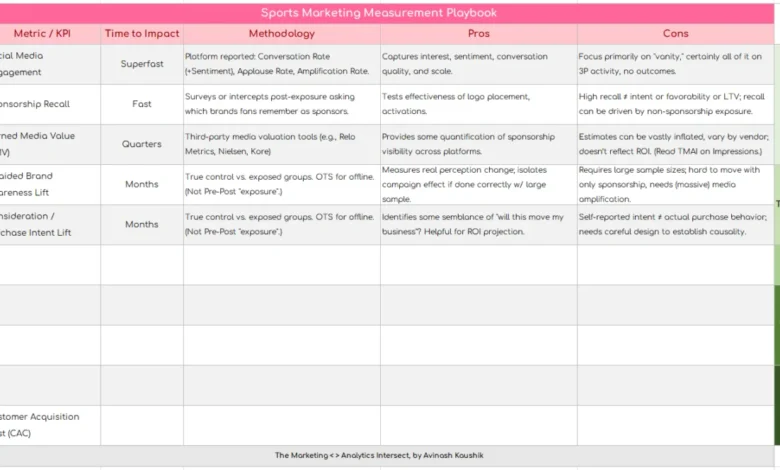
To bridge the gap between creative expenditure and financial accountability, marketing analytics frameworks have evolved into structured hierarchies of measurement sophistication. Evaluating a sports marketing investment requires progressing from basic activity metrics to rigorous econometric modeling.
Level 5: The Opening Gambit of Vanity
Virtually every brand launch within the sports sponsorship space begins at Level 5. Characterized by high-speed data availability and impressive presentation decks, this tier measures activity and exposure rather than actual business outcomes.
- Social Media Engagement: Brands track metrics such as conversation rates, applause rates, and amplification across corporate channels and athlete profiles. While these indicators reveal immediate audience reaction, they fail to demonstrate long-term commercial intent.
- Sponsorship Recall: Post-exposure surveys attempt to determine whether fans remember a brand as an official sponsor. Experts note that unaided recall metrics provide a significantly higher signal quality than aided questioning, which can artificially inflate positive responses.
- Earned Media Value (EMV): Often promoted by specialized agencies, EMV calculates the cumulative duration of a logo’s visibility and multiplies it by standard advertising rates. Major marketing associations have largely discredited EMV, as it assumes all exposure is uniformly positive and ignores audience relevance and commercial clutter.
Level 5 metrics offer an Impact Intelligence Score of just 1 out of 10, lacking both causal validation and financial linkage. They serve primarily as diagnostic tools for early-stage creative tuning rather than proof of business impact.
Level 4: The Quest for Brand Impact
Advancing to Level 4 requires shifting the analytical focus from superficial impressions to measurable shifts in human perception. This tier employs rigorous test-versus-control methodologies to determine whether a sponsorship actively influences consumer attitudes.
- Unaided Brand Awareness (UBA) Lift: Evaluating long-term revenue potential by measuring whether a brand becomes more prominent in the unprompted awareness of the target demographic over extended campaign cycles.
- Consideration and Purchase Intent Lift: Tracking whether exposed audiences demonstrate a statistically significant increase in preference for the sponsoring brand when entering a purchasing cycle.
Using propensity score matching to isolate exposed audiences from comparable control groups, brands can measure perception shifts across multi-quarter timelines. While Level 4 metrics do not yet map directly to transactional behavior, they establish the foundational brand equity necessary for medium-term revenue growth.
Levels 3, 2, and 1: Advancing Toward Financial Accountability
While achieving Level 4 validates the initial brand-building hypothesis, proving definitive profitability to a corporate board requires advanced analytical tiers:
- Level 3 (The Heart & Mind Influence): Measures compounding brand advantages and emotional resonance among key consumer segments.
- Level 2 (The First Digital Trace): Connects digital engagement trails directly to initial online and offline financial outcomes.
- Level 1 (Show Me the Money): The gold standard of marketing analytics, utilizing Marketing Mix Modeling (MMM) and causal incrementality testing to prove that revenue generated directly offsets the capital invested in the sports sponsorship.
Broader Industry Implications and Future Outlook
The maturation of sports marketing analytics represents a fundamental shift in how corporate partnerships are evaluated. As streaming platforms continue to absorb traditional broadcast viewership, sports properties will remain among the most valuable real estate in media.
However, the era of writing eight-figure sponsorship checks based solely on executive intuition and hospitality perks is drawing to a close. Brands that successfully transition from vanity-driven exposure metrics to rigorous, multi-level incrementality measurement will be positioned to maximize profitability. By turning on the analytical lights, enterprises can transform sports marketing from an unquantifiable corporate expense into a disciplined, high-return growth driver.