TikTok Shop consolidates its dominance in the United Kingdom as the platform eyes rapid pan-European expansion

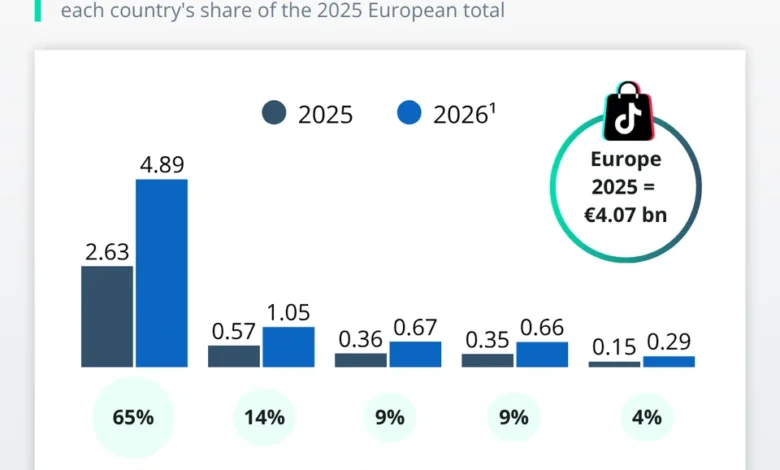
The United Kingdom continues to solidify its status as the premier European stronghold for TikTok Shop, significantly outpacing other continental markets in gross merchandise value (GMV). New data from the German ecommerce analytics firm ECDB indicates that the platform’s performance in the British market is poised to reach an impressive 5 billion euros in GMV by the end of the year. This surge reflects a broader shift in consumer behavior, where social entertainment and retail are increasingly converging into a seamless, impulsive shopping experience.
While the United Kingdom serves as the primary engine for the platform’s European growth, the broader ecosystem is undergoing a rapid transformation. With the recent rollout of a pan-European marketplace strategy, TikTok Shop is aggressively expanding its footprint, transitioning from a localized novelty to a formidable competitor in the traditional ecommerce landscape.
A Chronology of Market Penetration
The trajectory of TikTok Shop in Europe has been defined by a measured, staggered entry strategy. The United Kingdom served as the initial testbed in 2021, providing the company with invaluable data regarding logistics, consumer trust, and the integration of creator-led commerce.
Following the initial UK launch, the platform spent several years refining its operational model. By the end of 2024, the strategic expansion began to accelerate, with the platform entering Spain. The momentum reached a critical inflection point in March 2025, when TikTok Shop launched simultaneously in France, Germany, and Italy, effectively capturing the major economies of the European Union.
The latter half of 2025 marked a period of intensified growth. By June, the platform had extended its reach to include Ireland, the Netherlands, Belgium, Poland, and Austria. This rapid-fire expansion culminated in the introduction of "Sell Across Europe," a feature designed to break down geographic barriers for merchants and allow for a more cohesive, cross-border retail environment.
Comparative Market Analysis and Data
The gap between the United Kingdom and its European counterparts remains substantial. Last year, the UK accounted for a commanding 65 percent of all European spending on TikTok Shop, generating a GMV of 2.63 billion euros. This dominance is largely attributed to the maturity of the British ecommerce market and the high adoption rate of social commerce among UK consumers.
In contrast, the continental markets, while growing, are in earlier stages of development. Spain, which was among the first in the EU to receive the shopping feature, recorded 570 million euros in GMV last year—a 14 percent share of the European total. France and Germany, despite being massive economies, followed with 360 million euros and 350 million euros respectively, each representing 9 percent of the market. Italy, with its 150 million euros, accounted for 4 percent.
However, current forecasts from ECDB suggest that the growth trajectory is becoming more uniform. The data provider anticipates that all European markets will see their GMV roughly double throughout 2025. This indicates that the "learning curve" for consumers in newer markets like France and Germany is being shortened by the platform’s increasingly refined recommendation algorithms and the proven success of the creator-led model established in the UK.
The Ecosystem: Empowering Small and Medium Enterprises
A critical factor in TikTok Shop’s success is its ability to lower the barrier to entry for Small and Medium Enterprises (SMEs). In the United Kingdom alone, more than 300,000 SMEs have registered as vendors on the platform. This democratization of retail allows niche brands and local artisans to bypass traditional, capital-intensive retail distribution channels and reach audiences directly through short-form video content.

By providing a platform where "discovery" is the primary driver of the sales funnel, TikTok Shop effectively transforms the user’s feed into a digital storefront. For many SMEs, this offers a level of visibility that would otherwise be unattainable through standard search-engine-based ecommerce platforms, where smaller brands are often buried by legacy retailers.
Navigating the Cross-Border Frontier
One of the most significant developments in the platform’s evolution is the move toward cross-border trade between the European Union and the United Kingdom. Historically, trade between these regions has been complicated by post-Brexit regulatory requirements and differing tax frameworks.
TikTok Shop’s initiative to facilitate these transactions suggests that the platform is investing heavily in the logistical infrastructure required to handle cross-border VAT, customs, and fulfillment. A pilot program for these cross-border sales was initiated on September 21, with a broader rollout scheduled for October 19. If successful, this will enable British SMEs to tap into the EU consumer base directly, and vice versa, creating a truly unified European marketplace that transcends political borders.
Implications for the Broader Ecommerce Landscape
The rapid growth of TikTok Shop poses a direct challenge to incumbent e-commerce giants. Traditional marketplaces typically rely on "intent-based" shopping, where consumers search for specific products they have already decided to purchase. TikTok Shop, however, operates on "impulse-based" or "discovery-based" shopping, where the entertainment value of the video drives the purchase decision.
Industry analysts suggest that this shift could force traditional retailers to rethink their digital strategies. To remain competitive, established players may need to invest more heavily in influencer partnerships and social content, essentially attempting to replicate the engagement metrics that TikTok has mastered.
Furthermore, the data suggests that the "social commerce" sector is no longer a peripheral segment but a core component of the digital economy. As the platform matures, regulators are likely to pay closer attention to consumer protection, data privacy, and the impact on local retail sectors. The integration of 12 European countries into a single marketplace implies that TikTok Shop is positioning itself as a central pillar of the European digital single market, a move that will likely attract scrutiny regarding market concentration and fair competition practices.
Future Outlook
Looking ahead to 2026 and beyond, the primary challenge for TikTok Shop will be sustaining this growth while maintaining platform integrity. As the volume of transactions increases, the platform must ensure that its dispute resolution, counterfeit prevention, and customer support infrastructure can scale at the same pace as its GMV.
Moreover, the success of the cross-border pilot will be a bellwether for the platform’s long-term viability in Europe. If the company can successfully navigate the complexities of international logistics and varying consumer regulations, it will be well-positioned to cement its status as a primary retail destination.
For now, the data is clear: the United Kingdom serves as the blueprint, but the rest of Europe is rapidly catching up. The transition from a series of fragmented, localized experiments into a cohesive, continent-wide commerce engine represents one of the most significant shifts in the European retail landscape in recent memory. As TikTok Shop continues to bridge the gap between social entertainment and transactional utility, the lines between media consumption and consumer spending will only continue to blur, setting the stage for a new era of digital retail across the continent.