YouTube Q3 2026 Ad Revenue Growth Slows Down as Connected TV, Subscriptions, and AI Fuel Transformation

YouTube’s core advertising revenue experienced a modest growth deceleration in the third quarter of 2026, forcing parent company Alphabet to lean more heavily on diversified revenue streams such as premium subscriptions, connected television (CTV) advertising, and e-commerce integrations. According to Alphabet’s Q3 2026 financial release, YouTube advertisements generated $11.2 billion during the period. While substantial, this figure represents a year-over-year ad revenue growth rate of 9%, down from the 13% growth reported in the second quarter of the same year.
This cooling in pure ad revenue expansion comes at a transitional moment for the world’s largest video-sharing platform. Although advertising remains its primary financial engine, YouTube is successfully transforming its business model by scaling subscription services, expanding creator commerce initiatives, and integrating generative artificial intelligence across its production ecosystem. Industry analysts view this strategic pivot as a necessary evolution to maintain revenue momentum in a maturing digital advertising market, especially as audiences increasingly migrate from traditional linear television to streaming living room devices.
Financial Performance and Core Advertising Metrics
The third-quarter figures released by Alphabet paint a nuanced picture of YouTube’s economic health. The 9% year-over-year ad revenue increase to $11.2 billion reflects a slight contraction in momentum compared to earlier in 2026. Market researchers attribute this stabilization to broader macroeconomic factors affecting brand marketing budgets, as well as digital ad saturation.
However, the shortfall in advertising acceleration was partially offset by significant gains in other segments. YouTube continues to be a primary driver for Google’s overall subscription ecosystem, contributing significantly to an 11% year-over-year increase in Google’s total subscription revenue for Q3. A major catalyst for this growth is the rapid expansion of YouTube Music and YouTube Premium. Combined subscriber counts for these services have now surged to 150 million globally.
This milestone represents a dramatic acceleration in user adoption. YouTube first crossed the 100 million subscriber threshold for its combined music and premium offerings in early 2024. Reaching 150 million subscribers signifies that the platform has successfully converted millions of ad-supported viewers into paying customers, proving the viability of its tier-based monetization strategy.
The Living Room Revolution and Connected TV Dominance
Much of YouTube’s recent subscription momentum—and a rapidly expanding portion of its advertising revenue—is directly tied to the "Living Room" experience. During Alphabet’s Q2 earnings call in July, executives highlighted a significant surge in Premium sign-ups among connected TV (CTV) viewers. This trend aligns directly with broader shifts in media consumption habits, as more households substitute cable and broadcast television with streaming services.
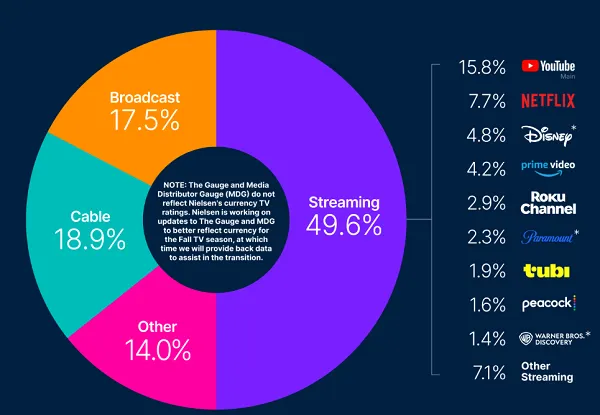
Validation of this shift came in August 2026, when Nielsen published its influential "The Gauge" report evaluating U.S. television viewing behaviors. The data officially cemented YouTube’s status as the top streaming platform in the United States, capturing a dominant share of total TV viewing time ahead of traditional subscription video-on-demand services and traditional networks.
Capitalizing on this viewership dominance, YouTube’s Living Room presence has evolved far beyond a passive viewing environment. During the Q3 earnings call, Google Chief Business Officer Philipp Schindler emphasized that the connected TV experience is now a major financial pillar. According to Schindler, Living Room ads currently account for more than one-third of YouTube’s total advertising revenue. Advertisers are increasingly viewing connected TV inventory on YouTube as a direct replacement for traditional television ad spending, commanding higher CPMs (cost per thousand impressions) and delivering targeted reach that linear TV cannot replicate.
Expanding the Creator Economy: E-Commerce and SMB Growth
Beyond its core ad and subscription businesses, YouTube is deeply invested in fortifying the creator economy to retain top talent and capture transactional revenue. The platform’s YouTube Partner Program (YPP) now boasts more than three million participating creators globally, providing a massive base of content producers who drive user engagement and platform stickiness.

Concurrently, YouTube is making aggressive inroads into digital commerce. Alphabet reported that more than 1.3 million channels are currently enrolled in YouTube’s shopping program, marking a substantial increase in e-commerce adoption among creators.
This retail push received a massive boost with the announcement of a strategic affiliate partnership with Amazon. Under this arrangement, U.S.-based creators can seamlessly tag Amazon products directly within their long-form videos, Shorts, and live streams. This integration significantly lowers the friction for creator-driven commerce, allowing audiences to make purchases without leaving the platform while opening new affiliate revenue streams for content producers.
On the enterprise side, Google’s Chief Business Officer noted that small and medium-sized businesses (SMBs) continue to show robust adoption of Demand Gen products. These AI-driven advertising tools enable SMBs to run targeted multi-format campaigns across YouTube, Discover, and Gmail, broadening the platform’s advertiser base beyond major global brands.
Generative AI Integration and Content Creation Tools
Artificial intelligence remains a central pillar of YouTube’s product roadmap, influencing everything from ad targeting to video production. Alphabet executives stressed during the Q3 earnings disclosures that AI tools are fundamentally altering how creators build content and how the platform matches ads with relevant audiences.
The scale of content production on the platform underscores the necessity of these automated tools. Schindler noted that users upload more than 20 million videos to YouTube every day. To manage this massive influx and assist creators, YouTube has introduced a suite of generative AI capabilities within YouTube Studio, alongside conversational editing assistants embedded directly into Shorts and the YouTube Create application.
The rollout of these AI features has been methodical. In March, YouTube launched an AI-powered "reimagine" option for Shorts, enabling viewers to generate alternative video variations based on existing creator clips. This was followed by testing of an "Extend with AI" feature, which allows creators to seamlessly generate alternative video endings.
User response to these features has been overwhelmingly positive, defying early skepticism regarding synthetic media. A data report published by YouTube revealed that 61% of creators who posted content on the app over the preceding 12 months expressed keen interest in utilizing AI tools to insert themselves into video content or augment their creative output.
Broader Implications and Industry Outlook
The financial and operational results from the third quarter of 2026 illustrate a mature platform successfully navigating a transitional phase. While the deceleration of pure ad revenue growth from 13% to 9% indicates that the days of unchecked linear expansion for digital ads may be leveling off, YouTube’s aggressive diversification is cushioning the impact.
By cementing its dominance in the living room through connected TV, scaling paid subscriptions to 150 million users, integrating deep e-commerce capabilities via partnerships with retail giants like Amazon, and deploying practical generative AI tools for its three million YPP creators, YouTube has constructed a multi-layered business model.
As digital platforms face ongoing scrutiny over content quality and the proliferation of low-effort synthetic media—often termed "AI slop"—YouTube’s data suggests that thoughtfully implemented generative tools are enhancing creator productivity rather than alienating audiences. Moving into the final quarter of 2026 and looking toward 2027, the platform’s ability to balance ad-supported viewership with high-margin subscriptions and transactional commerce will serve as a critical benchmark for the entire digital media industry.