The Pervasive Onslaught of AI-Generated Content Reshapes Social Media Landscape, with LinkedIn Emerging as a Primary Battleground

The proliferation of artificial intelligence-generated spam has escalated into a monumental challenge for social media networks globally, fundamentally altering the fabric of online discourse. Advanced AI models, now capable of mimicking human interaction with uncanny accuracy and producing hyper-realistic images and video clips, have blurred the lines between authentic and synthetic content, creating an environment of increasing skepticism and distrust. This deluge of AI-generated material poses significant questions about the future utility and integrity of platforms designed for human connection.
LinkedIn: At the Epicenter of the AI Spam Deluge
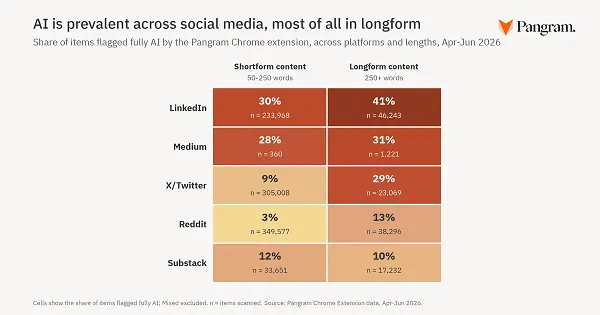
A recent report has spotlighted LinkedIn, the professional networking platform, as experiencing the most significant impact from AI spam among major social media platforms. Startlingly, 41% of all long-form posts on LinkedIn exhibit indicators of having been generated by AI tools. This figure, derived from an analysis by Pangram, a technology company specializing in AI-generated writing detection, positions LinkedIn uniquely in the ongoing battle against synthetic content. While no AI detection software can claim 100% accuracy, making a precise quantification of the problem inherently challenging, Pangram’s methodology, based on average measurements across various social media platforms, firmly places LinkedIn at the top. Following closely is X (formerly Twitter), where approximately a third of long-form posts appear to be AI-written, underscoring a widespread issue across diverse online communities.
Pangram’s methodology involves a browser extension designed to identify patterns and characteristics commonly associated with AI-generated text. This approach, while offering valuable insights, acknowledges the inherent limitations of current detection technologies, which are in a constant arms race with ever-evolving AI generation capabilities. The high percentage on LinkedIn is particularly concerning given its stated purpose as a platform for professional networking, thought leadership, and career development. The infiltration of AI-generated content on such a scale risks undermining the credibility of professional profiles, advice, and industry discussions, potentially devaluing the platform’s core offering.
The Broader Landscape: A Multi-Platform Struggle
The challenge of AI spam is not confined to LinkedIn; it is a systemic issue impacting virtually every social media platform. Each network is grappling with unique manifestations of this problem and implementing varied countermeasures, reflecting the diverse nature of their user bases and content types.
X (formerly Twitter): The Bot Dilemma and Monetization Shifts
X, under the leadership of Elon Musk, has been vocal about its struggles with AI-powered bots and misinformation. In March, Nikita Bier, X’s head of product, announced significant changes to the platform’s creator monetization incentives. This policy shift was a direct response to a sharp rise in AI-generated deepfakes, particularly those related to geopolitical events like the war in Iran. The aim was to disincentivize creators from generating and spreading such content, which can be highly damaging and misleading.

Musk himself has repeatedly emphasized the escalating impact of AI bots on social apps. In a March 2023 post on X, he articulated the daunting reality that the rapid advancement of AI had rendered it "impossible to keep bot armies out of social apps," stating that it was "trivial to spin up 100k human-like bots for less than a penny per account." His proposed solution—charging every user a small fee for access—was predicated on the assumption that even a minimal cost would act as a significant barrier to the creation of bot accounts at scale. However, this strategy largely failed to resonate with audiences. The concept of paid social options has historically struggled to gain widespread adoption, indicating a fundamental resistance among users to pay for access to platforms they have long enjoyed for free. This highlights a critical tension: the desire to combat AI spam versus the established expectations and behaviors of a global user base.
Pinterest’s Proactive Stance: Labeling and User Control
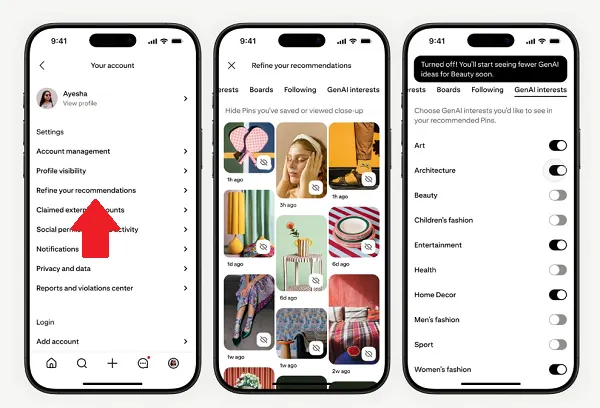
Pinterest has taken a more proactive approach, particularly in addressing concerns regarding the influx of AI-generated posts that some users reported were "flooding the feed." It stands out as one of the few platforms to introduce an "AI off switch," or at least toggles, providing users with the explicit option to limit the prevalence of AI-generated content in their feeds and topic explorations. This move signifies an acknowledgment of user dissatisfaction and an attempt to empower individuals to curate their online experience away from synthetic content. Pinterest’s strategy of labeling AI-generated content also represents a step towards greater transparency, allowing users to make informed decisions about the content they consume.
Reddit’s Defensive Measures Against Automated Activity
Reddit, known for its community-driven content and discussions, has also shared insights into its ongoing efforts to combat a rise in AI-generated comments and overall activity. The platform reported dealing with millions of daily spam views, a substantial portion of which is attributed to automated systems. Reddit’s strategy typically involves sophisticated moderation tools, community reporting mechanisms, and internal algorithms designed to detect and remove bot-like behavior and synthetic content. The challenge for Reddit, given its vast number of subreddits and diverse topics, is maintaining authentic discussions while fending off coordinated AI-driven campaigns that can manipulate narratives or spread misinformation.
LinkedIn’s Countermeasures: Reach Penalties
In response to its own significant challenge, LinkedIn has implemented countermeasures that include "reach penalties" when AI spam is detected. This means that posts identified as being AI-generated will have their visibility significantly reduced, limiting their exposure across the network. The goal is to make the creation of AI spam less effective and therefore less appealing to those who seek to game the system. However, the sheer volume of AI-generated content, as indicated by the Pangram report, suggests that these measures are part of an ongoing and complex battle rather than a definitive solution.
The Paradox: Platforms’ Dual Relationship with AI
A profound paradox lies at the heart of this struggle: while social media platforms are fighting a relentless battle against AI-generated spam, they are simultaneously investing massive resources into AI development and actively integrating AI tools into their user experience. This dual relationship underscores a fundamental tension within the industry.
Meta’s Ambitious AI Vision and User Resistance
Meta, the parent company of Facebook and Instagram, exemplifies this paradox. The company has committed hundreds of billions of dollars into AI infrastructure and development, publicly declaring its ambition to become a global leader in AI technology. This investment is translating into a push for users to integrate AI tools into their daily online interactions. Facebook and Instagram users are now routinely prompted to utilize "Meta AI" for various functions, including asking questions, generating images, and composing posts.
However, user reception to these integrated AI tools has been less than enthusiastic. When Instagram Chief Adam Mosseri recently announced the integration of Meta’s latest Muse Image generation tools into the app, the replies to his post were overwhelmingly negative. Comments such as "AI slop," "We need an option to turn off AI-generated content," and "Literally no one wants this" were common refrains. These strong user responses reflect a growing backlash against the forced integration of AI tools, particularly when it comes to recreational consumer use. Users perceive these tools as intrusive, unnecessary, or even detrimental to their experience, rather than as value-added features.
The Erosion of Trust and the Redefinition of Social Media
This rising user backlash is not surprising, as in many respects, AI tools stand as the antithesis of traditional social media engagement. Social media platforms were founded on the core concept of connection—specifically, human connection. The ability to interact with friends, family, and communities in a meaningful way has historically been their primary value proposition. AI tools, however, can only replicate this interaction through simulated personalities and automated replies. Furthermore, AI-generated images and videos are increasingly replacing genuine personal experiences, original artwork, and authentic life events, creating a synthetic layer over what was once considered real.
This development raises a fundamental question: What is the true purpose of social apps if a significant portion of what is being posted is fabricated, and if they are no longer primarily a means to showcase personal experiences and foster genuine human connections? If the majority of shared online content becomes demonstrably fake or AI-generated, it inevitably erodes trust in the entire network. This erosion weakens the key value proposition of social media until it potentially vanishes altogether.
The Future Landscape: Entertainment Versus Connection
In a scenario where trust is diminished and authentic human interaction is overshadowed by synthetic content, social media risks transforming into mere entertainment platforms. These platforms would essentially become digital content mills, churning out an endless stream of videos and images from anonymous or AI-generated personalities, effectively replacing traditional television screens with smaller, personalized screens offering shorter, algorithmically curated shows. This trend is already discernible, with many platforms prioritizing short-form video content and algorithmic recommendations over organic social feeds.
In this evolving paradigm, the definition of a "social media app" itself comes into question. Are messaging apps, where people engage in direct, private, and often more authentic conversations, now the true inheritors of the "social" mantle? For many users, these private messaging channels have become the primary, if not sole, venues for real online social interaction.
However, this shift also shrinks the broader value of social media as a public medium, moving it closer to a curated entertainment app that responds to individual user interests. Within such a framework, AI-generated content, despite its potential for novelty, may not ultimately win out in the long run. The sheer volume of AI content being posted inherently leads to issues of quality control. For every viral video of Harry Potter characters depicted in modern styles—often leveraging established intellectual property for its appeal—there will be thousands more forgettable, generic, or outright flawed depictions, characterized by anatomical inaccuracies, exaggerated facial expressions, or poorly synchronized audio.
While AI technology is undoubtedly improving at a rapid pace, the current landscape suggests that original ideas and human creativity still resonate more powerfully than what mass AI generation can produce. The paradox is that while empowering "more creativity" through AI tools might seem appealing, it could, ironically, lead to a decline in genuine user interest if the output lacks soul, originality, or authenticity. The ongoing struggle against AI-generated spam is not just a technical challenge; it is a profound existential crisis for social media, forcing a re-evaluation of its purpose, its value, and its very definition in an increasingly synthetic digital world.