The Evolving Consumer: How Economic Uncertainty Is Reshaping Digital Shopping Behaviors

The American consumer is currently navigating a complex economic landscape defined by cautious optimism and meticulous financial discipline. According to the 2026 Consumer Commerce Report from Feedvisor, a significant shift has occurred in the digital marketplace: while shoppers remain engaged, their approach to acquisition has become increasingly analytical and guarded. Eighty-seven percent of U.S. consumers surveyed indicated that prevailing economic factors have fundamentally altered their shopping habits. Despite this, the baseline for digital engagement remains robust, with 52% of respondents reporting that they purchase items online at least weekly, and 88% doing so at least monthly. This paradox of persistent activity tempered by intense scrutiny suggests a new era of "value-conscious consumption" where convenience is no longer enough to secure a sale.
The Rise of the Informed Shopper
The primary transformation in the retail sector is not a decline in volume, but a marked increase in the "pre-purchase labor" performed by the average shopper. Modern consumers are no longer passive recipients of marketing; they are active investigators. Feedvisor’s data highlights that 45% of consumers are conducting more rigorous price comparisons than they were a year ago. Furthermore, 41% of shoppers now explicitly wait for promotional periods, and 31% have heightened their reliance on secondary savings vehicles, such as digital coupons and cashback programs.

This behavior is particularly pronounced among those who cross-reference multiple retailers. Among the cohort that prioritizes price comparison, nearly 50% verify prices across at least three distinct retail platforms before finalizing a transaction. For brands and retailers, this underscores a critical reality: the digital storefront is now merely one stop in a much larger, multi-channel research process. To win the conversion, retailers must provide transparent, easily verifiable proof that their offering represents the best possible value in a crowded market.
Resilience of Discretionary "Small Treats"
Despite the overarching narrative of belt-tightening, the desire for discretionary consumption has not vanished; it has merely been recalibrated. Financial pressures have prompted a shift toward smaller, more frequent indulgences rather than large, infrequent luxury purchases. Data from the 2026 report reveals that 56% of consumers treat themselves to non-essential items—primarily in the categories of clothing, beauty, and groceries—at least once a month, with 34% engaging in such behavior on a weekly basis.
Crucially, these purchases are subject to strict budgetary caps. Approximately 44% of respondents keep these "mood-boosting" expenditures between $10 and $20. This trend indicates that while consumers are limiting their overall risk, they are unwilling to sacrifice the psychological benefits of small-scale retail therapy. Marketers who can position their products as affordable, high-quality, and emotionally rewarding are well-positioned to capitalize on this trend. The challenge for brands is to maintain the perception of premium quality while staying within the narrow price windows that today’s consumers have defined for themselves.

The Erosion of Promotional Trust
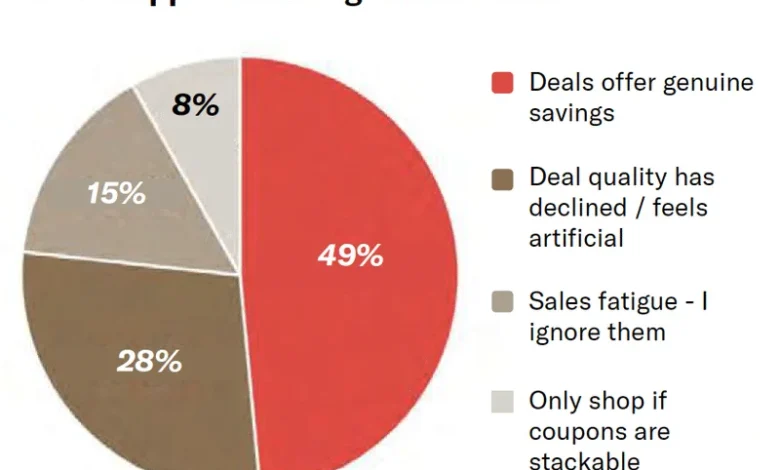
One of the most concerning findings for retail strategists is the growing skepticism surrounding traditional sales events. Major industry benchmarks, such as Amazon’s Prime Day or the traditional Black Friday kickoff, are facing a crisis of credibility. Only 49% of consumers currently believe that these high-profile events offer genuine, market-leading savings.
The sentiment is increasingly negative: 28% of consumers report that they perceive deal quality as declining or, worse, "artificial." Another 15% admit to experiencing acute "sale fatigue," leading them to tune out promotional messaging entirely. This skepticism is not distributed equally across demographics. Younger consumers, aged 18 to 29, are significantly more likely to be cynical about the authenticity of these deals, with 38% noting a decline in quality. In contrast, older demographics (65 and older) are more likely to ignore the noise of constant sales altogether.
For the retail industry, this marks a departure from the "discount-heavy" strategies of the last decade. As consumers become more adept at tracking historical price data through browser extensions and apps, the "biggest sale of the year" label is losing its persuasive power. A louder, more aggressive discount strategy is no longer a guaranteed remedy for stagnant sales; instead, it may exacerbate consumer mistrust.

AI as the New Shopping Assistant
In tandem with the demand for better prices, artificial intelligence has become an integral tool in the consumer’s research arsenal. Fifty-five percent of surveyed consumers have utilized AI tools to assist with product research or price comparisons over the past six months. The primary utility for these tools is the automation of tedious tasks: 39% of users leverage AI to identify the lowest available price, 31% to compare technical specifications, and over a quarter to track price fluctuations or hunt for active coupon codes.
However, this reliance on AI has a hard limit. Consumers are currently unwilling to cede autonomy to automated systems. Sixty-two percent of shoppers stated they would never trust an autonomous AI agent to complete a transaction, including payment and checkout, without human oversight. Even after receiving an AI-generated recommendation, a large portion of users revert to manual validation—searching via Google, checking Amazon reviews, and comparing alternatives. AI is currently viewed as a helpful clerk that suggests options, but the consumer remains the ultimate judge and executioner. For marketers, this means that AI-driven personalization can effectively place a product on a user’s shortlist, but the product listing, social proof, and price point must withstand the subsequent manual inspection.
Holiday Outlook and Economic Stratification
Looking toward the holiday season, the national outlook remains flat, masking significant volatility between different economic strata. On a broad level, 31% of consumers expect to spend more than last year, while 33% expect to spend less, and 37% intend to maintain their current levels. This aggregate view, however, is misleading.

When segmented by household income, the picture changes. Households earning upwards of $150,000 are 43% more likely to increase their holiday spending. Conversely, lower-income households—those earning less than $25,000—are facing a more precarious reality, with 26% planning to significantly reduce their outlays. Age is another critical differentiator; younger consumers remain more optimistic about their spending power compared to their older counterparts.
Furthermore, the holiday shopping timeline has shifted significantly. The traditional "late-season" rush is a thing of the past, with 60% of consumers aiming to complete the bulk of their shopping by the end of October. Only 11% of the population intends to wait until December to finalize their purchases. This compression of the shopping season requires retailers to be proactive with their inventory and marketing, as the window for capturing consumer interest is opening earlier than ever.
Strategic Implications for Marketers
The data suggests that the "one-size-fits-all" approach to consumer outreach is becoming obsolete. The modern retail environment requires a sophisticated, nuanced understanding of buyer intent. Brands must move beyond the superficial metrics of total sales and instead focus on the "why" and "how" of the purchasing decision.

The path forward for retail involves three core pillars: transparency, efficiency, and reliability. Retailers must provide clear evidence of value, as the consumer is now essentially acting as their own auditor. With the rise of AI-assisted research, the digital shelf must be optimized not just for search engines, but for the clarity required by AI scrapers and users alike. Finally, in an era where trust in traditional promotions is at an all-time low, brands that can offer consistent, everyday value—rather than relying on artificial, periodic sales spikes—will likely capture the greatest share of consumer loyalty.
As we look toward the remainder of the decade, the retail sector must adapt to a consumer who is empowered, informed, and deeply cautious. The technology exists to facilitate this new, high-friction shopping experience, but the burden remains on the retailer to prove that their product is worth the time, effort, and money required to complete the purchase. The companies that succeed will be those that view their customers not as targets to be converted, but as partners in a search for true market value.