The Evolution of WordPress Agency Management: How Automation is Redefining Scalability and Profitability


The digital landscape has fundamentally reshaped business operations, with a robust online presence becoming non-negotiable for success across industries. WordPress, powering over 43% of all websites, stands as a cornerstone of this digital transformation, driving a thriving ecosystem of agencies dedicated to its development, deployment, and maintenance. However, as WordPress agencies scale, the initial simplicity of managing a handful of client sites—winning a new client, adding a site to a portfolio, and including it on an update schedule—rapidly transforms into a complex operational challenge. This linear scaling model, where revenue grows alongside an equally demanding operational load, presents a critical bottleneck unless automation is embedded into the very foundation of the business. This article delves into the often-overlooked financial and operational costs associated with manual WordPress management, explores how advanced automation platforms cover every layer of an agency’s technology stack, and analyzes the profound economic shifts that occur when routine operational work no longer relies on individual human execution.
The Unseen Burden: The Real Cost of Manual WordPress Management
For many WordPress agency owners, the visible tasks of managing multiple sites are well-understood: design, development, content creation, and client communication. Yet, a deeper examination reveals a significant hidden cost: the multiplicative effect of routine maintenance tasks across an expanding portfolio. Each seemingly minor task, when repeated across dozens or even hundreds of client sites weekly, consumes disproportionate time and resources, rarely appearing as a direct line item in project budgets but heavily impacting an agency’s capacity for growth.
Consider a typical maintenance week for an agency. This often includes:
- Core WordPress Updates: Ensuring the CMS itself is running the latest, most secure version.
- Plugin Updates: Regularly updating numerous plugins, each with its own compatibility considerations.
- Theme Updates: Keeping client themes current to leverage new features and security patches.
- Security Scans: Proactively checking for vulnerabilities, malware, and suspicious activity.
- Database Optimization: Cleaning and optimizing databases to maintain site performance.
- Uptime Monitoring: Verifying site availability and addressing downtime incidents promptly.
- Backup Verification: Ensuring backups are successfully created and restorable.
- Cache Management: Clearing and optimizing caching layers after updates or content changes.
- PHP Version Management: Updating and ensuring compatibility with the latest PHP versions for performance and security.
This list doesn’t even encompass crucial performance checks—such as tracking load times, PHP response times, and front-end rendering performance—or the time-intensive process of generating comprehensive client reports across an entire portfolio. Industry reports indicate that IT maintenance can consume upwards of 70% of an IT budget in some sectors, and while WordPress agencies might not face identical figures, the principle of routine operational tasks overshadowing strategic work holds true. Spending two hours on plugin updates across thirty sites, for instance, generates no new revenue and does not advance a client’s strategic objectives. Instead, this time carries a significant opportunity cost—time that could be spent acquiring new clients, developing innovative solutions, or strengthening existing client relationships. This opportunity cost directly limits an agency’s growth trajectory and its ability to scale effectively.
Moreover, manual processes are inherently prone to inconsistency and error. The accumulation of small failures—a skipped plugin update, a cache not properly cleared after a deployment, an outdated PHP version—introduces compounding risks over time. Each manual step is an potential point of failure, leading to security vulnerabilities, performance degradation, and ultimately, client dissatisfaction.
The Flawed Approach: Why Simply Hiring More People Isn’t the Answer
When a team becomes overwhelmed by operational load, the natural instinct for many agency owners is to hire additional staff. However, for a WordPress agency aiming for scalable growth, this solution often proves to be financially inefficient and strategically short-sighted. Each new hire represents a substantial fixed cost, encompassing not just salary but also recruitment expenses, onboarding processes, ongoing training, software tooling, benefits, and the significant management time required to integrate them into the team. These costs are incurred long before a new developer or technician has contributed directly to client-facing, revenue-generating work.

Furthermore, increasing headcount for manual tasks does not fundamentally alter the underlying economic model. One developer manually maintaining 20 sites incurs the same per-site cost as two developers manually maintaining 40 sites. The operational burden scales linearly with the portfolio size, regardless of how many hands are involved. This creates a ceiling for growth, where increased client acquisition inevitably leads to a corresponding, often unsustainable, increase in operational expenditure.
Automation, by contrast, operates on a fundamentally different economic principle. A well-designed automated workflow, once established, can run across 20 sites with essentially the same marginal cost as running across 200 or even 2,000 sites. The initial investment in setting up the automation is amortized across a vastly larger number of instances, driving the marginal cost of adding another site to an automated process to near zero. This distinction is pivotal for scaling. As a testament to this, Local Leap Marketing reported a remarkable 60% growth in their business without needing to add any technical headcount after transitioning to Kinsta’s automated platform. Such growth would be virtually unachievable in a model where every new client site necessitates human intervention for its routine maintenance.
The Strategic Imperative: What WordPress Management Automation Truly Encompasses
For modern WordPress agencies, automation is not merely a convenience; it is a strategic imperative for sustainable growth and competitive advantage. Effective automation in a WordPress agency workflow operates across three distinct yet interconnected levels, each designed to eliminate a specific category of manual effort and collectively delivering exponential benefits. These levels include:
- Infrastructure-level automation: Managed hosting platforms providing automated server-side maintenance.
- Bulk operations and site management: Centralized dashboards for executing tasks across multiple sites simultaneously.
- Custom automation with API integration: Programmatic access to hosting features for bespoke workflows and integration with existing tools.
The true power emerges when an agency leverages all three levels in concert, creating a highly efficient and resilient operational framework.
Infrastructure-Level Automation: The Foundation of Stability and Performance
The deepest and often least visible layer of automation occurs at the infrastructure level, operating entirely beneath the WordPress dashboard. Platforms like Kinsta exemplify this by running every WordPress site within an isolated Linux container, each equipped with its own dedicated MySQL instance. This sophisticated architecture is the bedrock of infrastructure automation, allowing for site-specific maintenance, restarts, and optimizations without impacting any other site within the agency’s portfolio. This isolation is critical for security, performance, and reliability, preventing "noisy neighbor" issues common in less managed hosting environments.
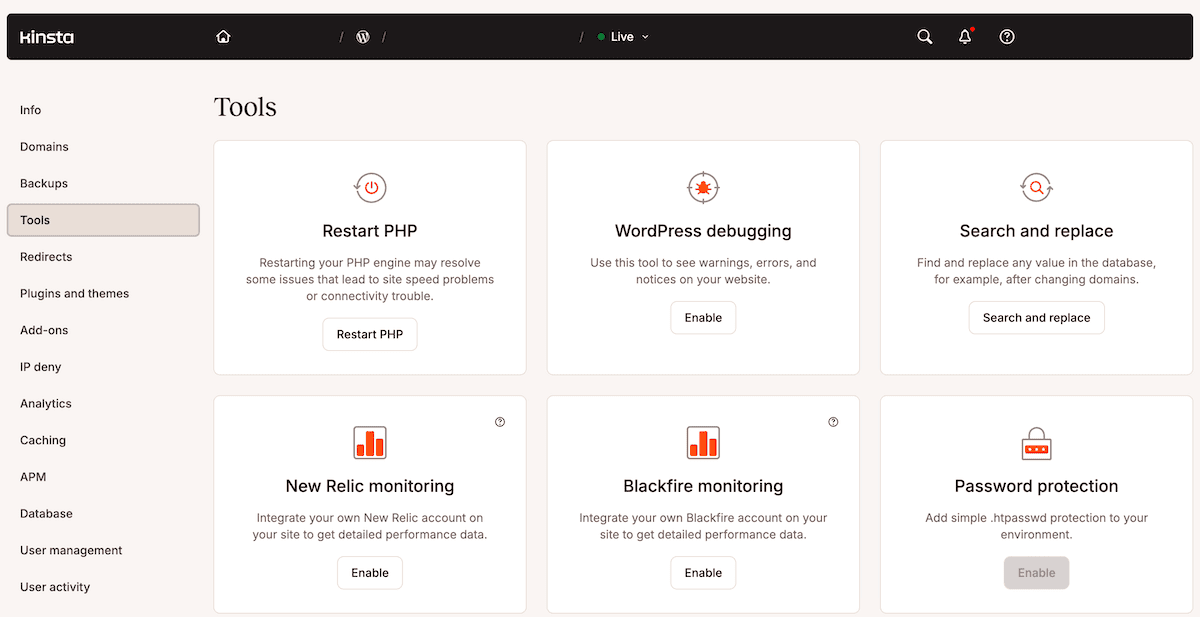
Kinsta offers a comprehensive suite of tools that automatically handle critical infrastructural tasks for every site hosted on its platform:
- Self-healing PHP: Automatically restarts PHP workers if issues arise, preventing prolonged downtime.
- Automatic daily backups: Ensures regular, restorable backups are created, a crucial safety net.
- Server-level caching: Configured and optimized automatically to deliver blazing-fast load times.
- Robust firewall and DDoS protection: Proactively defends against malicious attacks without manual configuration.
- Uptime monitoring: Constantly checks site availability, often alerting before clients even notice an issue.
- Database optimization: Automated routines keep databases lean and efficient.
- Security patches and updates: Applied at the server level, ensuring the underlying infrastructure remains secure.
These are tasks that, on self-managed or unmanaged servers, would demand significant, dedicated time from technical staff. On an intelligently automated platform, they occur continuously and autonomously, ensuring optimal performance and security without constant human oversight. For Straight out digital (Sod), an agency managing over 400 sites, this foundational layer is indispensable. As their team stated, "The automated error and vulnerability email alerts provide a layer of security, allowing us to quickly identify and address potential issues, ensuring the ongoing integrity of all the sites we manage." This proactive, automated monitoring transforms reactive problem-solving into a managed, preemptive process.
Streamlined Operations: Bulk Actions and Centralized Site Management via MyKinsta
Moving up the stack, the next layer of automation involves streamlining recurring operational tasks through centralized bulk actions. This capability, typically found in advanced hosting dashboards like MyKinsta, eliminates the need for agencies to log into each client site individually to perform routine maintenance. This consolidation of effort leads to substantial time savings and improved consistency.
For Adapting Social, consolidating their maintenance across more than 50 Kinsta sites dramatically reduced their weekly maintenance time from 15 hours to under 10 hours. This equates to over 250 hours saved annually, time that the agency strategically reinvested into direct client work, business development, and innovation—activities that directly drive revenue and growth.
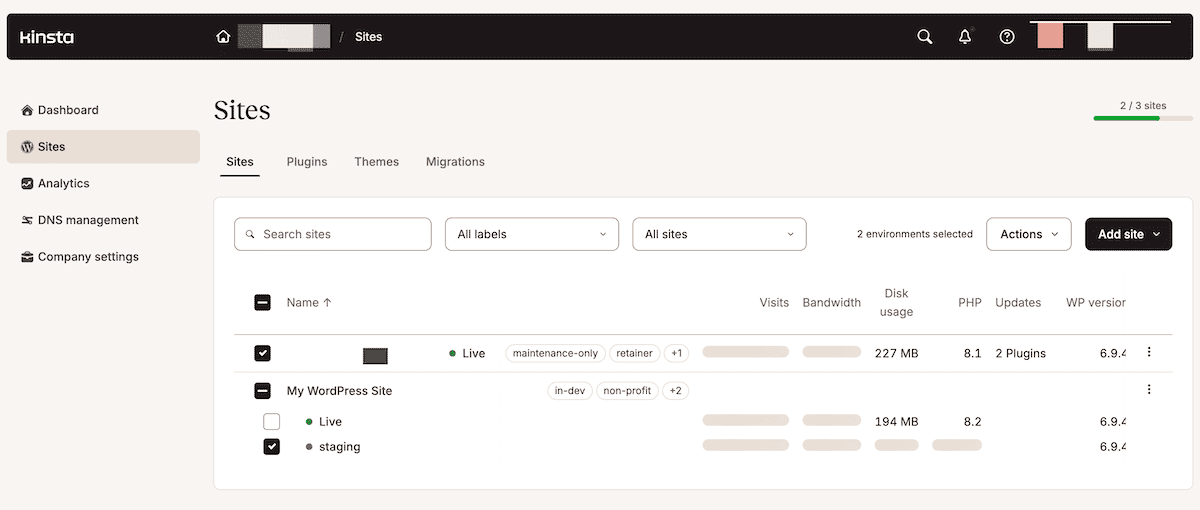
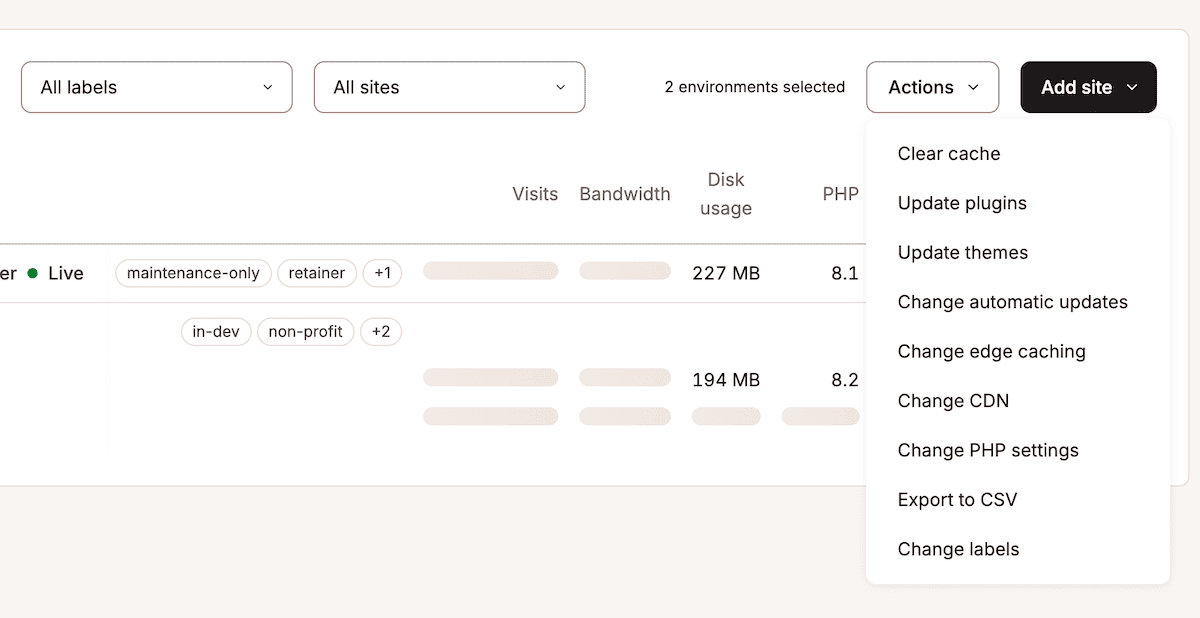
The process for initiating bulk actions is intuitive: within MyKinsta’s "Sites" list, users can select multiple environments—be it entire sites or specific staging/production environments—using checkboxes. Once selected, a single "Actions" dropdown menu provides a range of tasks, including:
- Clear cache: Instantly purges the cache across all selected sites, crucial after updates or content changes.
- Update plugins: Initiates updates for all plugins across the chosen environments.
- Update themes: Performs theme updates in bulk, ensuring design consistency and security.
- Change PHP version: Allows for mass updates or downgrades of PHP versions, vital for performance and compatibility.
- Enable/disable Kinsta CDN: Manages Content Delivery Network settings across multiple sites.
Beyond these core maintenance tasks, other valuable bulk actions exist, such as "Export to CSV," which generates a detailed spreadsheet containing critical data for each environment, including PHP version, bandwidth, disk usage, domains, and data center location. This provides at-a-glance portfolio health and aids in client reporting and resource planning.
Furthermore, advanced platforms offer options for core WordPress updates. While WordPress has its own auto-update schedule, premium features like Kinsta Automatic Updates enhance this with visual regression testing. This crucial addition automatically compares before-and-after screenshots of a site following an update, and if any visual anomalies or broken elements are detected, the update is automatically rolled back, preventing potential client-facing issues and saving countless hours of manual debugging.
Empowering Custom Workflows: Advanced Automation with the Kinsta API
The pinnacle of WordPress management automation is achieved through programmatic access via a robust API. The Kinsta API, for instance, grants developers and agencies direct programmatic access to the same powerful actions available within MyKinsta. This capability transcends mere efficiency; it empowers agencies to integrate hosting management deeply into their existing development workflows, custom tooling, and continuous integration/continuous deployment (CI/CD) pipelines.
The flexibility offered by an API means that its integration is limited only by an agency’s vision and specific operational requirements. Common use cases include:
- Automated site provisioning: Instantly creating new WordPress installations for new clients or projects.
- Custom reporting dashboards: Pulling performance, usage, and security data into internal reporting tools.
- Integration with project management systems: Triggering hosting tasks directly from project management platforms.
- Automated environment management: Spinning up staging environments for development and merging changes to production.
- Custom alerting and monitoring: Building bespoke notification systems based on specific site metrics or events.
For example, a simple function to retrieve server logs via the API demonstrates the interaction pattern: a query to a specific endpoint for an environment ID returns the desired data. This same pattern applies to any operation the API supports, from clearing caches to initiating backups.
async function getSiteLogs(environmentId, fileName, lines)
    const query = new URLSearchParams( 'error',
        lines: lines ).toString();

    const resp = await fetch(
        `https://api.kinsta.com/v2/sites/environments/$environmentId/logs?$query`,

            method: 'GET',
            headers: getHeaders, // Assuming getHeaders is defined elsewhere

    );

    const data = await resp.json();
    return data;
Critically, the Kinsta API also facilitates seamless CI/CD integration. This means that deployments can automatically trigger environment-specific tasks, such as cache clearing or database updates, without any manual steps. For agencies with established deployment workflows, the API ensures that Kinsta fits harmoniously into their existing processes, rather than requiring a separate, parallel operational stream. This integration drastically reduces deployment errors, speeds up release cycles, and ensures consistency across all projects.
Transforming Agency Economics: How Automation Redefines Profitability and Growth
The most profound impact of embracing WordPress management automation is the fundamental shift it brings to an agency’s economic model. Once an agency liberates its team from the relentless demands of manual maintenance, resources are freed to concentrate on activities that directly generate revenue, enhance client value, and strengthen long-term client relationships.
Consider the case of Beyond The Brand Media, an e-commerce WordPress agency. After migrating to Kinsta, they reported saving the equivalent of two hours per day for each helpdesk employee. This reclaimed time is not merely a cost saving; it represents the capacity of an additional full-time employee, but crucially, without the associated salary, onboarding, training, or management overhead. This recovered capacity can be strategically redirected into high-value initiatives:
- New client acquisition: Devoting more time to lead generation, proposals, and sales efforts.
- Service diversification: Developing and offering new, specialized services (e.g., advanced SEO, conversion rate optimization, custom integrations).
- Client strategy and consultation: Investing more time in understanding client goals and providing proactive strategic guidance.
- Product development: Building proprietary tools or themes that differentiate the agency.
- Employee skill development: Training staff in advanced technologies or strategic roles.
KnowTechie, with its lean team, recovered approximately 15 hours per month of administrative time previously spent troubleshooting hosting issues. This significant time saving was directly channeled into content creation, which is the core revenue driver for their site. This illustrates how automation doesn’t just cut costs; it reallocates human capital to where it can generate the most strategic impact and directly contribute to the agency’s bottom line.
The New Paradigm of Agency Growth
The conventional argument that cheaper hosting coupled with a larger team can achieve the same outcome as automation simply does not withstand scrutiny. Hosting that necessitates constant manual intervention, regardless of its initial price point, is inherently more expensive in the long run due to the hidden costs of labor, inefficiency, and risk.
Kinsta’s agency hosting plans are designed to aggressively reduce these operational costs for each site in a portfolio. Agencies that excel at scale are those that build systems where the marginal cost of adding an extra site decreases as they automate repetitive tasks. This represents a radical departure from the linear cost model most agencies begin with, and the disparity between these two models widens dramatically as an agency grows.
With a robust, Kinsta-backed automation stack, a new client onboarding workflow is transformed at every stage:
- Site Provisioning: Instead of manual setup, new sites are provisioned instantly via the API.
- Environment Setup: Staging environments are readily available from day one, facilitating seamless development and testing.
- Maintenance Schedules: Plugin and theme updates run automatically on a predefined schedule via Kinsta Automatic Updates, with visual regression testing ensuring stability.
- Performance Monitoring & Reporting: Performance and usage data are automatically pulled from MyKinsta analytics, eliminating manual reporting steps and providing real-time insights.
Each of these automations systematically removes a line item from a team’s task queue. Collectively, they fundamentally alter the relationship between portfolio size and the associated operational cost, allowing for exponential growth without a corresponding exponential increase in overhead. This creates a powerful competitive advantage, enabling agencies to offer more attractive pricing, faster service delivery, and a higher quality of client care.
Conclusion: Automation as the Indispensable Foundation for Profitable WordPress Management
Running a successful WordPress agency at scale in today’s dynamic digital environment mandates the adoption of sophisticated systems capable of maintaining client sites efficiently and securely, without placing disproportionate demands on a team’s time and resources. The operational workload required to keep a growing portfolio updated, secure, and performing optimally does not diminish on its own. Instead, it necessitates a deliberate strategic choice: to identify which tasks can be automated and to select the right tools and platforms to support that automation.
Kinsta’s comprehensive suite of services provides a multi-layered automation framework: robust infrastructure automation handles server-level complexities; intuitive bulk actions compress hours of per-site maintenance into minutes through a centralized dashboard; and a powerful API integrates hosting management directly into custom workflows and deployment pipelines. To fully harness these benefits, agencies must first map their current workflows, pinpointing where manual work is most concentrated. This analysis will guide the selection of the appropriate layer of automation—whether it’s leveraging infrastructure features, employing bulk actions in MyKinsta, or integrating with the Kinsta API—to effectively eliminate those bottlenecks.
For WordPress agencies committed to sustainable growth, enhanced profitability, and superior client service, embracing automation is no longer an option but a critical strategic investment. It transforms the agency from a reactive service provider to a proactive, scalable, and highly efficient digital partner. Agencies managing WordPress sites at scale and seeking to understand how a purpose-built platform can fundamentally support their business objectives are encouraged to explore Kinsta’s specialized agency hosting plans, charting a course towards a more automated, profitable future.