Garden Eight, a boutique digital design studio headquartered in Tokyo, has emerged as a prominent force in the evolution of corporate and brand digital communications through its unique synthesis of technical integrity and playful interaction. Comprising a specialized team of seven core members supported by an extensive network of external collaborators, the studio provides a comprehensive suite of services including web design, full-stack development, art direction, and strategic project management. By operating at the intersection of high-concept visual arts and rigorous technical implementation, Garden Eight has carved a niche for itself in a global market increasingly dominated by standardized, template-driven digital experiences. The studio’s foundational philosophy is centered on the dual concepts of "good and fun things" and remaining "playful, yet humble," ensuring that their output remains visually striking while maintaining a high degree of utility and reliability for both clients and end-users.

Strategic Integration of Design and Development
One of the defining characteristics of the Garden Eight methodology is the rejection of the traditional "waterfall" approach to web production, where design and development are treated as separate, sequential phases. In the standard industry model, a designer creates static mockups which are then handed off to a developer for implementation; this often results in a loss of nuance, particularly regarding motion and responsiveness. At Garden Eight, the majority of the team members possess cross-disciplinary skills, allowing for the simultaneous consideration of visual aesthetics, motion kinetics, and technical feasibility. This integrated workflow enables the studio to refine how a site moves and responds directly within the browser environment, rather than attempting to replicate a static image.
This approach is particularly critical in the modern digital landscape, where user experience (UX) is increasingly defined by micro-interactions and the fluid transition of data. By studying the specific context, industry tone, and user touchpoints of each project, Garden Eight develops a coherent information architecture that serves as the skeleton for more expressive elements. The studio’s ability to move back and forth between appearance and implementation allows for the adjustment of letterforms, motion speeds, camera angles, and light intensity in real-time, ensuring that the final product is a holistic digital experience rather than a collection of disparate parts.

Technical Infrastructure and Performance Standards
While Garden Eight is recognized for its creative flair, the studio maintains a rigorous focus on the backend architectures that ensure site longevity and operational efficiency. The team selects Content Management Systems (CMS) and front-end frameworks based on the specific operational requirements of the client. This flexibility ranges from conventional WordPress setups to sophisticated Jamstack architectures utilizing headless CMS solutions like Contentful, combined with modern frameworks such as Nuxt and deployment platforms like Netlify.
In the contemporary web environment, performance and accessibility have become non-negotiable benchmarks. Garden Eight integrates these considerations throughout the production lifecycle, testing for loading speeds, delivery loads, and fundamental accessibility standards, such as color contrast and screen-reader compatibility. Furthermore, the studio has recently expanded its technical scope to include optimization for search experiences (SEO) and AI-based information understanding, recognizing that modern websites must be legible not only to human users but also to the algorithmic crawlers that define digital visibility.

Chronology of Innovation: Key Project Milestones
The studio’s portfolio serves as a chronological record of its evolving technical capabilities and creative ambitions. Each project represents a specific challenge in digital storytelling, requiring a unique combination of 3D modeling, motion design, and interactive coding.
The Evolution of the Garden Eight Corporate Identity
In the renewal of its own corporate website, Garden Eight utilized the project as a laboratory for its internal culture. The studio has long maintained a tradition where each member selects a favorite animal as a personal icon. For the 2026 renewal, these icons were transformed into fully realized 3D characters. Using Blender for modeling and Three.js for browser-based rendering, these characters were cast as "performers" within the site’s interface. This project highlights the studio’s ability to blend soft, playful motifs with sophisticated technical distortions, creating a "portfolio-as-experience" that serves to spark immediate interest from potential collaborators.
Aircord: Redefining the Digital Portfolio
The collaboration with Aircord, a studio specializing in the intersection of light, sound, and physical space, represents one of Garden Eight’s most complex technical achievements. Having collaborated on four previous iterations of the Aircord site, the team moved away from the conventional "grid of projects" model. Instead, they designed the website as a continuous three-dimensional space. On the landing page, the interface appears as a distant object; as the user navigates to the "Projects" section, the camera moves through a ring-shaped environment where project footage circulates. The transition from a 3D overview to a 2D detail page is seamless, achieved by unfolding curved surfaces into planes within the same WebGL flow. This project exemplifies the studio’s "single creative act" philosophy, where design and implementation are indistinguishable.
HONKA RE:FRAME!: Education in the Age of AI
Launched in the spring of 2026, the HONKA RE:FRAME! project for Digital Hollywood presented a unique narrative challenge. The program is an honors class designed to help students navigate an era where AI provides answers, forcing a focus on the human capacity to ask questions. Garden Eight translated this abstract concept into a digital experience centered on human gestures. By using a minimalist human figure created in Blender and animated via Three.js, the site communicates a story of "stopping, reaching, and walking." The use of a particle-based orb that never settles into a fixed form serves as a visual metaphor for the "unfixed question." This project demonstrates how digital design can be used to elicit an emotional or philosophical response rather than merely conveying data.

PHOTOYOSHI and ANAI WOOD: Industry-Specific Customization
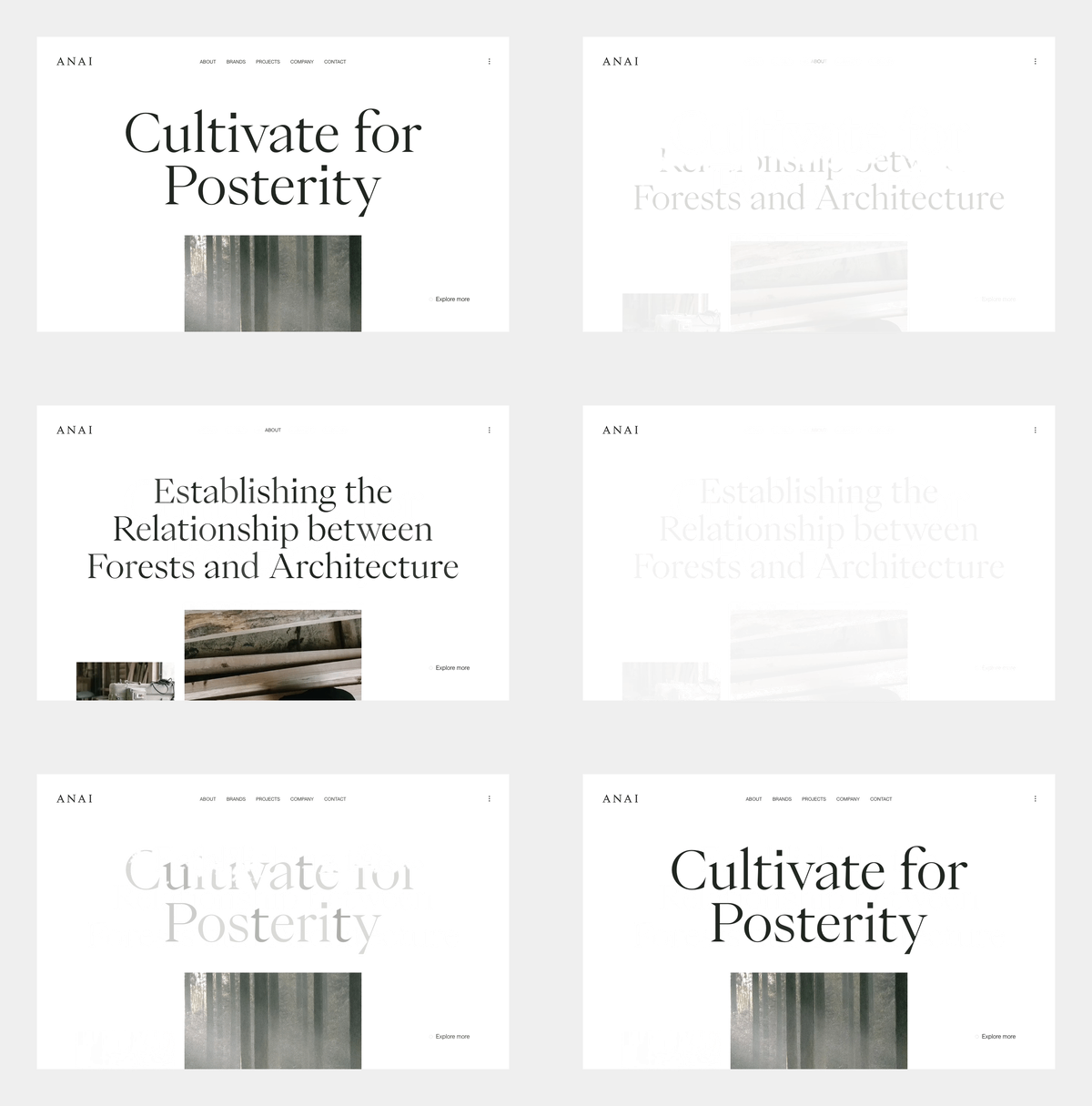
The studio’s versatility is further evidenced by its work for photographer Takamitsu Motoyoshi and Anai Wood Industry. For PHOTOYOSHI, Garden Eight focused on immersion, using infinite scrolling and randomized image delivery via a statically generated WordPress architecture to create a "fresh encounter" with every visit. In contrast, the ANAI WOOD project required a balance between the organic nature of timber and the geometric regularity of industrial milling. The site features text animations that "grow" upward and layouts that converge into grids, mirroring the company’s manufacturing process. The use of a WebGL-rendered forest in the menu background provides a memorable visual anchor for the brand’s forestry roots.
Motion and Interaction as Functional Elements
A recurring theme in Garden Eight’s output is the treatment of motion not as an aesthetic "extra," but as a core component of the site’s usability. The studio’s directors and developers meticulously examine pacing, the flow of user attention, and the specific responses to user actions. The primary directive is to ensure that motion does not interfere with the flow of content or the speed of user actions.

Once a foundation of usability is established, the studio adds layers of expression—page transitions, scrolling effects, and WebGL shaders—that contribute to the site’s character. By refining the continuity of these effects, the studio ensures that the digital experience remains fluid. This is particularly evident in their work for Plantica, a floral creative studio. The site functions as a digital catalog of intricate floral patterns, where every animation and loading sequence was designed to maximize the vivid beauty of the work while maintaining a smooth, elegant browsing experience for the user.
Broad Impact and Industry Implications
The success of Garden Eight offers a significant case study for the broader digital design industry. In an era where large agencies often struggle with the overhead of siloed departments, Garden Eight’s small, agile team structure demonstrates the efficiency of unified design and development. Industry analysts suggest that this "boutique" model is increasingly preferred by brands looking for bespoke, high-performance digital identities that stand out in a saturated market.

Furthermore, the studio’s focus on blending 3D environments (via WebGL and Three.js) with traditional 2D information architecture points toward the future of the web. As browser capabilities continue to expand and hardware acceleration becomes more common, the "continuous experience" pioneered by Garden Eight is likely to become a standard for high-end corporate communication.
The studio’s commitment to integrity—defined as creating work that is effective and reliable—alongside its commitment to "play" provides a roadmap for digital creators. It suggests that the most successful digital products are those that respect the user’s time and technical constraints while offering a moment of unexpected delight. As Garden Eight continues to push the boundaries of what is possible within the browser, their work remains a testament to the power of continuous transformation in the digital arts.