Novamira Unveils Plugin for Direct AI Agent Integration with WordPress, Revolutionizing Development Workflows

The landscape of web development is undergoing a significant transformation, with artificial intelligence increasingly becoming an indispensable tool in the daily operations of development teams. From assisting with research and crafting internal utilities to generating code and streamlining editorial processes, AI agents have firmly established their value. However, a common bottleneck has persisted: the disconnect between an AI’s ability to generate solutions and the manual effort required for their implementation and iterative refinement within a live development environment. This challenge is now being addressed by Novamira, a new open-source, self-hosted WordPress plugin designed to seamlessly integrate AI agents directly into a WordPress installation, granting them real-time access and execution capabilities.
The traditional workflow often involves a developer prompting an AI agent, such as Claude or Gemini, to address an issue—for example, fixing a malfunctioning contact form. Within moments, the AI delivers several lines of PHP code along with a confident explanation of its efficacy. This is where the "real work" typically begins. The developer must then manually navigate file managers, locate the correct files, paste the code, reload the site, only to frequently encounter fatal errors. The subsequent steps involve screenshotting the error, feeding it back to the AI for revision, and repeating the cycle. This manual back-and-forth can consume a significant amount of time, turning what seems like a simple fix into an hour-long ordeal. Novamira aims to eliminate this friction, transforming the interaction from a detached suggestion system into a dynamic, integrated development partnership.
The Core Innovation: Turning WordPress into an MCP Server
Novamira functions as a self-hosted WordPress plugin that essentially converts a WordPress site into an "MCP (Multi-Control Protocol) server" for AI agents. This designation signifies a centralized control point, allowing various AI clients to interact directly and programmatically with the website’s backend. The plugin facilitates a direct connection between an AI client—such as Claude Code, Claude Desktop, Cursor, Codex, Windsurf, VS Code, or Gemini CLI—and the WordPress installation. This direct link bypasses intermediary layers, providing the AI agent with a profound level of working access that was previously unavailable without extensive manual intervention.
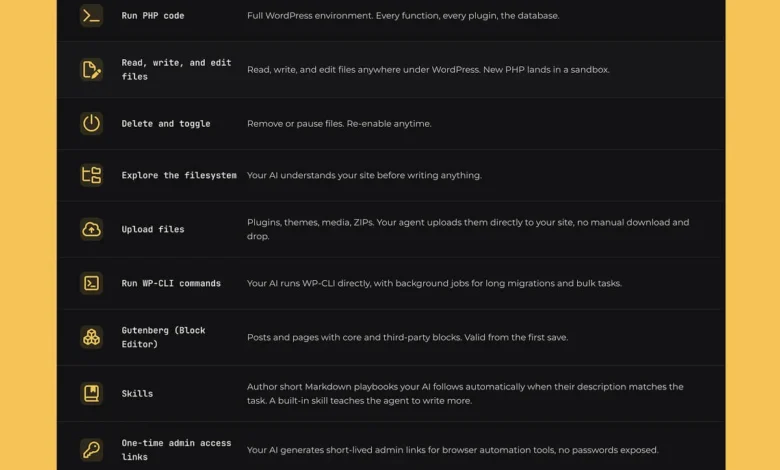
Upon connection, the AI agent gains the ability to execute PHP within the full WordPress environment, query and modify the database, read and edit files, run WP-CLI commands, construct Gutenberg pages, and even upload plugins or themes. This comprehensive suite of capabilities means that AI agents can move beyond merely suggesting code; they can actively inspect, diagnose, implement, and test solutions in real-time. The architectural choice for a direct, self-hosted connection is critical: no data or actions pass through Novamira’s own servers. Instead, the interaction remains between the user’s chosen AI client and their WordPress site. While the agent’s interpretation of site data is still processed by the respective AI provider, this architecture offers a significant degree of privacy and control for developers. Furthermore, Novamira imposes no metering on actions or builds, meaning usage is only limited by the user’s AI subscription plan. This "bring your own AI" model aligns with a growing preference among developers for flexible, non-vendor-locked solutions.
Real-Time Context: AI Agents Gain True Site Awareness
One of Novamira’s most significant advantages lies in enabling AI agents to "see" and understand the real-time state of a WordPress site before attempting any modifications. With direct access, an AI can inspect active plugins, discern how a theme registers custom post types or functionalities, and test its generated PHP code against the live installation. This immediate feedback loop allows the agent to identify and correct errors within the same conversational context, drastically reducing the debugging time.
This capability unlocks the potential for AI to tackle a broad spectrum of everyday development tasks that, while conceptually simple, often consume considerable developer hours. Examples include debugging a broken e-commerce checkout process, performing bulk edits across hundreds of posts or custom fields, wiring up complex third-party integrations, or executing intricate data migrations. These are tasks that can be articulated in a single sentence but traditionally demand an entire afternoon of meticulous work. By empowering AI agents with this level of contextual awareness and operational control, Novamira promises to significantly boost developer productivity and efficiency.
Enhancing AI Efficacy: Skills and Persistent Memory

Beyond foundational access, Novamira introduces advanced features designed to further enhance the utility and effectiveness of AI agents. The plugin ships with "Skills," which are essentially short Markdown playbooks stored directly within WordPress. These playbooks serve as educational modules, teaching any connected AI agent about the site’s specific conventions, architectural patterns, and recurring workflows. This allows developers to codify best practices and site-specific knowledge, ensuring that AI agents adhere to established standards and perform tasks more accurately and efficiently, reducing the need for repetitive instructions. This concept aligns with the broader AI development trend of "Retrieval Augmented Generation" (RAG), where AI models are provided with specific, relevant context to improve their outputs.
While the free Novamira plugin provides the complete access layer—including PHP execution, database access, file operations, WP-CLI integration, Gutenberg support, uploads, and Skills on an unlimited number of sites—an optional add-on, Novamira Pro, addresses two distinct, yet crucial, challenges in advanced AI-assisted development.
Firstly, Novamira Pro tackles the issue of "memory." In typical AI interactions, each conversation is often stateless, requiring developers to re-explain project conventions, brand guidelines, and past architectural decisions. Pro maintains persistent context across sessions, storing a project’s historical decisions and details. This means the AI agent retains knowledge from previous interactions, leading to more consistent, context-aware, and efficient problem-solving over time, reducing cognitive load on the developer.
Secondly, Pro offers "specialization." It includes maintained expertise for 37 popular WordPress builders and plugins, such as Elementor, Bricks, Divi, WooCommerce, Advanced Custom Fields (ACF), Gravity Forms, and major SEO plugins. AI agents often struggle with the complex, proprietary data structures and methodologies employed by these sophisticated tools, leading to "mangled" or incorrect outputs. Novamira Pro provides specific knowledge bases and heuristics for these widely used extensions, enabling the AI to interact with them accurately and effectively. This targeted expertise ensures that the AI can reliably perform tasks within these specialized environments, a common pain point for developers leveraging AI for site maintenance and feature development. The value proposition of the paid tier becomes evident in its ability to navigate the intricacies of the WordPress ecosystem’s most prevalent and complex components.
Technical Underpinnings: The Abilities API in WordPress 6.9
The robust capabilities of Novamira are built upon the WordPress 6.9 Abilities API, making this version the minimum requirement for the plugin, alongside PHP 8.0. The Abilities API, introduced in a recent major WordPress release, represents a significant evolution in how developers can programmatically interact with and extend the platform. Prior to this, developers relied primarily on WP-CLI for command-line interactions and the REST API for external applications to interface with WordPress. While powerful, these methods often presented limitations for highly granular, real-time, and internal programmatic control.
The Abilities API was designed to provide a more refined and robust framework for defining and managing actions that can be performed within the WordPress environment. It offers a standardized and secure way for plugins and themes to declare their capabilities and for other components or external agents to leverage those capabilities. For Novamira, this API is foundational, enabling the plugin to expose a controlled yet comprehensive set of WordPress functionalities directly to AI agents. This architectural choice underscores Novamira’s commitment to leveraging native WordPress advancements for deep integration, rather than relying on more generic or less secure methods. The API’s focus on granular control and internal programmatic use makes it an ideal conduit for AI agents requiring precise interaction with the WordPress core and its ecosystem.
Navigating the Risks: Full Access Demands Full Responsibility
The power of Novamira—granting full access to a WordPress installation—inherently comes with significant responsibility. An AI agent, operating with administrator-level privileges, possesses the capability to not only fix issues efficiently but also to introduce critical errors with equal speed. Database modifications, in particular, often lack an immediate "undo" button, emphasizing the potential for irreversible changes.
The developers of Novamira have been commendably transparent and direct about these inherent risks. They have implemented several safeguards: AI abilities are disabled by default; only authenticated administrators can connect an AI client; and any new PHP files generated and executed by the AI are confined to a monitored sandbox environment equipped with crash recovery mechanisms. The official documentation explicitly acknowledges that while the sandbox offers protection, direct PHP execution by a sufficiently powerful agent could potentially bypass some of its limitations.

Their recommendations align with established best practices for professional development:
- Environment: Novamira should be primarily used on local development or staging sites.
- Backups: A current and reliable backup should always be in place before any AI-driven modifications.
- Human Review: Developers must thoroughly review all code and changes produced by the AI agent.
- Production Deployment: AI abilities should remain disabled on live production sites. All changes should be deployed through standard, controlled development workflows, such as version control systems (e.g., Git) and continuous integration/continuous deployment (CI/CD) pipelines.
This approach underscores that Novamira is a tool built for seasoned professionals who possess a deep understanding of programmatic access and the judgment required to manage its risks. It is not intended as a substitute for human oversight but rather as an augmentation to expert development practices. The implications for security within the WordPress ecosystem are profound, necessitating a heightened awareness of AI agent capabilities and a commitment to secure development practices. The future of AI in web development will undoubtedly see continued innovation in security protocols and risk mitigation strategies to complement such powerful tools.
Broader Impact and Future Outlook for WordPress Development
Novamira’s emergence marks a pivotal moment in the evolution of WordPress development, signaling a shift towards more integrated and intelligent automation. Its open-source, self-hosted, and client-agnostic approach stands in stark contrast to the potential future landscape of proprietary, closed, and hosted AI development platforms. This choice aligns strongly with the open-source ethos of the WordPress community, offering developers greater control, transparency, and flexibility.
The implications for various stakeholders within the WordPress ecosystem are significant:
- For Freelancers and Small Agencies: Novamira could democratize access to advanced development capabilities, enabling faster project turnaround times, more efficient debugging, and the ability to take on more complex tasks without necessarily expanding human resources proportionally. This could significantly enhance competitiveness.
- For Large Agencies and Enterprises: The plugin offers a powerful tool for streamlining large-scale maintenance, managing intricate migrations, and accelerating custom feature development across numerous sites. The "Skills" and "Pro" memory features become particularly valuable in maintaining consistency and efficiency across large, long-term projects.
- For Site Owners: While not directly interacting with Novamira, site owners will benefit indirectly through faster, more cost-effective development, maintenance, and support services from their development partners. This could lead to more robust and feature-rich websites delivered more quickly.
This innovation fits into a broader trend of AI augmenting software development, seen in tools like GitHub Copilot, Cursor, and various AI-powered IDEs. However, Novamira specifically addresses the unique challenges and opportunities within the WordPress environment, which powers over 43% of the internet. The plugin’s ability to provide a contextualized, executable interface for AI agents suggests a future where routine coding, debugging, and integration tasks are increasingly handled by intelligent systems, allowing human developers to focus on higher-level architectural design, complex problem-solving, and innovative feature development.
The journey towards truly autonomous, self-healing web systems is still ongoing, but Novamira represents a critical step in providing AI agents with the necessary tools to operate effectively within a dynamic content management system. The ongoing testing by WP Mayor, leading to a full hands-on review, will provide invaluable insights into its practical efficacy and real-world impact. Until then, Novamira has already secured its place among the top emerging WordPress web development AI tools, poised to redefine how developers interact with their sites and their AI assistants.
Considering this powerful integration, if you were granted a staging site and an AI agent with full access through Novamira, what would be the very first development task you would assign it to optimize or solve?