Meta Expands Parental Oversight Controls for AI Chatbots Amid Rising Youth Engagement Concerns

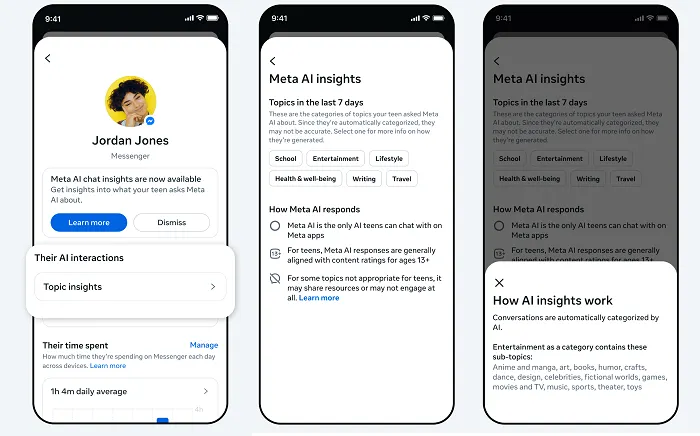
Meta Platforms has officially introduced a new suite of parental supervision tools designed to give parents and guardians greater insight into how teenagers interact with the company’s artificial intelligence chatbots. Rolling out across Meta’s ecosystem beginning today, the updated controls allow adults to view the general topics their teenage children have been inquiring about over a rolling seven-day period, though exact chat transcripts remain private.
This latest development marks a significant expansion of Meta’s ongoing safety roadmap. It arrives at a time of mounting scrutiny regarding the role of generative artificial intelligence in the daily lives of minors, particularly as millions of young people increasingly rely on conversational agents not only for academic assistance, but also for companionship and emotional support.
Core Features of the New Meta AI Supervision Controls
Under the newly implemented framework, parents who activate the supervision feature gain access to a summarized log of subject categories and themes that their teen has discussed with Meta AI over the past week. However, to respect adolescent privacy and foster trust, the system deliberately restricts access to the verbatim text of the conversations.
In addition to topic visibility, Meta is introducing a more restrictive "Limited Content" setting. By default, the Meta AI app operates under a standard 13+ content policy. However, parents who desire a more guarded environment for their teens can manually switch to the Limited Content setting. This option further narrows the boundaries of acceptable discourse, placing additional algorithmic constraints on the types of queries and responses the chatbot can generate within the application.
This update directly addresses the standalone Meta AI app, integrating it into the broader parental oversight architecture that Meta previously deployed across its core social media applications, including Instagram and Facebook.

The Evolving Landscape of Teen AI Adoption
The rollout of these controls occurs against a backdrop of rapidly accelerating artificial intelligence adoption among minors. Recent research underscores just how deeply integrated AI tools have become in the lives of modern adolescents. According to data published by the Pew Research Center, roughly 57 percent of teenagers in the United States have utilized AI chatbots to search for information, while 54 percent have turned to automated tools to assist with homework and school assignments.
Beyond academics and general search queries, sociological and psychological studies reveal a more complex psychological dynamic. Reports from academic outlets such as The Conversation indicate that a substantial portion of the teenage demographic is increasingly treating AI chatbots as surrogate companions, turning to them for emotional validation, mental health advice, and interpersonal sounding boards.
While these tools offer undeniable utility—acting as patient tutors, brainstorming partners, and accessible information gateways—they also introduce a spectrum of complex societal risks. Education experts and child psychologists have raised persistent alarms regarding the potential for algorithmic misinformation, the reinforcement of dangerous confirmation biases, academic dishonesty and cheating, and the psychological impact of forming parasocial attachments to non-human entities.
A Chronological Look at Meta’s Safety Architecture
Meta’s approach to regulating minor engagement with generative artificial intelligence has evolved iteratively over the past several years, reflecting the rapid pace at which the technology has scaled.
- Early Integrations: As Meta began embedding generative AI features across its family of apps—such as Instagram direct messaging and Facebook search bars—concerns grew regarding how minors would encounter unverified or inappropriate synthetic content.
- April Oversight Launch: In response to these early anxieties, Meta rolled out its initial phase of parental overview tools in April. These foundational controls offered parents limited insights into queries submitted specifically within the AI features embedded inside Meta’s established social platforms.
- The Standalone App Challenge: As the standalone Meta AI application gained traction, safety advocates pointed out a regulatory gap between integrated in-app features and dedicated AI platforms.
- Present Expansion: The current update closes that gap by extending supervision controls to the dedicated Meta AI application, ensuring comprehensive oversight whether a teen interacts with the technology via a social feed or a standalone conversational interface.
Looking forward, industry analysts suggest these controls may eventually pave the way for minors to access more advanced generative architectures, such as Meta’s proprietary Muse agents. Although Muse agents are currently restricted, expanding supervisory frameworks represents a necessary prerequisite if Meta intends to eventually lower age barriers and fulfill its corporate mission of delivering personalized superintelligence to all demographics.
Industry Response and Stakeholder Perspectives
Child safety advocates, digital rights organizations, and mental health professionals have offered mixed reactions to Meta’s latest safety initiative. Many have lauded the tech giant for taking proactive steps to increase transparency for parents, noting that visibility into inquiry topics provides a much-needed bridge for families to initiate difficult conversations about digital literacy and safe technology use.

"Knowing what topics your child is querying is a helpful diagnostic tool," said Dr. Elena Vance, a child psychologist specializing in digital media habits. "It allows parents to spot potential red flags—ranging from academic stress to mental health distress—long before a crisis manifests. However, visibility alone is not a silver bullet. Parents must actively use these insights to talk to their children about the limitations and biases inherent in artificial intelligence."
Conversely, some privacy advocates and critics argue that restricting access to actual chat transcripts may render the supervision tools insufficiently granular. They contend that without seeing the context of a conversation, parents may struggle to determine whether a flagged topic—such as mental health struggles or complex personal relationships—is being addressed safely by the chatbot or whether the AI is inadvertently providing harmful advice or validation.
Furthermore, questions remain regarding enforcement and user compliance. Tech platforms have historically faced challenges ensuring that underage users do not bypass age restrictions by falsifying their birth dates during the account creation process. While parental supervision controls are effective when activated, their success relies entirely on parents and teens opting into the supervision ecosystem.
Broader Implications for the Tech Sector
Meta’s deployment of enhanced AI supervision tools is likely to set a precedent for other major technology companies operating in the generative AI space. As competitors race to capture younger demographics and integrate conversational assistants into everyday consumer technology, regulatory bodies worldwide are increasing pressure on corporations to build privacy-preserving, child-safe architectures from the ground up.
In the European Union and various United States jurisdictions, lawmakers are actively drafting or enforcing stricter guidelines regarding automated profiling, data collection from minors, and the psychological safety of algorithmic systems. By voluntarily implementing these oversight mechanisms, Meta is attempting to demonstrate corporate responsibility and preemptively address regulatory anxieties.
Nevertheless, the fundamental challenge remains unresolved: how to safely integrate developing minds with technologies designed to simulate human empathy, reasoning, and authority. As teenagers continue to blur the lines between tool and companion, the effectiveness of Meta’s new supervision controls will ultimately be measured not by the features themselves, but by how successfully they foster genuine, offline communication between parents and children in an increasingly synthetic world.
Related posts: