Meta Expands Test to Limit Facebook Link Posts for Non-Paying Professional Accounts Following Meta One for Business Launch

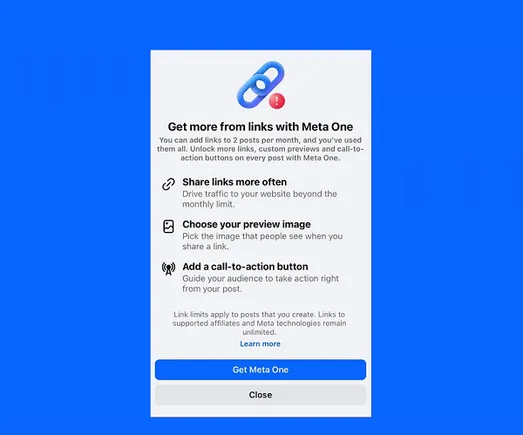
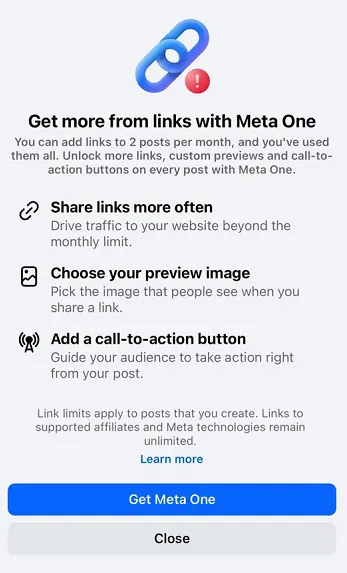
The digital marketing landscape is shifting once again as Meta broadens its tests restricting organic outbound link sharing on Facebook. Following the recent rollout of the Meta One for Business subscription packages, numerous business managers and professional account holders have reported receiving pop-up notifications stating that their capacity to publish link posts will be capped at a mere two per month unless they upgrade to a paid tier.
This development marks a significant escalation in Meta’s ongoing strategy to monetize professional features across its ecosystem. While the initial iteration of Meta One for Business heavily emphasized monthly caps on outbound links for Instagram posts and Reels—varying by the chosen subscription level—the integration of similar restrictions onto the core Facebook platform signals a unified, cross-app paywall approach for outbound traffic. As organic reach for external links continues to decline across Meta’s family of apps, business owners, content creators, and social media strategists are forced to reevaluate their distribution tactics and budgeting priorities.
The Evolution of Meta’s Link Restriction Tests
The current wave of restrictions does not emerge in a vacuum. Meta first initiated small-scale tests restricting specific business and creator Pages to a maximum of two link posts per month back in December 2025. During those initial trials, the social media conglomerate maintained that the objective was to analyze whether increasing the volume of posts containing external links yielded genuine, measurable value for commercial entities, or if it merely contributed to lower-quality user experiences driven by clickbait and referral spam.
Throughout these preliminary testing phases, Meta implemented crucial exemptions to protect the platform’s baseline utility. Notably, recognized publisher Pages were largely insulated from the restrictions to ensure a steady, uninterrupted flow of news and informational content within the Facebook newsfeed. However, with the formal commercial launch of Meta One for Business, the scope of these limitations has expanded rapidly. What began as a localized, experimental trial is now crystallizing into a standardized feature of Meta’s tiered subscription model, affecting a broader spectrum of commercial and professional accounts that do not fall under the traditional news publisher umbrella.
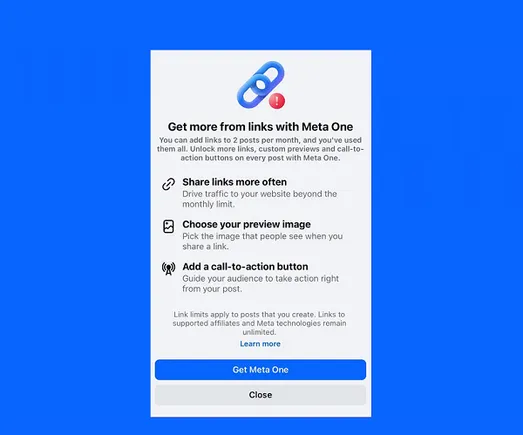
When professional account managers log into their dashboards under the new regime, they are greeted by explicit system prompts notifying them of the two-link threshold. To unlock higher volumes of outbound link sharing—alongside other associated perks tied to the Meta One suite—organizations must commit to a recurring monthly subscription fee. For brands that rely heavily on driving direct web traffic from social media channels to e-commerce storefronts, corporate blogs, or external landing pages, this restriction presents a critical operational bottleneck.
Historical Context: The Three-Stage Monetization Playbook
To fully understand Meta’s current push toward charging businesses for basic distribution capabilities, industry analysts often point to the company’s long-standing playbook. Back in 2016, during an annual stockholder meeting, Meta CEO Mark Zuckerberg outlined a definitive three-stage monetization strategy for the company’s applications and ecosystem.
The first stage focuses entirely on building consumer utility and capturing widespread attention by developing engaging, consumer-facing products and scaling user adoption to massive global proportions. During this phase, platforms remain entirely open, accessible, and free for both individual users and businesses, encouraging the organic accumulation of a captive audience.
The second stage involves cultivating and scaling business ecosystems. Meta successfully achieved this by encouraging brands, small businesses, and media organizations to build dedicated presences, cultivate communities, and utilize organic posting tools to reach consumers directly on Facebook and Instagram. For years, businesses were told that establishing a robust organic presence was essential for brand growth and customer engagement.
The third and final stage centers on the monetization of those established business ecosystems. Over the past decade, Meta has methodically executed this phase by steadily degrading organic reach for commercial entities—most notably through algorithmic adjustments that prioritize content from friends and family over corporate pages—and steering those same businesses toward paid advertising products like sponsored posts and targeted ad campaigns. The introduction of Meta One for Business represents the next logical evolution of this third stage: transitioning from pay-to-promote advertising models to subscription-based tiers that gate fundamental publishing capabilities, such as outbound link sharing.

Analyzing the Data: The Real Value of Link Posts on Facebook
While business owners may view the limitation of two link posts per month as a catastrophic blow to their digital marketing strategies, hard platform data suggests that the practical impact on overall audience exposure may be far less severe than anticipated.
Meta’s official Widely Viewed Content Report for the first quarter of 2026 provides revealing insights into how users consume content across the platform. According to the report, a staggering 98.7% of all post views in the United States during that timeframe did not include an outbound link to a source outside of Facebook. In stark contrast, only 1.3% of viewed content incorporated a link directing users away from the application.
This figure represents a dramatic, long-term decline in the visibility and consumption of outbound links. When Meta first began publishing transparency data regarding widely viewed content in 2022, approximately 9.8% of viewed content included an external link. Over the subsequent four years, algorithmic adjustments, changing user consumption habits, and Meta’s preference for keeping users within its walled garden have driven that percentage down to historic lows.
Because the Facebook algorithm inherently suppresses the visibility of posts containing outbound links in favor of native video, images, and text-only updates, many organic link posts already struggle to generate meaningful impressions or click-through rates. Consequently, capping non-paying accounts at two link posts per month may force brands to abandon ineffective organic link-posting habits and redirect their energies toward higher-performing native formats, or compel them to invest in paid acquisition channels if outbound traffic remains an indispensable Key Performance Indicator (KPI).
Industry Reactions and Strategic Implications for Brands
The rollout of Meta One for Business and the simultaneous expansion of link restrictions have elicited mixed reactions across the digital marketing community. While some marketing professionals argue that charging for features that were once entirely free constitutes a predatory bait-and-switch tactic, others view it as an inevitable economic reality of operating on proprietary commercial infrastructure.
For small and medium-sized enterprises (SMEs) operating on tight marketing budgets, the decision to subscribe to Meta One for Business requires careful cost-benefit analysis. Organizations must weigh the monthly subscription expense against the actual referral traffic and conversion revenue historically generated by organic Facebook link posts. If internal analytics reveal that organic link posts yield negligible returns, many businesses will likely bypass the subscription tier entirely, adapting their content strategies to maximize native engagement while reserving financial investments for targeted advertising campaigns.
Conversely, content-heavy businesses, niche publishers, and digital media brands that rely on social referral traffic may find themselves pressured to subscribe to maintain their current workflows. However, because recognized news publisher Pages are currently exempt from the link-posting limitations, traditional journalistic outlets retain a distinct operational advantage over standard commercial brands under the new framework.
Looking ahead, digital strategists anticipate that Meta will continue refining its subscription offerings, potentially introducing granular tiers, localized pricing structures, and expanded utility metrics based on feedback gathered during these ongoing tests. As the lines between organic social media management and software-as-a-service (SaaS) subscriptions continue to blur, marketing teams must remain adaptable, diversifying their traffic acquisition channels across search engines, email newsletters, and alternative social networks to mitigate platform dependency risks.