Meta Unveils New WhatsApp Business Tools MCP to Simplify AI-Powered Customer Engagement and Automated Workflows


Meta has announced the official launch of the WhatsApp Business Tools Model Context Protocol (MCP), a transformative integration designed to streamline how businesses establish customer support channels and automated messaging profiles on the world’s most popular instant messaging platform. By bridging the gap between third-party artificial intelligence tools and the WhatsApp Business Platform, Meta is looking to eliminate traditional technical barriers, empowering brands of all sizes to deploy sophisticated, AI-driven conversational agents with minimal coding expertise.
The initiative marks a significant step forward in Meta’s broader strategy to commercialize its messaging ecosystem. As consumer behavior shifts decisively away from public social media feeds toward private direct messaging channels, businesses are under increasing pressure to meet customers where they are. The new MCP framework allows marketers to integrate their preferred third-party AI software directly into WhatsApp, translating plain-language operational commands into fully functional automated workflows, custom messaging templates, and responsive customer support agents.
The Mechanics of the WhatsApp Business Tools MCP
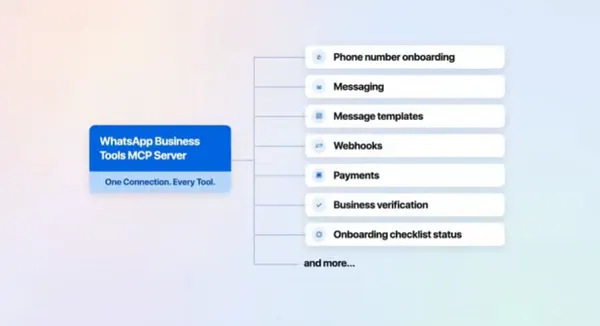
At its core, the WhatsApp Business Tools MCP functions as an interoperable bridge connecting external artificial intelligence environments to the backend infrastructure of the WhatsApp Business Platform. Historically, setting up automated response trees, building integrated customer relationship management (CRM) connections, and drafting compliant marketing templates required specialized software development kits (SDKs), dedicated engineering teams, and substantial investments of time and financial resources.
Under the new procedure, the barrier to entry drops significantly. Marketers and business owners can utilize their chosen AI chatbot tool and simply describe the desired agent profile, behavioral guidelines, or customer service functionality using natural language. The underlying AI system interprets these conversational requests and automatically generates the systematic process requirements, configuration parameters, and structural frameworks needed to deploy the features directly onto WhatsApp.
For instance, if a retail brand wants to launch a customized marketing template designed to alert shoppers about abandoned carts or flash sales, team members can interact with their AI tool of choice to draft, refine, and deploy the asset conversationally. Similarly, customer service agents can be trained on specific company knowledge bases through simple text prompts, ensuring that automated responses accurately reflect brand guidelines, product specifications, and return policies without manual coding.

Background and Evolution of Meta’s Business Messaging Strategy
The introduction of the MCP framework represents the latest milestone in Meta’s multi-year evolution of WhatsApp from a simple peer-to-peer messaging application into a robust commercial ecosystem. Acquired by Facebook (now Meta Platforms) in 2014 for approximately $19 billion, WhatsApp initially focused on maintaining an ad-free, secure messaging experience for individual users. However, as the platform scaled past two billion active users globally, leadership recognized the immense potential for monetization through enterprise services.
In 2018, Meta released the WhatsApp Business app for small businesses, followed shortly by the introduction of the WhatsApp Business API for medium and large enterprises. These tools allowed brands to send transactional notifications—such as flight confirmations, shipping updates, and appointment reminders—at scale. Over the subsequent years, Meta steadily expanded these capabilities, introducing catalog features, in-app shopping carts, and payment integrations in select markets like India and Brazil.
As generative artificial intelligence technologies matured rapidly between 2023 and 2025, Meta integrated conversational AI assistants across its family of apps, including Meta AI on WhatsApp, Instagram, and Messenger. The launch of the WhatsApp Business Tools MCP is the natural convergence of these two trajectories: combining Meta’s enterprise messaging infrastructure with third-party generative AI models to democratize conversational commerce.
Market Context and the Shift Toward Private Messaging
Meta’s timing for the rollout of the WhatsApp Business Tools MCP aligns with profound shifts in consumer communication habits. Over the past half-decade, digital media researchers and social media analysts have documented a marked migration of online interactions from public feeds—such as those on Facebook, X (formerly Twitter), and public Instagram profiles—into private direct messages (DMs) and encrypted chat groups.
Recent industry data underscores this trend. WhatsApp usage within the United States, a market historically dominated by native SMS and Apple’s iMessage, has experienced steady, accelerated growth, surpassing 100 million active monthly users. Globally, the platform handles upwards of 100 billion messages daily. Consumers increasingly prefer the intimacy, speed, and asynchronous nature of chat applications for interacting with both peers and commercial entities.
For brands, this cultural shift presents both an opportunity and an operational challenge. While consumers are more receptive to engaging with businesses via chat, managing high volumes of inbound inquiries manually is economically unsustainable for most organizations. Traditional rule-based chatbots, while helpful, often frustrate users with rigid menus and limited comprehension. By facilitating the integration of advanced third-party AI agents through the MCP framework, Meta aims to solve this dilemma, enabling businesses to deploy scalable, context-aware, and emotionally intelligent automated systems.
Industry Implications and Expert Analysis
Technology analysts and digital marketing experts have responded to the announcement with cautious optimism, noting that while the technical simplification is a welcome development, businesses must navigate several strategic considerations before deploying AI agents at scale.
From an efficiency standpoint, the benefits are clear. Always-on automated systems powered by advanced AI can process thousands of simultaneous customer queries instantly, drastically reducing response times and lowering operational overhead for customer support centers. Furthermore, the ability to rapidly generate marketing templates and automated workflows through conversational prompts drastically shortens the go-to-market timeline for promotional campaigns.
However, industry observers also emphasize potential risks associated with automated customer interactions. Ensuring brand safety, maintaining data privacy compliance, and preventing "hallucinations"—instances where generative AI models provide incorrect or misleading information—remain critical challenges for enterprises. Companies utilizing third-party AI tools linked via the WhatsApp Business Tools MCP will need to implement rigorous monitoring, human-in-the-loop oversight systems, and strict guardrails to maintain customer trust.
Additionally, data governance and regulatory compliance will play a central role in how companies adopt these tools. With stringent data protection frameworks such as the European Union’s General Data Protection Regulation (GDPR) and the California Consumer Privacy Act (CCPA) governing how consumer data is collected and processed, businesses must ensure that the third-party AI tools they connect to the WhatsApp Business Platform adhere strictly to enterprise-grade security standards.
Future Outlook for WhatsApp Enterprise Solutions
As Meta continues to roll out the WhatsApp Business Tools MCP to developers and enterprise clients, the broader implications for the software-as-a-service (SaaS) and marketing technology sectors are substantial. Many customer relationship management platforms, helpdesk software providers, and conversational AI startups are expected to build native integrations supporting the new protocol, further cementing WhatsApp’s position as a foundational layer for digital commerce.
For Meta, empowering businesses to operate more efficiently on WhatsApp reinforces the platform’s utility, driving higher transaction volumes and potentially increasing enterprise spending on paid messaging features and click-to-WhatsApp advertisements. As artificial intelligence continues to redefine the boundaries of human-computer interaction, tools like the WhatsApp Business Tools MCP signal a future where conversational commerce is not reserved for tech giants with massive engineering budgets, but is accessible to businesses of every scale.