Meet the Startup Automating the Backbone of Industrial Pipefitting Through Robotics

Industrial infrastructure relies on a vast, intricate network of pipes to transport everything from crude oil and natural gas to municipal water and food ingredients. At the core of this infrastructure are bolted flange joints—the mechanical connections that secure sections of pipe together. For decades, the maintenance, assembly, and disassembly of these joints have depended on grueling, physical labor performed by skilled pipefitters. However, chronic labor shortages, demanding 12-hour shifts, and a pervasive decline in North American trade productivity have pushed the industry to its limits. Enter Lindsey Elliott, a former ExxonMobil engineer and planner, and her startup, Nexterity, which has developed a remote-controlled robotic solution designed to fundamentally transform how industrial piping is maintained.
The Genesis of Nexterity and the Problem with Industrial Bolting
The inspiration for Nexterity did not emerge in a vacuum. Elliott spent years analyzing the inefficiencies inherent in the logistics and maintenance of infrastructure used by the oil, gas, and petrochemical sectors. Throughout her career, a recurring bottleneck continually demanded attention: the manual labor required to torque and untorque the bolts securing industrial pipe flanges.
In traditional operations, pipefitters must manually manage heavy pneumatic or hydraulic tools to loosen and tighten bolts under physically punishing conditions. These tasks often take place in confined spaces, at awkward angles, and during grueling multi-month stretches where workers face mandatory 12-hour shifts. The physical toll of this work frequently leads to repetitive strain injuries, fatigue-related accidents, and chronic musculoskeletal problems among trade workers.
Compounding these human costs is an escalating labor crisis. Like many traditional blue-collar industries, the skilled trades are experiencing an aging workforce and a dwindling pipeline of new recruits. According to industry observations cited by Elliott, North American pipefitting productivity has suffered notably over the past decade, creating an urgent demand for technological intervention that can bridge the labor gap without compromising safety or precision.
Decoding the Hardware: How the Nexterity Robot Works
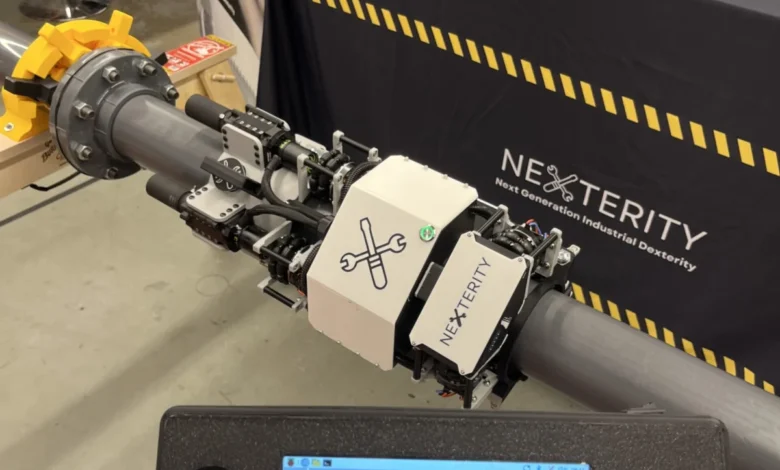
To address these systemic inefficiencies, Nexterity engineered a specialized, battery-powered robotics system explicitly tailored for industrial pipe maintenance. The technology centers on a two-piece modular apparatus designed to clamp securely around standard industrial piping.
Once affixed to a pipe, the robotic unit autonomously traverses the exterior surface, positioning itself over targeted flange joints. Operating via remote control, the device can simultaneously loosen or tighten up to four bolts in a fraction of the time required by a human technician operating traditional handheld gear.
Crucially, Nexterity prioritized portability and field deployment in its design philosophy. Consultations with industry professionals—affectionately known within engineering circles as "torque dorks"—helped shape the product specifications. Industry data revealed that approximately 80% of industrial piping falls within a diameter range of two to eight inches, corresponding to Nominal Pipe Sizes NPS2 through NPS8. By focusing engineering efforts on this specific demographic of piping, Nexterity ensured maximum market applicability.
The resulting hardware configurations are compact enough to fit inside a standard Pelican case. A single technician can easily transport, assemble, and operate the equipment on-site. This modularity underpins Nexterity’s business model, which treats the robotics units akin to rental construction equipment—allowing facilities to rapidly deploy the technology without massive upfront capital expenditures.
Industry Validation and the TechCrunch Disrupt Spotlight
Nexterity’s innovative approach recently earned the startup significant recognition, securing a coveted spot among the Startup Battlefield 200 participants at TechCrunch Disrupt. This platform has provided Elliott and her team with an opportunity to showcase their industrial automation technology to a global audience of investors, technologists, and industry leaders.
The journey toward this milestone involved years of rigorous research and direct engagement with trade associations. Elliott’s presence at events such as the annual Bolting Symposium—now in its 13th year—and her active collaboration with members of the Pressure Vessels and Piping Division of the American Society of Mechanical Engineers (ASME) provided invaluable feedback loops. These interactions validated her hypothesis that repetitive, standardized tasks in piping maintenance represent prime candidates for targeted automation.
Broad Market Implications Beyond Oil and Gas
While Nexterity’s initial application targets the oil, gas, and petrochemical sectors where Elliott built her career, the broader market implications extend far beyond fossil fuels. Industrial piping infrastructure is a universal requirement across an array of vital economic pillars.
Water treatment facilities, municipal wastewater management systems, food and beverage processing plants, mining operations, nuclear energy installations, and emerging green manufacturing facilities all rely on identical configurations of bolted flange joints. Because fluid dynamics and structural containment principles remain consistent across these diverse industries, the market potential for a standardized bolting robot is vast.
Market analysts note that as manufacturing sectors worldwide face simultaneous pressures to decarbonize, improve operational efficiency, and mitigate labor shortages, the adoption of robotics in heavy industry is accelerating. Solutions that enhance worker safety while boosting baseline productivity are shifting from novel concepts to essential components of industrial longevity.
The Path Forward for Industrial Automation
As Nexterity prepares for broader commercial deployment, the startup faces the task of scaling its manufacturing capabilities and proving the reliability of its robotics fleet in harsh industrial environments. By keeping the technology focused on the repetitive, physically taxing elements of pipefitting, Elliott aims to shift the industry ethos toward a model characterized by intelligent automation rather than brute-force labor.
For the skilled pipefitters currently facing grueling schedules and high injury risks, the arrival of remote-controlled mechanical assistance represents a welcome shift. If widely adopted, Nexterity’s approach could redefine labor standards in heavy industry, ensuring that infrastructure maintenance evolves in step with modern technological capabilities.
Related posts: