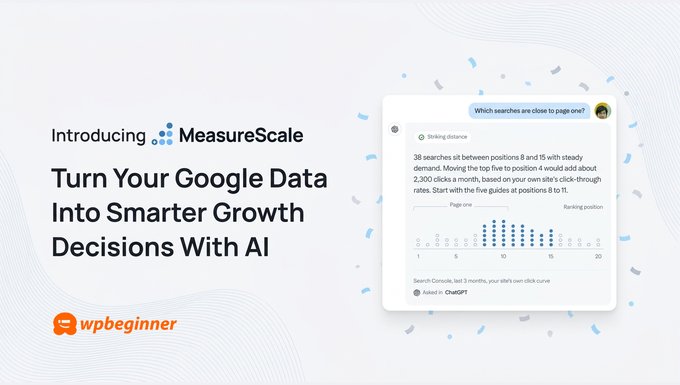
Introducing MeasureScale: Turn Your Google Data Into Smarter Growth Decisions With AI

In the modern digital economy, website owners and digital marketers are inundated with metrics. Tools like Google Search Console, Google Analytics, and Google Ads collect billions of data points daily, mapping every user click, impression, conversion, and bounce. However, a persistent challenge has plagued the analytics landscape: while these platforms accurately report what is happening on a website, they frequently fail to explain why it is happening or provide actionable guidance on what steps to take next.
To bridge this gap, many professionals have turned to artificial intelligence. By connecting raw website data to large language models (LLMs) and AI assistants, users hoped to automate complex data analysis and uncover hidden growth vectors. Unfortunately, early experiences with standard AI connectors have revealed significant limitations. Most systems pass raw, uncontextualized data directly to AI algorithms. As a result, the models often generate confident-sounding responses that blur the line between genuine analytical insight and statistical hallucinations. For website managers trying to drive genuine revenue growth, separating fact from fiction has turned into a tedious, manual process of cross-referencing every number.
Addressing the critical need for trustworthy, context-aware AI analytics, tech entrepreneur Syed Balkhi and his team have officially launched MeasureScale. Built by the creators behind MonsterInsights—the widely utilized Google Analytics plugin for WordPress serving over three million websites—MeasureScale functions as a Model Context Protocol (MCP) server. It is specifically designed to bridge the gap between live Google data feeds and popular AI assistants, offering a streamlined path from raw metrics to strategic business decisions.
The Technological Foundation: Understanding Model Context Protocol (MCP)
At the core of MeasureScale’s architecture is the Model Context Protocol, an emerging open standard that facilitates secure, structured communication between AI models and external data repositories. Unlike traditional plugins or basic API integrations that simply dump unformatted spreadsheets into an AI chat window, an MCP server acts as an intelligent intermediary.
When a user poses a question to an AI assistant integrated with MeasureScale—such as querying traffic fluctuations or conversion drops—the system does not rely on the AI to guess how to query the database. Instead, MeasureScale proactively determines the appropriate analytical framework required to answer the question, executes that analysis on live Google data, and then hands the structured, verified results to the AI assistant. The AI’s role is subsequently focused on translating the finished statistical analysis into clear, plain-English guidance for the user.
This methodology fundamentally alters the reliability of AI-driven insights. By pre-processing the data and applying strict analytical parameters before the AI interprets the findings, MeasureScale significantly reduces the risk of hallucinations. Furthermore, the tool maintains complete transparency: every answer generated by the assistant explicitly discloses its underlying data source, the exact date range covered, and whether the underlying data set is finalized or subject to future platform revisions. For instance, if Google Analytics applies sampling to a high-traffic report or Search Console experiences a data delay, the system explicitly flags these nuances, ensuring users never mistake an automated estimate for an immutable fact.
Platform Integration and Compatibility
MeasureScale has been engineered for broad ecosystem compatibility from day one. Rather than demanding complex website installations, proprietary tracking scripts, or platform-specific extensions, the service operates entirely via cloud authentication. It is fully compatible with any domain verified within Google Search Console, regardless of whether the underlying site runs on WordPress, Shopify, custom PHP, or static HTML architectures.
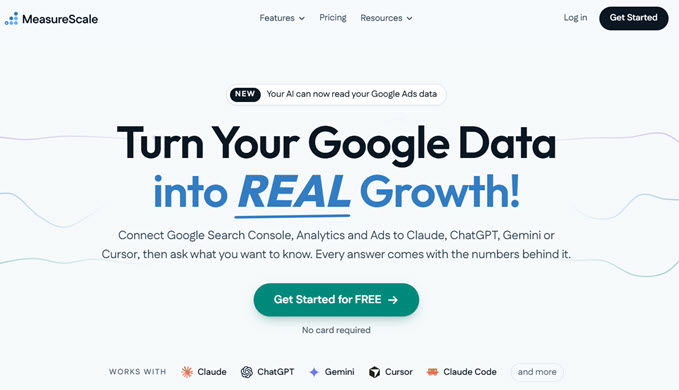
Furthermore, the tool integrates seamlessly with a wide array of leading AI environments. Users can deploy MeasureScale within mainstream conversational interfaces like ChatGPT, Claude, and Gemini, as well as developer-focused environments and coding assistants such as Cursor and Claude Code. This flexibility allows digital marketers, solo entrepreneurs, and enterprise growth teams to incorporate data analysis directly into their existing daily workflows without adopting unfamiliar proprietary software interfaces.
Optimizing Organic Search Performance via Google Search Console
Search engine optimization remains one of the most reliable channels for sustainable digital growth, yet identifying high-impact optimization opportunities within Google Search Console often requires advanced data filtering. MeasureScale addresses this by automating complex keyword and ranking evaluations.
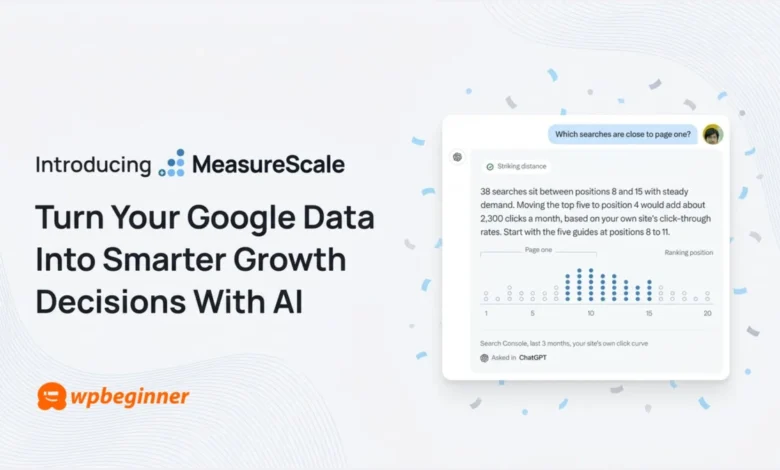
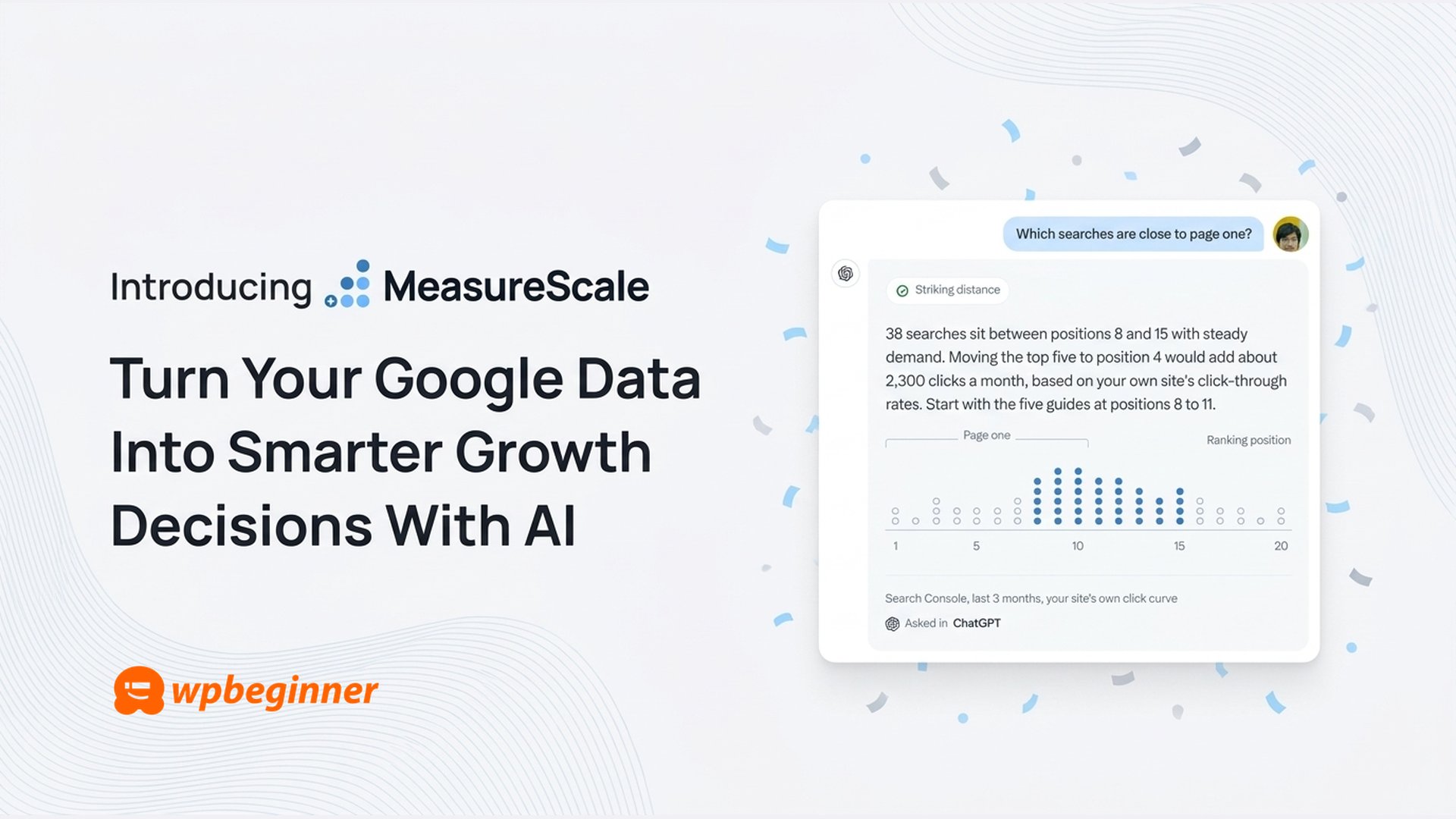
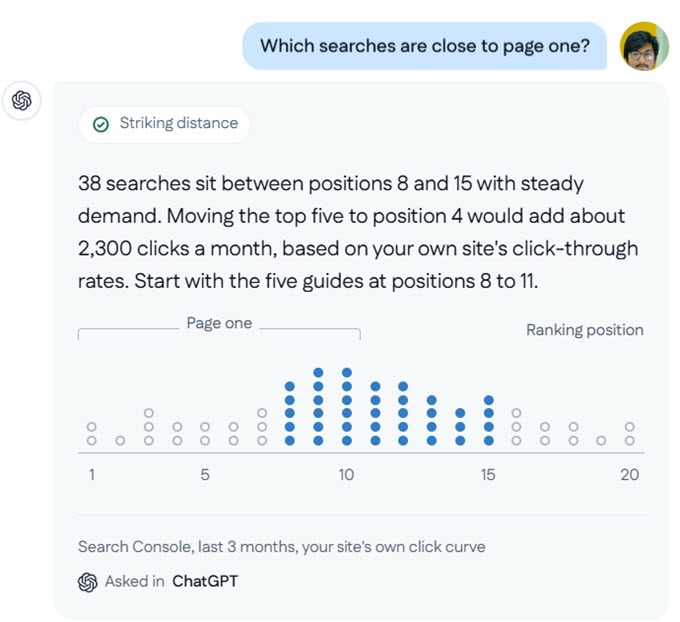
Among the platform’s primary capabilities is the identification of "striking distance" keywords—search queries where a website currently ranks just outside the first page of Google search results (typically positions 11 through 20). These queries represent some of the lowest-hanging fruit for organic traffic expansion, as minor content enhancements can propel a page into top-tier visibility. MeasureScale automatically isolates these keywords and calculates projected traffic gains based on the specific historical click-through rates of the target domain, bypassing generalized industry averages in favor of bespoke statistical forecasting.
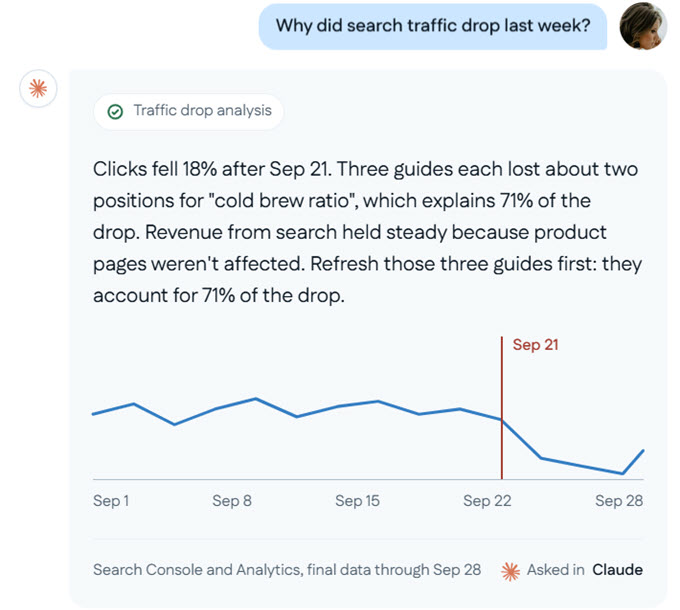
Beyond keyword tracking, the tool assists site owners in diagnosing sudden organic traffic declines. By cross-referencing historical search performance against known algorithmic updates or site modifications, MeasureScale helps isolate the precise variables driving traffic shifts, enabling content teams to take corrective action swiftly.
Connecting Traffic to Revenue Through Google Analytics
Traffic volume alone does not guarantee business viability; the ultimate measure of a website’s success lies in its ability to convert visitors into leads, subscribers, or paying customers. By bridging Google Search Console with Google Analytics 4 (GA4), MeasureScale transforms standard traffic reports into revenue-attribution dashboards.
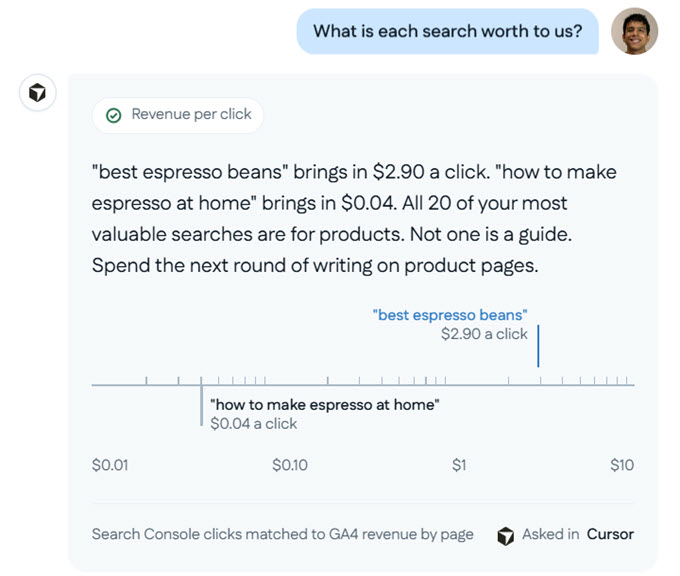
Traditional analytics platforms often obscure the relationship between organic search queries and bottom-line financial outcomes. MeasureScale resolves this by mapping estimated revenue, user sign-ups, and conversion events directly back to individual search queries and landing pages. E-commerce merchants can instantly determine which specific search terms generate paying customers rather than merely driving high-bounce traffic.
Additionally, the integration provides visibility into user behavior patterns leading up to checkout drop-offs and tracks emerging traffic channels, such as visits originating from AI search engines and generative chat interfaces like ChatGPT. This granular visibility allows digital strategists to reallocate content creation budgets toward high-converting topics rather than chasing vanity metrics.
Safeguarding Google Ads Budgets
For organizations supplementing organic reach with paid acquisition, MeasureScale offers read-only integration with Google Ads campaigns. Advertisers can query their ad performance metrics using natural language to evaluate campaign efficiency, assess cost-per-acquisition trends, and identify underperforming ad spend.
Significantly, MeasureScale operates under a strictly read-only security paradigm regarding advertising accounts. The system cannot alter active campaigns, modify bidding strategies, adjust daily budgets, or change targeted keywords. This architectural safeguard ensures that all strategic decisions and campaign modifications remain firmly under human control, eliminating the risk of automated software errors compromising marketing expenditures.
Attribution Testing and Controlled Experimentation
One of the most persistent hurdles in digital marketing is establishing causality. When a website implements widespread content updates, structural redesigns, or metadata optimizations and subsequently experiences a surge in traffic, isolating the true driver of growth is notoriously difficult. Seasonal trends, competitor movements, and broader algorithmic shifts frequently confound internal evaluations.
MeasureScale introduces a systematic attribution testing feature designed to solve this evaluation problem. When a site administrator implements changes across a specific subset of pages, they can log the modification date within the AI assistant. After a standard 28-day observation window—allowing search engine crawlers sufficient time to re-index and stabilize rankings—MeasureScale compares the performance of the modified pages against a control group of similar, untouched pages on the same domain.
The resulting output provides a definitive verdict: whether the optimization yielded statistically significant positive results, proved ineffective, or requires additional observation time. Complete with numerical uplift metrics and comparative baseline data, this feature provides agencies and in-house marketing teams with the empirical evidence needed to demonstrate return on investment to stakeholders.
Enterprise-Grade Security and Privacy Protocols
Granting external software applications access to proprietary Google accounts represents a critical operational decision for any organization. In response to potential security concerns, MeasureScale has prioritized robust data protection and privacy standards.
The platform utilizes encrypted credential management, ensuring that user authentication tokens are securely stored and completely invisible to external AI assistants. Furthermore, because MeasureScale relies primarily on read-only permissions for connected Google services, it cannot delete historical data, alter configurations, or compromise core web assets. Advanced write-access permissions—such as submitting XML sitemaps or establishing GA4 annotations—are strictly optional and require explicit, manual user authorization prior to execution.
Market Positioning and Pricing Strategy
To ensure broad accessibility across the digital economy, MeasureScale has adopted a tiered pricing model designed to accommodate independent creators, growing businesses, and enterprise agencies alike.
The entry-level tier is offered free of charge and provides foundational Google Search Console integration for a single website without requiring credit card details. The Pro tier, priced at $99 per year, expands functionality by incorporating Google Analytics, Google Ads, and automated page speed performance monitoring. Specialized agency and team plans are also available, offering expanded site capacities, multi-seat collaboration workspaces, and dedicated client management features. Every new account initiates with a complimentary 14-day trial of the Pro feature set.
Industry Implications and Future Outlook
The launch of MeasureScale marks a significant maturation point in the application of generative artificial intelligence to digital marketing and data analytics. By addressing the critical industry bottlenecks of data hallucination, context loss, and lack of transparency, the tool establishes a new operational standard for how businesses interact with their digital metrics.
Backed by the extensive industry experience of Syed Balkhi and the development team behind MonsterInsights, MeasureScale is positioned to rapidly scale its footprint within the digital marketing ecosystem. As the platform prepares for upcoming integrations within the official extension directories of major AI applications, its overarching mission remains clear: democratizing enterprise-grade data analysis and empowering website operators of all technical backgrounds to transition seamlessly from passive observation to confident, data-driven growth.