Google Chrome Faces Scrutiny Over Silent 4GB AI Model Integration and the Ethics of On-Device Prompt APIs

Google has recently initiated a significant update to its Chrome browser, integrating the Gemini Nano artificial intelligence model directly into the software’s local infrastructure. This move, characterized by a silent background download of approximately 4 gigabytes of data, has sparked a debate within the web development and privacy communities regarding user consent, the definition of web standards, and the increasing dominance of Chromium-based browsers in shaping the internet’s future. The integration is part of Google’s broader strategy to implement the Prompt API, a tool designed to allow web developers to access on-device large language models (LLMs) directly through the browser. However, the method of deployment and the regulatory requirements attached to the API have drawn sharp criticism from industry experts and rival browser engines alike.
The Silent Rollout of Gemini Nano
The controversy began as users and developers noticed an unexplained surge in disk space usage and network activity associated with the Google Chrome browser. Investigations revealed that Google had begun pushing Gemini Nano, a streamlined version of its Gemini LLM, to Chrome installations. Unlike typical browser updates that focus on security patches or performance optimizations, this 4GB transfer represents a standalone product bundled with the browser.
A primary point of contention is the lack of an opt-in mechanism. Under current implementation, the model is downloaded without explicit user permission. Furthermore, technical reports indicate that if a user manually locates and deletes the Gemini Nano files from their local directory, the Chrome browser is programmed to re-download them automatically. This behavior has led critics to compare the rollout to the 2014 Apple Inc. marketing campaign where the U2 album Songs of Innocence was automatically added to the libraries of over 500 million iTunes users without their consent. In the case of Google, however, the "gift" is a massive computational model that consumes significant storage and bandwidth.
Technical Foundations of the Prompt API
The Prompt API is the technical interface that allows JavaScript developers to interact with Gemini Nano. By making the LLM available locally, Google aims to reduce the latency associated with cloud-based AI, improve privacy by keeping data on the user’s machine, and lower the operational costs for developers who would otherwise have to pay for API calls to external servers.
According to technical documentation published by the Chrome team, the Prompt API is intended to facilitate tasks such as text summarization, classification, and rephrasing directly within the browser environment. While the benefits of on-device AI are recognized—particularly in terms of offline availability and reduced data exposure—the implementation strategy has raised questions about where a "browser" ends and a "standalone product" begins. Critics argue that while the API is being marketed as a new web standard, it functions more like a proprietary extension of Google’s ecosystem that has been unilaterally imposed on the web platform.
Chronology of Development and Prototyping
The rollout of Gemini Nano and the Prompt API is not a sudden development but the culmination of over a year of internal planning and public prototyping. The timeline of this integration highlights Google’s long-term vision for "AI-first" browsing:
- Early 2023: Google begins internal discussions regarding the integration of on-device LLMs into the Chromium project.
- Late 2023: An "Intent to Prototype" is filed in the Blink-dev mailing list, the primary forum for discussing changes to the Chrome rendering engine. This phase allowed for initial experimentation by a limited group of developers.
- Mid-2024: Published explainers and documentation for the Prompt API appear on developer.chrome.com and GitHub, detailing how the API would interact with local hardware.
- Late 2024: Reports emerge from the general user base regarding the silent 4GB downloads, indicating that the feature has moved from a limited prototype to a wide-scale rollout in stable Chrome builds.
Throughout this period, Google has framed the development as a response to "positive developer sentiment." However, critics point out that this sentiment is often measured within Google’s own ecosystem, potentially ignoring the broader concerns of the international web standards community.
Mozilla and the Challenge to Open Web Standards
The most significant institutional opposition to Google’s approach has come from Mozilla, the developer of the Firefox browser and a long-standing advocate for an open, decentralized web. Mozilla’s concerns are focused on the "Generative AI Prohibited Uses Policy" that Google requires developers to acknowledge before using the Prompt API.
Mozilla argues that the API sets a worrying precedent because it includes "User-Agent (UA) specific rules" that go beyond the requirements of international law. Specifically, Google’s policy prohibits the generation of "sexually explicit content" and "misleading claims related to governmental or democratic processes." While these restrictions may appear socially responsible, Mozilla contends that hard-coding moral or political guidelines into a web API is a violation of the neutral nature of the web platform.
In a formal statement, Mozilla representatives noted that the web platform should provide capabilities without dictating the specific nature of the content created with those capabilities. By tying a web API to a specific corporation’s usage policy, Google is effectively acting as a global regulator of content, leveraging its browser’s market share to enforce its internal corporate values on the entire internet.

The Precedent of User-Agent Specific Policies
The debate over the Prompt API touches on a fundamental philosophy of the internet: the separation of the tool from the content. Historically, web standards (such as HTML, CSS, and basic JavaScript APIs) are designed to be "agnostic." A browser should be able to render a page regardless of whether the content is controversial, provided it does not violate local laws.
By introducing the Prompt API with a built-in "Prohibited Uses Policy," Google is introducing a layer of "governance-by-code." If this model becomes the standard for future web APIs, it could lead to a fragmented web where different browsers permit different types of speech or data processing based on the corporate headquarters of the browser manufacturer. This shifts the power of censorship and content moderation from governments and judicial systems to private software companies, often without the oversight or transparency required in democratic processes.
System Requirements and Resource Management Concerns
Beyond the philosophical and regulatory debates, the silent download of Gemini Nano raises practical concerns regarding hardware resources. A 4GB model is substantial for users on limited data plans or those using devices with restricted storage, such as entry-level laptops and tablets.
Furthermore, running an LLM locally requires significant RAM and GPU/CPU resources. There are concerns that:
- Storage Bloat: Chrome, already known for its high memory usage, is now becoming a major consumer of disk space. For users with 128GB or 256GB SSDs, a 4GB forced download represents a non-trivial percentage of available storage.
- Bandwidth Impact: In regions with metered internet or slow connection speeds, a 4GB background download can disrupt other essential activities and lead to unexpected data charges.
- Performance Degradation: If the model is activated by web applications in the background, it could lead to thermal throttling or battery drain on mobile devices and laptops.
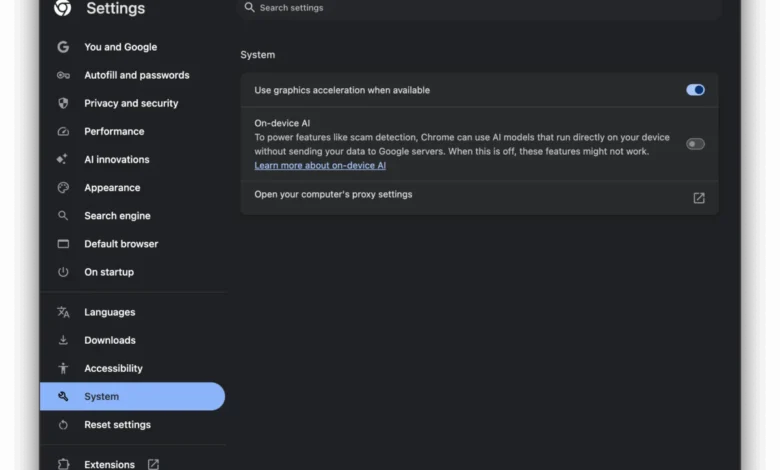
Google has attempted to mitigate some of these concerns by providing a toggle in the "System" settings of the Chrome browser to disable "on-device AI." However, many users remain unaware of this setting, and reports suggest that the model may remain on the disk even if the feature is disabled.
Browser Diversity and the Evolution of the Web Platform
The situation with the Prompt API highlights the current state of the browser ecosystem, where Google’s Chromium engine maintains a market share of approximately 65% to 70%. When a single entity controls the most widely used browser, its "Intent to Prototype" often becomes a de facto standard, regardless of the objections from smaller players like Mozilla or Apple (WebKit).
Industry analyst Alex Russell and developer Mat Marquis have both commented on the "inevitability" that Google brings to the web standards process. Marquis famously noted that Google participates in the standards process "the way a bear participates in the camping process"—its sheer size and influence mean that it can dictate the direction of the "campsite" simply by being there.
This dominance raises questions about the future of the World Wide Web Consortium (W3C) and other standards bodies. If Google can ship a 4GB AI model and a proprietary API to billions of users before the industry has reached a consensus, the concept of "web standards" may be evolving into a "follow the leader" model.
Broader Impact and Implications
The integration of Gemini Nano into Chrome is more than a technical update; it is a signal of the "AI-ification" of the operating system and the browser. As AI becomes a foundational layer of computing, the companies that control the AI models will likely control the user experience of the web.
The implications of this move include:
- Centralization of Power: Google’s ability to force-download products to millions of machines reinforces its role as the gatekeeper of the digital experience.
- The Blurring of APIs: The distinction between a "Browser API" (which serves the user) and a "Web API" (which serves the developer and the open web) is becoming increasingly murky.
- Privacy Paradox: While local AI is theoretically better for privacy, the mandatory nature of the download and the telemetry required to manage the model may introduce new vectors for data collection.
As the industry moves forward, the controversy surrounding the Prompt API will likely serve as a case study in the challenges of balancing rapid technological innovation with the principles of user agency and open standards. For now, Chrome users are left with a 4GB addition to their systems—a silent passenger that represents the next major battlefield in the evolution of the internet.